
The short answer. Your invitation email is the source of truth for your assessment: use its deadline, stated duration, and linked instructions rather than a general guide. An invitation asks you to complete Solve; it does not by itself establish which screening stages you have passed. It does not guarantee an interview, and its duration number does not guarantee which games you will see.
Does everyone get a McKinsey Solve invitation?
The current official public sources reviewed for this guide do not publish a universal invitation rate or establish that every applicant receives Solve. Some individual recruiting programs may tell their applicants that they will receive Solve, but that does not create one McKinsey-wide rule. An invitation also does not, by itself, prove that you passed a particular resume-screening stage.
How long after applying does an invitation arrive?
McKinsey does not publish one universal invitation timeline. Office, role, program and recruiting cycle can change the sequence. Follow the timeline in your application confirmation or portal, check your spam folder, and contact your recruiter if a date they gave you has passed. Another candidate's wait is not evidence about your application.
A fictional invitation, annotated
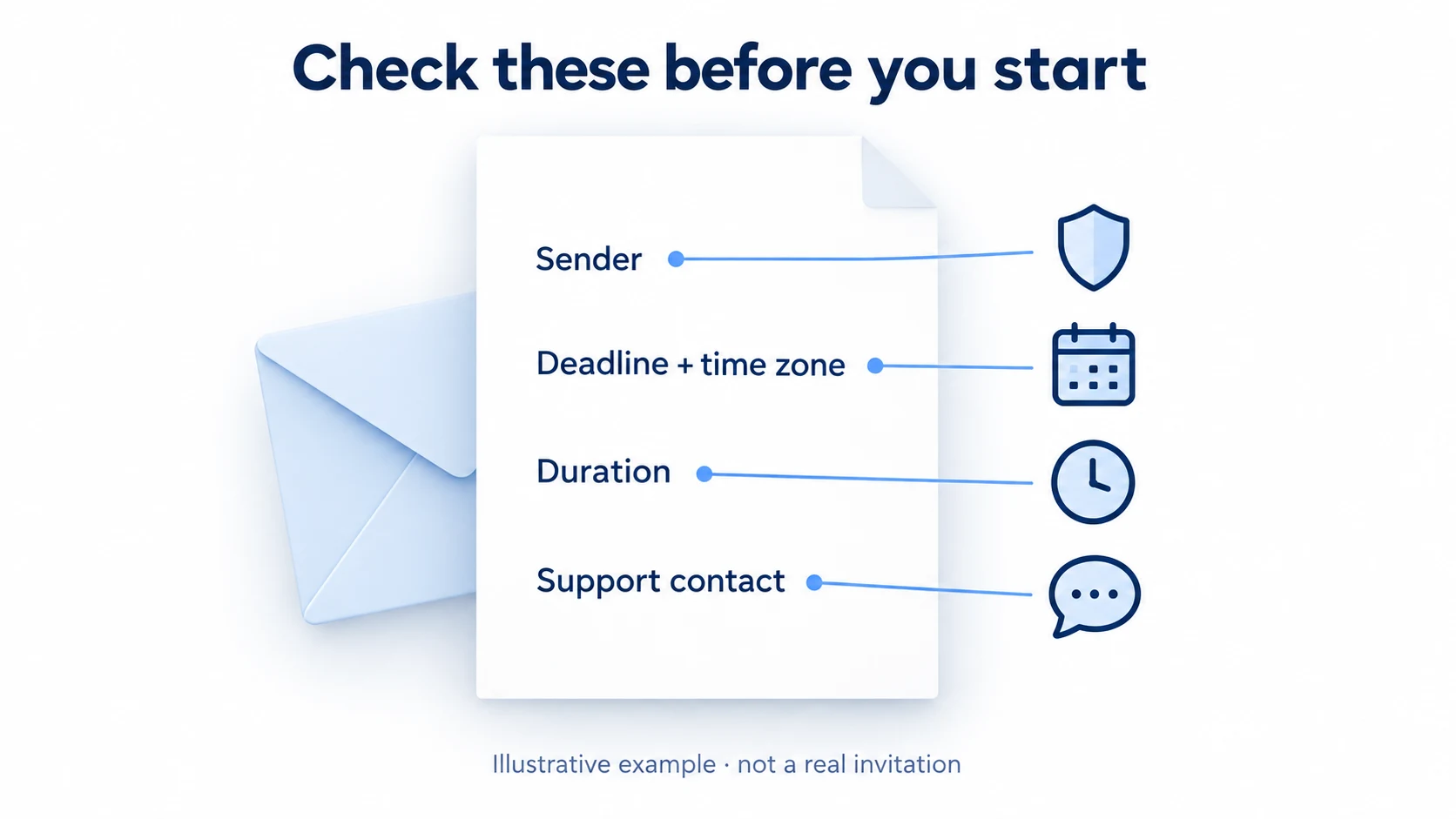
The teaching diagram below is invented. It is not a real invitation or a reconstruction of one. It shows the four details worth extracting from your own email.
On small screens, scroll the table horizontally to compare all columns.
| Invitation detail | What it tells you | What it does not prove | Your action |
|---|---|---|---|
| Sender and link | Where your personal assessment starts | That a forwarded or copied link is safe | Verify the sender and keep the link private |
| Deadline and timezone | Your stated completion cutoff | How long the assessment lasts | Convert the deadline into local time in writing |
| Stated duration | The uninterrupted block to reserve | A guaranteed module list | Add setup margin and follow named modules, if any |
| Support route | How to report an assessment fault | An automatic deadline extension or retake | Save it before starting |
Four things people confuse
- Deadline vs. duration. The deadline is the calendar cutoff for completing the assessment. The duration is how long the assessment itself takes once started. Plan a start time that leaves setup margin before the deadline, not exactly at it.
- Timezone. Convert the stated deadline into your local time in writing, then double check the conversion. Ask your recruiter about deadline questions; do not assume an extension.
- Duration vs. tutorial. Each task begins with an untimed tutorial, according to the current official FAQ. Tutorial time is for learning the interface of that task, so use it for that purpose rather than rushing through. Do not assume whether your invitation's duration includes tutorial or setup time; leave extra margin and clarify anything ambiguous.
- Invitation vs. interview. Receiving Solve is not proof that an interview will follow. McKinsey considers Solve performance alongside the rest of your application, so the invitation itself promises no interview.
What the invitation proves, and what it does not
It confirms that you were invited to complete Solve, gives your personal deadline and duration, and points to the instructions that govern your sitting. It does not prove which games you will face, what any other candidate faced, or what score you need. Candidate reports about 65, 85, and 95 minute invitations are discussed below, but they remain reports, not official configuration tables.
Duration reports: use with care
Candidate reports on preparation sites mention 65, 85 and 95 minute invitations. Those reports do not establish a reliable duration-to-module map. If your invitation names modules, follow those names; if it only gives total time, do not infer a game list, question count or test version. Use the stated duration to reserve an uninterrupted block, with setup margin, and prepare transferable skills rather than betting on an unverified configuration. A Solve Games Guide duration discussion was reviewed in September 2026; its module associations are not official guidance.
What if the invitation is missing or something looks wrong?
- No invitation yet. Check the portal, spam folder and any date in your application confirmation. If a stated date has passed, ask your recruiter rather than inferring a rejection.
- Broken assessment link or failed technical check. Use the Solve support route in your invitation. The current FAQ points candidates to technical support or live chat for assessment faults.
- Wrong deadline, timezone ambiguity or accommodation question. Contact your recruiter before starting. Technical support cannot decide application or accommodation questions.
Can I change my Solve time slot?
The August 2025 Solve FAQ says that, if you have not started the assessment, you can open your original link and schedule a new time slot. That is not a promise that the completion deadline will move. If the link does not offer a suitable option, or you need the deadline changed, contact your recruiter and follow the instructions in your own invitation.
A short preparation allocation example
Suppose your deadline is Friday evening and your invitation states 85 minutes. A proportionate plan: Wednesday, resolve setup (technical check, quiet room, support contacts saved) and do one untimed familiarization per module. Thursday, run one timed session on your weakest module and review every error. Friday morning or midday, sit the real assessment with margin before the deadline. Use the Sea Wolf constraint exercise, SFL ranking exercise, and Red Rock worked dataset to identify a specific skill to revisit. The dates are illustrative, not a McKinsey schedule.
Choose a practice module before test day
Who to contact: a small decision tree
- The link fails, graphics stall, or the assessment freezes? Contact Solve technical support immediately, at the time it happens, using the support path in your invitation (the current FAQ points to [email protected] or live chat). Describe what you observed. Support may reset your session or offer extra time depending on the issue, which is a case by case decision, not a guaranteed retake.
- Deadline, scheduling conflict, or accommodation need? Contact your recruiter early. Technical support does not handle application questions, and a support ticket does not automatically move your deadline.
- Unsure which kind of problem you have? If the assessment itself malfunctions, start with technical support and inform your recruiter afterward. If the question is about your application, start with the recruiter.
Next: the test day checklist covers setup and troubleshooting in detail. After submission, the scores and results guide explains what your outcome can and cannot tell you.
Sources, dated
Official page: McKinsey digital assessment, checked September 20, 2026. Official FAQ: Solve FAQ (PDF, August 2025), reverified September 20, 2026. Candidate duration reports: Solve Games Guide and CaseBasix invitation guide, reviewed September 2026 and treated as unverified reports, not authority. Use your invitation for personal scheduling details and follow McKinsey's official assessment integrity rules.