McKinsey does not publish a Solve timeline: its August 2025 Solve FAQ says only that your invitation email states your assessment length, and the deadline in that email is the only one that applies to you. Accounts from 2024 to 2026, which are anecdotes and not policy, usually describe one to three weeks from application to invitation, a completion window of about a working week, and one to four weeks from submission to a decision. Your recruiter's dates override every number on this page.
| Stage | What McKinsey says | Reported range |
|---|---|---|
| Application to invitation | Not published | 1 to 3 weeks (unverified) |
| Completion window | No standard; use the deadline in your invitation | About a working week, such as 5 days (unverified) |
| The sitting | Length stated in your invitation; untimed tutorials (FAQ, August 2025) | 65, 85 or 95 minutes (candidates, 2026) |
| Solve to decision | Not published | 1 to 4 weeks, sometimes longer (unverified) |
| Reapplication wait | One Solve completion every 12 months from your completion date (FAQ, September 2026) | About 12 months, some offices longer (unverified) |
Most timeline questions come down to "is my wait normal?" The honest answer has two layers. The official layer is thin: McKinsey's Solve page and its August 2025 FAQ explain what the assessment is, that your invitation gives your assessment length, and that results are considered with the rest of your application. They do not promise how fast any stage moves. The reported layer is richer but noisy: candidates describe ranges that change by office, role, recruiting cycle and year. This guide keeps the two layers apart at every stage and says plainly where we could not verify a range.
Looking for how the Solve game itself has changed over the years, from the Imbellus pilot to the 2026 Sustainable Futures Lab? That history is in the McKinsey Problem Solving Game (PSG) explainer and the dated McKinsey Solve update log. Year-by-year game tables disagree with each other, so check any date against those two pages. This guide covers the other meaning of timeline: how long each stage of your application takes. If a deadline is the problem, see what happens if you need a McKinsey Solve deadline extension.
How long does the McKinsey Solve process take, end to end?
The McKinsey Solve process has no published end-to-end length; the only overall figure we found is an average of about 40 days from application to offer that circulates on recruiting sites and is unverified. The stages below show the range reported at each point, from invitation to interviews. Tags show how strong each number is: candidate-reported, or prep-site and recruiter claims we could not verify.
- 1 to 3 weeks after applyingCandidate-reportedSolve invitation arrives
Reported after a recruiter screen; a figure of about one week also circulates and is unverified. Some regional offices take several weeks.
- About a working weekCandidate-reportedPrep-site claimDeadline window
5 to 7 days is reported by candidates; a figure of one to two weeks also circulates and is unverified. Your invitation states your date.
- 65, 85 or 95 minutesLength is in your invitationYou sit Solve
Plus untimed tutorials before each game. Which games each length brings is reported, not official; see the 95-minute guide.
- 1 to 4 weeks, sometimes longerCandidate-reportedDecision on your application
Reports from 2024 to 2026. Figures of 7 to 14 days (and, elsewhere, 2 to 14) circulate on prep and recruiting sites, with a stretch to 4 weeks, and are unverified.
- Rounds often 2 to 3 weeks apartCandidate-reportedRecruiter claimFirst and final interview rounds
Two rounds, each mixing a case and personal experience questions. Figures of 3 to 7 days to schedule a recruiter call after Solve results, 1 to 2 weeks to hear after the first round and 1 to 7 business days after the final circulate on recruiting sites and are unverified.
- About 40 days, application to offerRecruiter claim, unverifiedOffer decision
An average said to range from a few weeks to several months. No account we read gives an end-to-end figure.
Sources read October 3, 2026: unlinked candidate posts and unverified recruiting-site claims. None of these durations is McKinsey policy.
Some of these claims also conflict with what candidates describe: one gives Sea Wolf as 35 minutes where candidates say about 30, and another describes Solve as a 60 to 70 minute exercise where invitations in 2026 state 65, 85 or 95 minutes. Their timing figures are listed above as claims, not evidence.
Opening your Red Rock run…
The Red Rock run did not open here.
What does McKinsey officially say about each Solve stage?
McKinsey officially states only that your Solve invitation gives your assessment length, that each task opens with an untimed tutorial, and that results are considered with the rest of your application; every stage duration is reported, not official. Read each stage left to right: the dark label is what McKinsey states, the light label is what candidates describe. Where a stage has no official statement, the card says so.
- Application submitted
- McKinsey says
- You apply through the careers site; Solve is part of many application processes.
- Reported
- A recruiter screen usually comes first; the order varies by region and role (unverified).
- Solve invitation arrives
- McKinsey says
- The invitation email states your assessment length and links your instructions.
- Reported
- About 1 to 3 weeks after applying, sent in batches; some regional offices take several weeks (unverified).
- Deadline window
- McKinsey says
- Your invitation email sets out your assessment. The FAQ suggests a time slot where you will not be disturbed and sends non-technical questions, such as timing, to your recruiter.
- Reported
- Roughly a working week, for example five days. No published standard.
- You sit Solve
- McKinsey says
- Length stated in your invitation; each task opens with an untimed tutorial; PC or Mac, alone, no outside tools.
- Reported
- 65, 85 or 95 minutes depending on which games you get (unverified).
- Decision on your application
- McKinsey says
- Solve results are considered with the rest of your application. No published results timeline.
- Reported
- Mostly 1 to 4 weeks, occasionally a month or longer; acceptances and rejections said to take the same time (unverified).
- Interview invitation
- McKinsey says
- Not described on the Solve page or FAQ.
- Reported
- Two interview rounds, each combining case and personal experience questions, often 2 to 3 weeks apart (unverified).
Original diagram by Solve Game Prep. "Reported" ranges come from candidate accounts we read; they are unverified, they are not McKinsey policy and do not apply to every office.
How long after applying do you get the McKinsey Solve invitation?
The reported wait for a McKinsey Solve invitation after applying is one to three weeks, with invitations sent in batches and some regional offices taking several weeks. No invitation timeline is stated by McKinsey, and these ranges are unverified.
Official: nothing on the current Solve page or FAQ says how long after you apply the invitation arrives, and nothing says every applicant receives it.
Reported: candidates give ranges from one to two weeks, to one to three weeks, to "within the month", with some saying invitations go out in batches and some saying two to three weeks or more is normal for some roles. The shared advice is to contact the recruiter after about three to four weeks of silence. For Middle East applications, candidates add that the invitation is not sent automatically, a recruiter reviews the CV first, and some regional offices run on a rolling basis that can take several weeks.
Two cautions. First, these are anecdotes, not a sample of candidates, so treat the ranges as rough. Second, one account says an independently taken Solve score from the past year can be pulled into a later application, while others expected a fresh invitation. We could not verify either view against an official source, so ask your recruiter if it matters to you.
What to do: start light preparation as soon as you apply rather than waiting for the email. If you only learn the format once the invitation lands, your window is short. The McKinsey Solve guide explains the games, and the guide on how to prepare for McKinsey Solve gives a seven-day, three-day and 48-hour schedule you can start before the invitation arrives.
Does McKinsey send the Solve game to everyone?
Not necessarily: McKinsey's official Solve page and FAQ do not say every applicant receives the Solve game. Candidates describe it the same way: receiving the invitation means the application was reviewed and judged relevant enough to send the test, and invitations are "not automatic". A recruiter screen comes first. At the same time, the order varies by region, role and recruiting channel, so do not read the invitation as a formal "CV pass". It means you have been asked to complete Solve, nothing more. You may also see estimates of what share of applicants receive Solve: a figure of 60 to 70% of applicants and another of 80 to 90% of those who pass the CV screen circulate. Neither gives a source and both are unverified, so we do not treat either as fact. The invitation guide covers what the email proves and what it does not, and the scores and results guide covers how much the result counts once you have it.
If your application status says "under review" and no invitation has arrived, that is commonly reported as normal for the first few weeks. Check your spam folder and portal before you assume anything.
How long do you have to complete McKinsey Solve after the invitation?
You have until the deadline in your own McKinsey Solve invitation; no standard window is published, and candidates describe roughly a working week, such as five days.
Official: the FAQ says the invitation email gives your assessment length. Your deadline is in the same email, but no standard window is stated. The August 2025 FAQ does not describe rescheduling; ask your recruiter if you need the timing changed, and see McKinsey Solve deadline extension for what candidates describe.
Reported: candidates describe a five-day window. Another account shows a candidate given a calendar date ("complete Solve until Monday") without a clear hour, and the advice was to ask HR for the exact cutoff and not to leave it to the final day. Guides often quote "five to seven days" or "about a week"; we could not verify that range as a standard, and shorter windows are mentioned too. Use your own email.
What to do: write your deadline down in your local time zone, decide a start slot that leaves at least a day of margin, and complete a technical check early. If the window clashes with exams or travel, contact your recruiter before you start, not after.
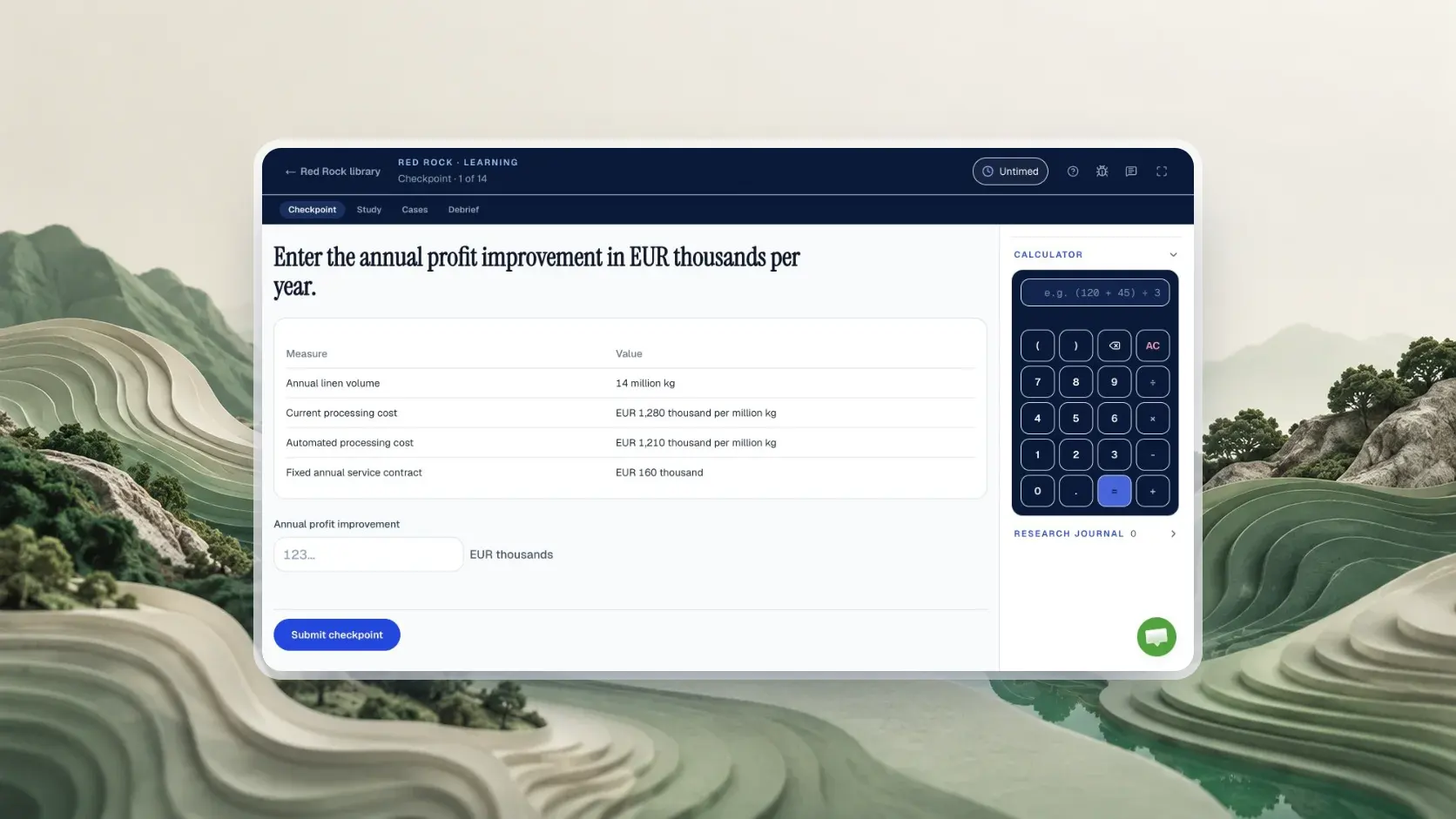
Run a free practice game inside your deadline window
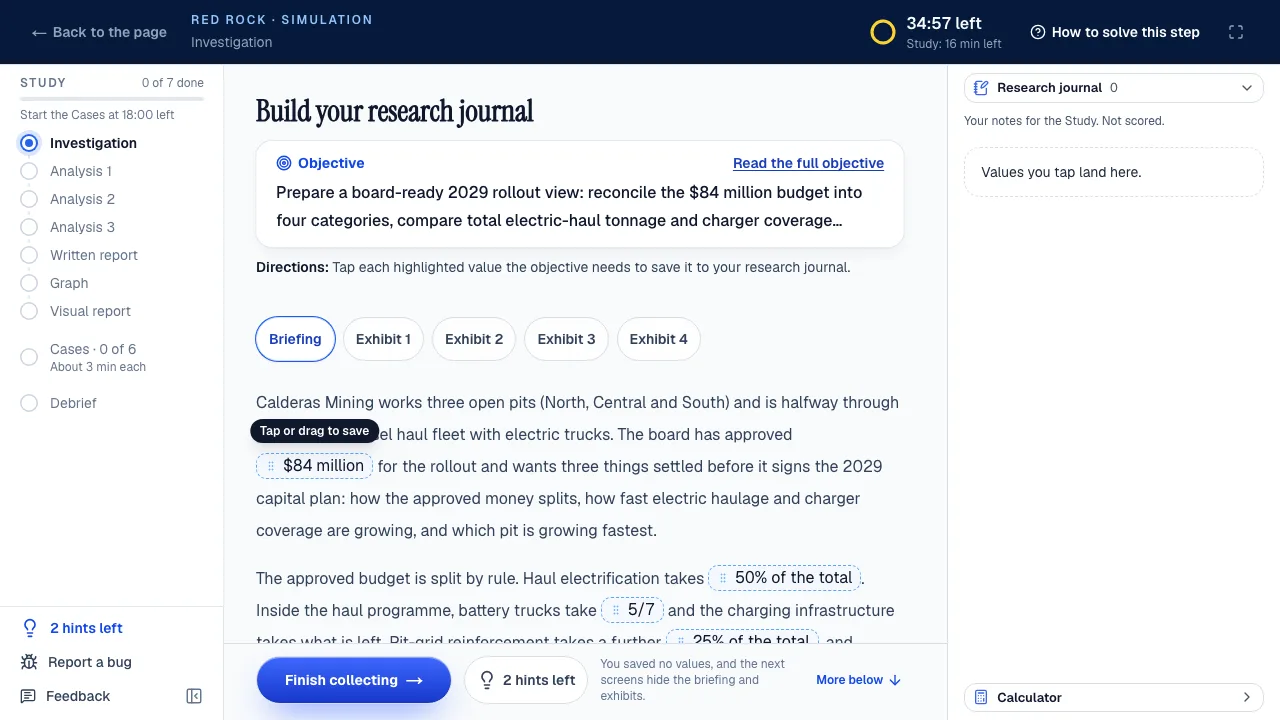
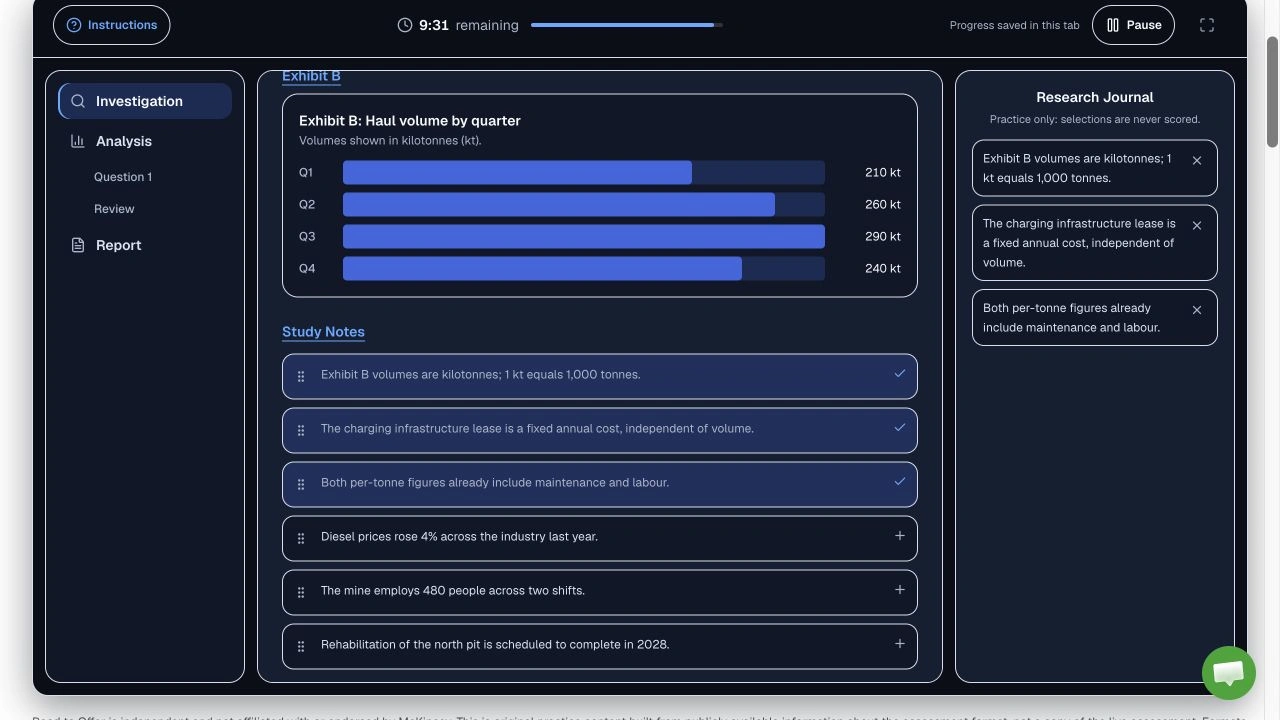
Our free Solve plan asks your invitation length and test date, then gives dated practice steps selected for that invitation for up to 28 days; a free account (no card) is required to view and save it. The practice library offers one free run each of Red Rock, Sea Wolf, SFL Classic and SFL Island. Red Rock includes the full Study and six Cases on a 35-minute practice clock; Sea Wolf includes Site 1 of Simulation 1, four scored decisions on a 10-minute Simulation clock; Classic has 13 linked decisions on a 20-minute advisory clock; Island includes onboarding and all three project days on a 40-minute Simulation clock. With no account you can play the Red Rock Study, all of Sea Wolf Site 1 with its score, the start of SFL Classic and the SFL Island tutorial and onboarding; a free account (no card) unlocks the rest of each free run, the other scores and the reviews. Visual explanations include highlighted Red Rock calculations and charts, Sea Wolf constraint and treatment visuals, Classic decision and dependency diagrams, and Island evidence chains, placement maps and team feedback. Paid Learning mode adds step-by-step coaching and feedback across all four formats, untimed in the clocked games, through the matching game pack, Solve pack or qualifying Annual access.
How much time should you block for the McKinsey Solve sitting?
Block comfortably more than the 65, 85 or 95 minutes your McKinsey Solve invitation states, because McKinsey's August 2025 FAQ says each task opens with an untimed tutorial, and setup and the technical check come on top. Your invitation's length tells you how long the assessment takes, and candidates link those lengths to specific games. About 65 minutes has meant Red Rock (about 35 minutes) and Sea Wolf (about 30). About 85 minutes adds the standard 20-minute Sustainable Futures Lab. Since August 24, 2026, candidates have also reported 95-minute invitations, and on September 11 one described the newer 30-minute SFL inside them; 85-minute invitations kept arriving afterwards, so treat 95 minutes as a pilot. McKinsey has announced neither format. The 95-minute guide and dated update log track those reports.
| Invitation length | Reported games | Why reserve extra |
|---|---|---|
| About 65 minutes | Red Rock, Sea Wolf | Each task starts with an untimed tutorial, plus setup and the technical check |
| About 85 minutes | Red Rock, Sea Wolf, standard SFL | Same, with a third tutorial |
| About 95 minutes | Red Rock, Sea Wolf, newer 30-minute SFL (pilot reports) | Same; follow the live tutorial if it differs from any guide |
What to do: block a quiet, uninterrupted period comfortably longer than the stated length. The test-day checklist covers setup and what to do if something breaks.
When do you hear back after McKinsey Solve?
Hearing back usually takes one to four weeks after submitting McKinsey Solve, with occasional waits beyond a month, according to candidates from 2024 to 2026.
Official: McKinsey says Solve results are considered with the rest of your application. It does not publish a results timeline.
Reported: this is the stage candidates describe most, and they mostly agree within a range:
- One to two weeks is described as typical, with one candidate waiting almost two months, and acceptances and rejections said to take the same time.
- Two to four weeks is described by others, with waiting up to a month said to be normal for some offices and Middle East offices sometimes slower.
- For an Associate role, descriptions range from "within two weeks" to "a few weeks" to two to four weeks.
So the reported range is roughly one to four weeks, with a tail beyond a month. One genuine disagreement: some say only successful candidates usually hear back, while others say unsuccessful candidates also get an update. We cannot settle that from public sources, which is another reason to follow up rather than read silence as a verdict.
One message to recognise: an automated "Solve Score Request" style email, sent shortly after submitting. Some receive one a day after Solve and read it as system-generated, not a decision. The McKinsey Solve results guide explains what a result can and cannot tell you, and the pass rate guide explains why no public cutoff exists.
What to do: after submitting, write down which games you saw and any technical issue, then move on to case preparation. If the window your recruiter gave you passes, or about three to four weeks pass with no stated window, send one polite follow-up.
How long from a Solve result to McKinsey interviews?
After a positive McKinsey Solve result, two interview rounds are described, typically two to three weeks apart, and a figure of 3 to 7 days to schedule a recruiter call circulates on recruiting sites, unverified. McKinsey does not describe the interview schedule on its Solve page or FAQ.
Official: the Solve page and FAQ do not describe the interview schedule.
Reported: candidates describe two interview rounds with two interviews each, each mixing a personal experience component and a case, with typically two to three weeks between rounds and some flexibility on scheduling. Candidates recruiting for full-time Business Analyst roles describe timelines that shift by year and office, so we do not quote ranges from them.
What to do: start case and personal experience preparation during the results wait, not after the invitation. If interviews follow, you may have less than two weeks to prepare.
Does silence after McKinsey Solve mean you were rejected?
Not on the available evidence: candidates between 2024 and 2026 reported that acceptances and rejections after McKinsey Solve take about the same time, and waits of three to four weeks are normal for some offices. This table lines up the reported normal range for each kind of silence with what to do. The readings are candidate and recruiter-site opinions, not McKinsey statements.
On small screens, scroll the table horizontally to compare all columns.
| Silence | Reported reading | Who says it | What to do |
|---|---|---|---|
| No invitation 1 to 3 weeks after applying | Normal; invitations go out in batches | Candidate-reported | Check spam and the portal; keep preparing |
| Status "under review", no invitation after several weeks | Commonly normal in offices that review on a rolling basis | Candidate-reported | Contact the recruiter after about 3 to 4 weeks |
| About 1 week after Solve | Normal, wait it out | Candidate-reported Recruiter claim | Start case preparation |
| 3 to 4 weeks after Solve | Within the reported range for some offices, including some Middle East offices | Candidate-reported | Send one polite follow-up if no window was given |
| More than a month after Solve | Unusual but reported; one candidate waited almost two months. Candidates said acceptances and rejections take the same time | Candidate-reported | Follow up with the recruiter; do not read it as a verdict |
| 1 to 2 weeks after a first round | Normal range | Recruiter claim | Prepare for the final round anyway |
| More than a week after a final round | Upper end, but not unusual | Recruiter claim | One follow-up to your recruiter |
One open question: candidates disagree on whether unsuccessful candidates always hear back (see the results section above), so prolonged silence is a reason to follow up, not proof either way.
How long must you wait to reapply to McKinsey after a Solve rejection?
McKinsey's official September 2026 Solve FAQ says you may complete Solve only once every 12 months from your completion date: the day you finished the assessment, not the day you heard back. Some candidates report longer waits before a new application, up to 18 months in some offices; that is unverified, so confirm yours with your recruiter. For the full picture, see can you retake McKinsey Solve?
Official: the September 2026 Solve FAQ says Solve scores are valid for one year and you may complete Solve only once every 12 months from your completion date.
Reported: candidates who were rejected after the assessment stage most often say about 12 months, with others saying 12 to 18 months, some European offices up to 18 months, and a few mentioning that earlier exceptions can sometimes be requested. Applications to several offices are reportedly handled as one decision, so a rejection from one office typically applies to the others, and one account cited 12 to 24 months.
What to do: ask your recruiter for the period that applies to you, then use the time to change something material: a stronger CV, a new role, or measurably better problem-solving practice. Reapplying with the same profile rarely helps, according to the same candidates.
What does a realistic McKinsey Solve calendar look like?
A realistic McKinsey Solve calendar runs about five weeks from application to a decision: roughly 12 days to the invitation, five days to complete, then about three weeks of waiting. This example is invented to show how the stages fit together. It is not a McKinsey schedule.
| Date | Event | Action that day |
|---|---|---|
| Day 0 | Application submitted | Read the Solve overview; one untimed look at each game |
| Day 12 | Invitation: 85 minutes, deadline in five days | Convert the deadline to local time; run the technical check |
| Days 13 to 15 | Preparation | One timed run per game; review every error using the tips guide |
| Day 16 | Sits Solve, one day before the deadline | Follow each untimed tutorial carefully |
| Days 17 to 35 | Waiting | Case and personal experience practice; one follow-up only after the stated window |
The point of the example is the order of actions, not the day numbers. If your invitation arrives faster or your window is shorter, compress the preparation days, not the setup.
Why do McKinsey Solve timelines vary?
McKinsey Solve timelines vary by office and region, role and program, recruiting cycle, and how many offices you applied to, according to candidates; none of these has an official published effect.
- Office and region. Candidates repeatedly mention rolling processes and slower responses in some regional offices.
- Role and program. Business Analyst, Associate, internship and experienced-hire processes run on different calendars.
- Recruiting cycle. Campus deadlines bunch applications and batches; off-cycle applications can move faster or slower.
- Multiple offices. Candidates say several office preferences are usually handled as one decision, which can affect timing.
None of these factors has an official published effect. They explain why two candidates' timelines can differ without either being a signal. If you are still deciding how hard to prepare, is McKinsey Solve hard? explains where candidates lose points. For the format and rules on one page, see McKinsey Solve game prep. The timing differs for some applicants: MBA candidates are covered in the next section, and experienced hires in the invitation guide.
When does McKinsey Solve fall in the MBA recruiting cycle?
McKinsey states no MBA-specific Solve schedule: no invitation week, no interval after applying and no school-wide date, and no separate policy for first-year or second-year candidates. Its official sources describe Solve as one step in consultant recruiting, say the invitation states your assessment length, and say the result is considered with the rest of your application. Candidates suggest invitations can land inside a compressed recruiting cycle, but that cannot tell you what will happen in your office or class, so your school's and recruiter's instructions govern.
| Question | Answer and status | What to do |
|---|---|---|
| When will Solve arrive? | Not published. No MBA-wide date or sequence in McKinsey's public Solve sources | Use your school's and recruiter's current instructions |
| Does the program or office change scoring? | Not published. No program or office cutoff, percentile or slot allocation | Ignore rumours of ranking only against classmates |
| First year or second year? | No separate policy is published; the difference is your own internship or full-time calendar | Plan around your recruiting events, not an assumed scoring change |
| What if no decision arrives? | No result turnaround or MBA-specific retake rule is published | Keep up case preparation until a message states the next step |
The practical move is to keep case preparation running and add short Solve blocks around it: one practice run before the invitation if you can, then targeted work on your weakest game once the invitation sets a deadline. McKinsey says no business or gaming knowledge is needed, so strong casing helps with the shared habits (picking the right figure, checking units, committing to a recommendation) without giving you an official Solve advantage. The Solve prep plan has short schedules that fit around recruiting events.
Sources and evidence boundaries
- Official: McKinsey Solve (digital assessment) page and Solve FAQ (PDF, August 2025), checked October 3, 2026. They state the invitation gives your length, tasks start with untimed tutorials, support can offer extra time or a link reset for technical issues reported at the time, and results are considered with the rest of the application. They do not publish invitation, deadline or results timelines.
- Official: the September 2026 Solve FAQ, checked November 7, 2026, says Solve scores are valid for one year and that you may complete the assessment only once every 12 months from your completion date.
- Candidate accounts (anecdotal, unverified), read October 3, 2026: results waits, deadlines, multi-office rejections, automated score emails, interview rounds, reapplication, invitation waits and invitation lengths. They are unlinked and unnamed, and they are not McKinsey policy.
- Recruiter and online claims (unverified), read October 3, 2026: timing and invitation-share figures that circulate on recruiting sites. Used only as labelled claims.
- Not verified: a standard deadline window length, interview-timing ranges by recruiting year, and claims that independent Solve scores carry into later applications. Figures such as the share of applicants who receive Solve give no source, so we do not use them as evidence.
- Our practice: we offer four independent practice formats: Red Rock, Sea Wolf, SFL Classic and SFL Island. Practice results are not McKinsey results. Written and reviewed by Esteban Ronsin.