The short answer. In our coaching view, you can prepare well for McKinsey Solve in about a week of 60 to 90 minute sessions: two days learning each game untimed, three days of targeted timed practice on your weakest error types, one full timed rehearsal, and a light final day for setup and rest. With three days, compress that into learn, drill and rehearse. With 48 hours, skip theory, run one timed attempt per game, fix the single biggest leak, and protect your sleep. McKinsey publishes no recommended preparation time (Solve page and August 2025 FAQ, checked October 3, 2026), so read the duration in your invitation first: a 65, 85 or 95-minute assessment changes which games you need.
| Time left | Plan | Daily time | What you can realistically fix |
|---|---|---|---|
| 7 days or more | 7-day plan | 60 to 90 min | Format, pacing and your top two or three error types per game |
| 3 to 6 days | 3-day plan (repeat Day 2 if you have spare days) | 90 to 120 min | Format, pacing and your single biggest error per game |
| 1 to 2 days | 48-hour plan | 2 to 3 hours on Day 1, under 1 hour on Day 2 | Format and pacing only; no new techniques |
McKinsey does not publish a recommended preparation time, a pass mark or scoring weights. Its official Solve page says no business or gaming knowledge is needed and every task starts with an untimed tutorial. So the goal of a prep plan is not to learn hidden content. It is to arrive knowing each game's rules, with a pacing habit you have already tested under a clock.
The seven-day plan in one line. The 3-day and 48-hour plans below keep the same order (learn, drill, rehearse, rest) and shorten each phase.
How long should you prepare for McKinsey Solve?
About a week of 60 to 90 minute sessions is enough to prepare for McKinsey Solve in our coaching view; McKinsey publishes no recommended preparation time, so treat any number as coaching guidance. A useful way to decide is to count sessions, not days. You need roughly four kinds of work: learning each game's mechanics, timed practice per game, reviewing mistakes, and one full rehearsal at your invitation length. At 60 to 90 minutes a session, that fits comfortably into a week and tightly into three days. In 48 hours you can cover it only by doing one timed attempt per game and reviewing it straight away.
More time helps less than you might expect. Solve tests reasoning under a clock with unfamiliar content each time, so after you know the rules and have a pacing habit, extra hours mostly repeat what you already do. If you are deciding whether the test deserves weeks of study, read is McKinsey Solve hard first; it explains where prepared candidates actually lose points.
How many practice runs do you need for McKinsey Solve?
Published advice for McKinsey Solve ranges from one or two full mocks (one PrepLounge coach, 2025) to 6 to 12 runs per game (SolvePrep, September 2026), and none of it comes from McKinsey. Our 7-day plan uses 8 runs in total, two or three per game. The ranges below are per game unless marked, and each comes from a different kind of source.
The PrepLounge bar marks one coach's "one or two"; another coach's "a handful" is not a number, so it is not drawn. SolvePrep's guide gives Red Rock 6 to 10, Sea Wolf 8 to 12 and SFL 6 to 8. None of these figures cites McKinsey or a published sample.
Who says what. On a PrepLounge thread (August to September 2025), five coaches answered a candidate asking whether 15 to 25 mocks per game were needed. All called that excessive; one suggested "one or two" to learn the format and pacing, another "a handful of well-targeted practice sessions". PSG Secrets (April 21, 2026) recommends at least three practice tests. SolvePrep's guide (September 28, 2026) suggests 6 to 12 runs per game and 10 to 25 hours over one to two weeks, and its homepage (undated) reports an average of 8 practice runs among its passing users. Both commercial sites sell practice runs, which is worth knowing when reading their numbers.
Our count, with the arithmetic. The 7-day plan below gives Red Rock three runs (Day 1 untimed, Day 3 timed, Day 6 rehearsal), Sea Wolf three (Day 2 untimed site, Day 4 timed, Day 6) and the SFL two (Day 5 timed, Day 6). That is 3 + 3 + 2 = 8 runs in total, closer to the coaches than to the commercial sites. It is a judgement, not a measured optimum: add a run for a game only while your error log shows the same mistake repeating, and stop adding once it does not.
What does your McKinsey Solve invitation length mean for your prep?
Candidates report that a 65-minute McKinsey Solve invitation means Red Rock and Sea Wolf, 85 minutes adds the standard 20-minute Sustainable Futures Lab, and 95 minutes has a newer 30-minute SFL instead. McKinsey's FAQ says your assessment length is stated in your invitation email. Candidates report three lengths in 2026, and each maps to a different set of games. This is a candidate-reported map, not an official specification, so check your own invitation and the in-game tutorial. The invitation guide shows how to read the email, and the 95-minute guide covers the newest version in detail.
| Invitation | Games reported | How to adapt the plan |
|---|---|---|
| About 65 minutes | Red Rock (about 35 min) and Sea Wolf (about 30 min) | Drop SFL practice and give its sessions to Red Rock, which carries the longer clock |
| About 85 minutes | Red Rock, Sea Wolf and the standard Sustainable Futures Lab (about 20 min: one ranking task, then about 12 linked decisions) | Follow the plans as written |
| About 95 minutes | Red Rock, Sea Wolf and a new SFL of about 30 minutes (four researchers, four workstations, three simulated days) | Practise the standard SFL for prioritising habits, then study the new format by reading; Road to Offer's practice version is coming soon |
95-minute invitations were first reported on August 24, 2026, the new 30-minute SFL was first described on September 11, and both SFL versions were still being reported in late September. Treat it as a pilot with no known pattern by region or office. If your email does not state a length, plan for 85 minutes and ask your recruiter.
Start Day 1 with a free Red Rock, Sea Wolf or SFL run
What is a good 7-day McKinsey Solve prep plan?
A 7-day McKinsey Solve plan spends Days 1 and 2 learning the games untimed, Days 3 to 5 on timed practice of one game each, Day 6 on a full rehearsal and Day 7 on setup and rest, in one 60 to 90 minute session a day. This plan assumes an 85-minute invitation and one session a day. Each row says what to do and the point at which you can stop. "Done when" matters more than the clock: if you hit it early, stop and rest; if you miss it, carry the gap into the next session rather than adding a late-night block.
| Day | Focus | Exact practice | Done when |
|---|---|---|---|
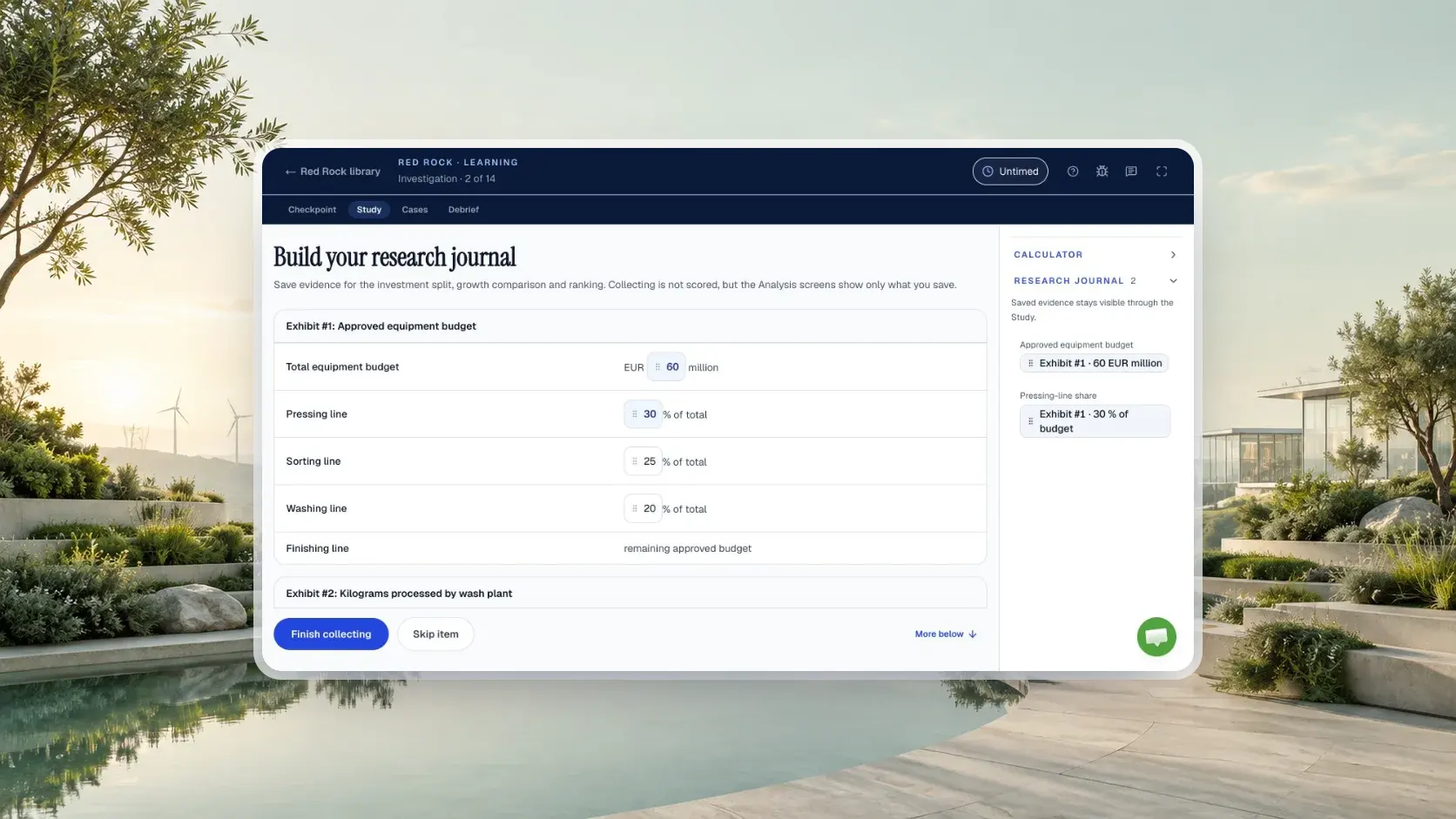
| 1 | Learn Red Rock | Read the Red Rock worked questions, then run one Red Rock study untimed | You can name the Study stages and save each number with its unit |
| 2 | Learn Sea Wolf and SFL | Read the Sea Wolf rules and examples and the SFL guide, then run one Sea Wolf site untimed | You can explain why a microbe set passes a site's ranges and traits |
| 3 | Red Rock under time | Run a timed Red Rock study, then log every error by type | You finished the Cases inside 35 minutes and logged each mistake |
| 4 | Sea Wolf under time | Run timed Sea Wolf, all three sites | You reached the third site with time left |
| 5 | SFL and your weakest game | Run a timed SFL simulation, then redo the error type you logged most often | Your ranking and later decisions follow one consistent logic |
| 6 | Full rehearsal | All games back to back at your invitation length, one sitting, no notes: open the free practice hub and run Red Rock, Sea Wolf, then SFL | You completed every game and noted where time ran short |
| 7 | Setup and rest | Work through the test-day checklist, reread your error log, one short warm-up such as a few untimed Red Rock questions | Device check passed and you stop before evening |
Days 1 and 2: why you learn untimed first
McKinsey gives you an untimed tutorial before each task, but the tutorial explains controls, not strategy. If your first contact with Red Rock's Research Journal or Sea Wolf's site ranges happens under a clock, you spend real minutes reading rules. Untimed runs let you build a correct model of each game: what counts as evidence in a Red Rock Study, how averages work across a Sea Wolf treatment, how an SFL ranking constrains the decisions after it. The bar is understanding, so the "done when" column asks you to explain an answer, not to score well.
Keep a one-page error log from the first session. Write the type of mistake (wrong denominator, missed unit, ignored trait, inconsistent ranking), not the score. That log drives Days 3 to 5.
Days 3 to 5: why one game per day, under time
Timed practice is where scores move, because Solve rewards finishing with sound answers. Spending a whole session on one game lets you run it, review it and immediately retry the specific error, which a mixed session does not. Red Rock goes first because its reported 35-minute clock covers one Study and six standalone Cases, and the Cases come last on the same clock; the Solve tips guide gives a time budget. Sea Wolf follows because its three sites reward a fixed routine. Day 5 combines the SFL with your weakest game because the standard SFL is the shortest module.
Review is half the session. For each wrong answer, write what you would do differently in one sentence. If the same error appears twice, that is your target for the next attempt.
Day 6: why a full rehearsal matters
Running every game back to back at your invitation length tests something single-game practice cannot: concentration in the last game. Sea Wolf or the SFL can feel different after 35 minutes of Red Rock arithmetic. Sit the rehearsal at the time of day you plan to take the real assessment, in the same room, with nothing on the desk. Note the minute where attention dropped and plan a short reset there on test day.
Day 7: why the last day is light
New techniques learned the day before are more likely to confuse than help. The final day protects the things that fail silently: an unsupported device, a missed timezone, a deadline you misread. McKinsey's FAQ asks you to use a PC or Mac, work alone, and use no outside tools or recordings, so set up the room exactly as you will use it. Then stop early and sleep.
How do you prepare for McKinsey Solve in 3 days?
In 3 days, run each McKinsey Solve game timed on Day 1, fix your most frequent error and sit a full rehearsal on Day 2, and keep Day 3 for setup and rest. With three days, each day does double duty. You learn and drill in the same session, and the rehearsal moves to Day 2 so Day 3 can stay light.
| Day | Focus | Exact practice | Done when |
|---|---|---|---|
| 1 | Learn and run every game | Skim the Red Rock, Sea Wolf and SFL guides, then run Red Rock timed and Sea Wolf timed | One attempt per game, errors logged by type |
| 2 | Fix and rehearse | Redo your most frequent error type, then run the SFL timed as the last game of a full sitting | You finished every game inside its clock |
| 3 | Setup and rest | Test-day checklist, reread the 15 tips, short warm-up | Device check passed, notes cleared, early night |
Why the 3-day plan works
Three days are enough to remove surprise, which is the most expensive problem. Day 1 deliberately mixes reading and timed play: you read just enough of each guide to know the rules, then let the clock show you where you are slow. Day 2 fixes one error type per game rather than chasing everything, and ends with a full sitting so your concentration has been tested once. Day 3 is light for the same reason as in the 7-day plan.
If you have four to six days, repeat Day 2 with a fresh attempt for each extra day instead of adding new reading.
How do you prepare for McKinsey Solve in 48 hours?
With 48 hours before a McKinsey Solve deadline, the aim is narrow: know each game's rules, have one timed attempt behind you, and arrive rested. Everything else is optional.
| Block | Focus | Exact practice | Done when |
|---|---|---|---|
| Day 1, first hour | Red Rock | Read the format section of the Red Rock guide, then one timed Red Rock run | You know your time split between Study and Cases |
| Day 1, second hour | Sea Wolf and SFL | One timed Sea Wolf run, then one timed SFL run | You reached the end of both games |
| Day 1, last 30 minutes | Review | Write your top error per game on one card | Three sentences, one per game |
| Day 2 | Setup and calm | Test-day checklist, reread your card, then take the assessment or rest | Device check passed and nothing new learned |
Why the 48-hour plan cuts so much
In two days, the risk is not a lack of practice. It is turning up tired and second-guessing techniques you met that morning. One timed run per game gives you the one thing reading cannot: a feel for how long each phase takes. The review card is short because you will only remember a few corrections under pressure. If you have only one evening, do Day 1's first two hours and the device check, and skip the rest.
How should a McKinsey Solve prep plan change for 65, 85 or 95 minutes?
For a 65-minute McKinsey Solve invitation, drop SFL practice and give the time to Red Rock; for 95 minutes, add reading on the new 30-minute SFL format and rehearse at the full 95 minutes. The tables above assume 85 minutes. Use these swaps for the other reported lengths.
| Plan | 65 minutes | 85 minutes | 95 minutes |
|---|---|---|---|
| 7 days | Day 5 becomes a second timed Red Rock run; rehearsal is 65 minutes | As written | Day 5 adds reading the 95-minute format after the standard SFL run; rehearsal is 95 minutes |
| 3 days | Day 2 ends with Sea Wolf instead of SFL | As written | Day 2 adds 20 minutes reading the new SFL format |
| 48 hours | Skip the SFL run and give the time to Red Rock review | As written | Keep the standard SFL run, then read the new format once |
For the 95-minute version, practice for the new 30-minute SFL is coming soon on Road to Offer, our practice platform, so the standard SFL is the closest stand-in. Reported details: you lead four researchers across four workstations over three simulated days, and each day runs through Explore, Assign, Support and Reflect. The transferable habits are the same ones the standard SFL trains: read every constraint before acting, decide in a defensible order, and keep later choices consistent with earlier ones. The SFL guide compares both versions.
Which McKinsey Solve prep mistakes waste the most time?
The McKinsey Solve prep mistakes that waste the most time are practising only your favourite game, studying retired games, chasing a target score, cramming the night before and neglecting the rest of your application.
- Practising only the game you like. Candidates often repeat the game they already do well. Your error log decides what you practise, not your preference.
- Studying outdated games. Ecosystem Building and Plant Defense appeared in early versions of the assessment, but 2026 candidate reports no longer include them. See what changed in 2026 and the Ecosystem game's status before spending time on old guides.
- Chasing a target score. McKinsey shows no score scale to candidates and publishes no pass mark, so a practice score is a training signal, not a prediction. The scores and results guide and pass rate guide explain what is and is not known.
- Cramming the night before. The last evening is for setup and sleep.
- Ignoring the rest of the application. McKinsey considers Solve results together with the rest of your application, so once your plan is done, case and personal experience preparation is the better use of spare hours.
How do you know you are ready for McKinsey Solve?
You are ready for McKinsey Solve when three statements are true. You can describe each game's goal and controls without opening a guide. You have finished each game inside its reported clock at least once. And your error log shows the same mistake no longer repeating. If two out of three hold the day before, take the assessment as scheduled; another day of practice rarely beats a rested sitting. For the bigger picture of the assessment, the McKinsey Solve pillar guide covers format and history, and the timeline guide shows what happens after you submit.
These guides are written and reviewed by Esteban Ronsin, founder of Road to Offer and Solve Game Prep; see the author page. The practice page lists every free module.
Sources and evidence boundaries
Official: McKinsey digital assessment (Solve) page and the Solve FAQ (PDF, August 2025), both checked October 3, 2026. They state that length is in your invitation, tasks start with an untimed tutorial, no business or gaming knowledge is needed, and the rules for device and outside tools. They do not publish preparation time, game timings or scoring.
Candidate reports: the PrepLounge timing thread (95-minute invitation first reported August 24, 2026; an 85-minute report on August 25; the new 30-minute SFL reported September 11), checked October 3, 2026. Game timings and stage names are candidate and preparation-provider reports, not McKinsey specifications.
Third-party plans reviewed for coverage, not copied: SolvePrep's last-48-hours guide, reviewed October 3, 2026. The day-by-day plans and time budgets on this page are our coaching guidance, not official advice.