McKinsey publishes no McKinsey Solve pass rate. Prep sites such as CaseBasix, Case Prep and SolvePrep estimate that about 20% to 30% of candidates pass, or about 70% to 80% do not, without showing data or a method (unverified, checked October 3, 2026). The only official figures are that Solve is given to around 300,000 early-career candidates a year (McKinsey blog, July 2025) and that results are considered together with the rest of your application, so no single score guarantees, or rules out, an interview.
| Figure | Value | Source and status |
|---|---|---|
| Pass rate | About 20% to 30% | Prep-site estimate (CaseBasix, Case Prep, MConsultingPrep); unverified |
| Fail rate | About 70% | Prep-site estimate (SolvePrep, PSG Secrets); unverified |
| Candidates taking Solve | Around 300,000 a year | Official: McKinsey blog, July 9, 2025 |
| Pass mark, cutoff, score scale | Not published | Official: McKinsey Solve page and August 2025 FAQ |
"What is the pass rate?" is a reasonable question. You want to know how hard the bar is and how much preparation is enough. The problem is that the question assumes a fixed bar that McKinsey has never described. This guide does three things: it lists the claims that circulate and shows what each one is based on, it explains what McKinsey's own sources say actually decides advancement, and it ends with the parts of the outcome you can control. For how to read a result you have already received, use the scores and results guide; this page does not repeat it.
What does McKinsey officially say about passing Solve?
McKinsey says nothing about a pass rate. The current McKinsey Solve page and the August 2025 Solve FAQ (checked October 3, 2026) publish no pass rate or cutoff, and say only the following about how Solve works and counts:
- Solve is McKinsey's game-based assessment, and no business or gaming knowledge is needed.
- Your invitation states how long your assessment is, and each task begins with an untimed tutorial.
- You complete it alone, without outside tools, and you may not record it.
- Your Solve results are considered together with the rest of your application.
- McKinsey's July 2025 blog post adds that Solve is given to around 300,000 early-career consultant candidates a year.
Neither source gives a passing score, a percentile cutoff, the weight Solve carries, or a score scale shown to candidates. Every number you read about passing comes from somewhere else. That is the boundary for the rest of this page.
Where do the McKinsey Solve pass rate numbers come from?
Every McKinsey Solve pass rate figure comes from prep sites or forum coaches, not McKinsey: CaseBasix and MConsultingPrep say about 20% pass, Case Prep says 20% to 30%, and SolvePrep and PSG Secrets say about 70% fail, all without data. We checked the pages and threads that most often surface for "McKinsey Solve pass rate" on October 3, 2026; the table is a map of claims, not a set of facts.
| Claim | Who says it | Stated basis | Why it is unverified |
|---|---|---|---|
| Pass rate around 20% | CaseBasix pass-rate page, updated August 17, 2026 | Labelled an estimate; no source or method given | No McKinsey data, survey or sample is cited |
| 60% to 70% of applicants receive Solve | Same CaseBasix page | No source given | McKinsey publishes no invitation rate; CaseBasix's invitation page (May 27, 2026) says 80% to 90% of those who pass the screen instead |
| Failure rate around 70% | SolvePrep score guide, dated September 14, 2026 | "Most estimates"; no citation | The page itself says no passing score is published |
| Pass rates of 20% to 30%; about the 80th percentile is usually enough | Case Prep passing-score guide, August 17, 2026 | Self-described inference from candidate reports and coaching data | The page asks readers to treat it as a range, not a target |
| About 70% do not pass; decile 8 or above to be confident | PSG Secrets assessment guide, April 17, 2026 | "Unofficial statistics"; no source | No sample or method; the same site sells a course |
| About 20% pass; filters 80% of roughly 200,000 applicants a year | MConsultingPrep pass-rate page, undated | No source given | No date, no data. McKinsey's own July 2025 blog says Solve is given to around 300,000 candidates a year, more than this applicant figure |
| Usually about 20% invited to interview; recently closer to the top 10% | A coach on a PrepLounge thread, April 30, 2024 | Personal view of the hiring market | No data; other coaches in the thread said details are confidential |
| Roughly 20% to 30% move on after Solve | A coach on a PrepLounge thread, June 4, 2026 | No basis stated | One answer, no sample |
Notice two patterns. First, several figures cluster around "one in five", and none of the sources shows its data, so agreement between them is not independent evidence. Second, several of them mix different things: the share of applicants invited to Solve, the share of Solve takers who reach interviews, and a percentile on the test. Those are three different numbers, and none is published.
Prep sites that run their own simulators sometimes publish statistics about their own users. Those can be honest about their method and still say nothing about McKinsey's decision, because their users, tasks and scoring differ from the real assessment.
Where does Solve sit in the McKinsey hiring funnel, and how many candidates take it?
McKinsey Solve sits after the application and CV screen and before the case and personal experience interviews, and McKinsey says the result is read together with the rest of your application. The only official volume figure is from McKinsey's July 2025 blog post: around 300,000 early-career candidates take Solve each year. Every other number below is a third-party claim, and the claims do not add up to McKinsey's figure.
- ApplicationClaim
"More than 200,000 applications" a year, per CaseBasix (August 2026); "roughly 200,000", per MConsultingPrep (undated).
- CV screen, then Solve invitationClaim
60% to 70% of applicants receive Solve after a resume screen, per CaseBasix's pass-rate page; CaseBasix's invitation page says 80% to 90% of those who pass the screen. A PrepLounge coach (June 2026) said an invitation usually means the CV already passed. McKinsey's July 2025 blog says around 300,000 early-career candidates take Solve each year, which does not fit these applicant and invitation estimates (200,000 applicants at 60% to 70% would be 120,000 to 140,000 Solve takers); treat both as unreliable.
- Solve result read with your applicationOfficial
Around 300,000 early-career candidates a year take Solve (McKinsey blog, July 2025), and McKinsey says results are considered together with the rest of your application. The share who advance, about 20% to 30% in most estimates, is not published.
- Case and personal experience interviewsNot published
No source we found gives a credible share of interviewees who receive offers.
- OfferClaim
Overall acceptance "below 1%", per CaseBasix, without a source.
Compiled by Solve Game Prep from CaseBasix, MConsultingPrep, a PrepLounge thread, McKinsey's Solve page and its July 2025 blog, checked October 3, 2026. Only step 3 is an official statement.
CaseBasix also says large offices such as New York and London have "more competitive thresholds than smaller markets". That is plausible given the coach view below that the bar moves with the candidate pool, but no source offers data for it.
How does the McKinsey Solve pass rate compare with the old PST?
Prep sites say McKinsey Solve filters slightly more candidates than the paper Problem Solving Test (PST) it replaced, but McKinsey has published neither figure. Two prep sites compare the two: CaseBasix says Solve eliminates about 80% of candidates against about 70% under the PST, and MConsultingPrep says the PST was "estimated to eliminate around 70%". Neither cites McKinsey, and the PST was a different test taken by a different applicant pool, so the comparison says little about your odds today. The PSG, Imbellus and Solve history explains how the tests relate.
Why do candidates fail McKinsey Solve?
Candidates most often fail McKinsey Solve through an unfamiliar format, time pressure, too many interacting variables, inconsistent decisions and no realistic practice, according to CaseBasix (August 2026) and MConsultingPrep. McKinsey publishes no failure reasons, so these are reported patterns, not McKinsey feedback; each is paired below with a fix.
- Unfamiliar format. Time goes on working out what the screen wants. Fix: learn the controls in the untimed tutorial, and run each game once before test day.
- Time pressure. Rushed decisions late in a game, or Red Rock Cases left unanswered. Fix: rehearse a time budget, as in the Red Rock method.
- Too many interacting variables. Sea Wolf ranges and trait rules, or SFL priorities, slip out of view. Fix: check every choice against the rules before committing, as in the Sea Wolf method.
- Inconsistent decisions. Later SFL choices contradict the priorities set at the start. Fix: write your ranking down and test each decision against it, as in the SFL guide.
- No realistic practice. Candidates who go in cold meet all of the above at once. Fix: one timed run per game, then review errors by type.
Reasons 1, 2, 3 and 5 are listed by CaseBasix (August 2026), and MConsultingPrep also names unfamiliarity and lack of preparation. Reason 4 is a common coaching concern for the SFL. The fixes are ours.
Is there a McKinsey Solve passing score or cutoff?
McKinsey publishes no Solve passing score or cutoff, and does not show candidates a score scale or a threshold (Solve page and August 2025 FAQ, checked October 3, 2026). Coaches who answer forum questions describe the bar as relative rather than fixed: in the April 2024 PrepLounge thread, an ex-McKinsey coach said no exact cutoff exists publicly and described invitations depending on the candidate pool and hiring needs, so the same result could lead to an interview in one market and not another. That is a coach's description, not a McKinsey statement, but it fits the official line that Solve is weighed with the rest of the application.
Some candidates do report receiving a score or decile, sometimes after asking a recruiter. The scores and results guide explains percentiles and deciles and includes a polite request template. Knowing your decile tells you where you ranked in a comparison group; it still does not tell you the cutoff, because none is published.
Do you need decile 8 or above? PSG Secrets (April 2026) says decile 8+ means you can be confident and decile 6 most likely does not advance, without citing data. The April 2024 thread below cuts against treating that as a safe line: a 75th percentile result is in the 8th decile, and that candidate was rejected.
What is a good McKinsey Solve score?
A good McKinsey Solve score has no official definition, because McKinsey publishes no scale; "good" can only mean a relatively strong result that supports the rest of your application. Two reported cases show why a score alone is not the answer:
- In the April 30, 2024 thread, an applicant in Australia and Oceania reported a 75th percentile result followed by a rejection.
- In a July 22, 2026 thread, an applicant with a reported top-decile independent score was still waiting on a CV review before any invitation.
Both are single reports. Together they illustrate the official point: the result is one input, read alongside your CV, experience and the office's needs. If you are still deciding how much to prepare, is McKinsey Solve hard? shows where prepared candidates actually lose points.
What McKinsey says it considers
- Solve resultsRed Rock, Sea Wolf, and the SFL if your invitation includes it
- The rest of your applicationCV, experience, education and other application material
One decision
Interview invitation, or application closed
No published pass rate, cutoff or weighting
Original diagram by Solve Game Prep, based on McKinsey's statement that Solve results are considered with the rest of the application. The relative weight of each input is not published.
How do you know if you passed McKinsey Solve?
You know you passed McKinsey Solve when you receive an interview invitation; a message saying your application will not proceed means you did not. An automated score email, a decile shared on request or a long silence is not a decision. Based on the forum threads we read, candidates describe four kinds of messages after Solve:
| Message | What it is, as reported | Is it a decision? |
|---|---|---|
| Automated score email soon after submitting | A system email about your Solve score, received a day after Solve in a September 2025 thread; coaches read it as automatic | No |
| Score or decile shared on request | Some candidates report receiving it after asking a recruiter | No, it is information, not an outcome |
| Interview invitation | The application moves forward to case and personal experience interviews | Yes, you advanced |
| Application will not proceed | A message closing the application for this cycle | Yes, for this application |
Timing is not a signal either. Coaches in a February 2024 thread said acceptances and rejections take the same time. The Solve timeline guide gives the reported waits for each stage and when to follow up.
How can you improve your chance of passing McKinsey Solve?
You improve your chance of passing McKinsey Solve by knowing which games your invitation includes, removing avoidable errors in each game and protecting the sitting itself; an unverified pass rate is not useful for planning. Each of the seven steps below is trainable.
- Know which games you face. Your invitation length is the best clue: candidates report that about 65 minutes means Red Rock and Sea Wolf, about 85 adds the standard Sustainable Futures Lab, and about 95, reported since August 24, 2026, includes a newer 30-minute SFL first described by a candidate on September 11, 2026. The 95-minute guide explains the difference.
- Remove avoidable errors in Red Rock. Units, denominators and irrelevant facts are the usual traps. The Red Rock practice method works through them.
- Check every Sea Wolf choice against the site ranges and trait rules before you commit. The Sea Wolf method shows how.
- Stay consistent across SFL decisions. The SFL guide covers both versions.
- Use the untimed tutorials. The FAQ says each task starts with one. Learn the controls there, not on the clock.
- Protect the sitting. A quiet room, a passed technical check and your support contact saved, as in the test-day checklist.
- Strengthen the rest of the application. Since Solve is read alongside it, a sharper CV is part of "passing" too.
Find your weakest game with a free practice run
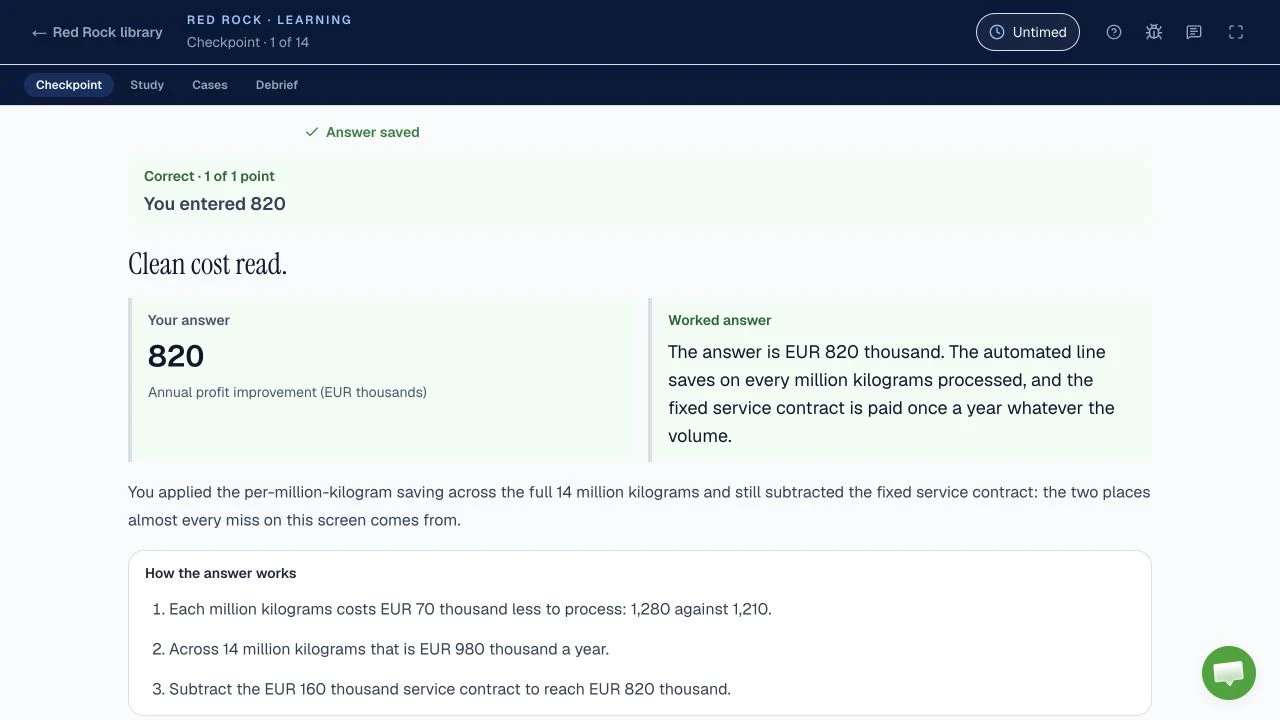
A practical way to use practice: run each game once untimed, list every error by type, then run it timed and check whether the same error types return. A shorter error list is a better readiness signal than any circulated percentage. The prep plan turns that into a seven-day, three-day or 48-hour schedule, and the tips guide lists fifteen habits that protect your score.
What should you do if you did not pass McKinsey Solve?
If you did not advance after McKinsey Solve, plan to reapply later and fix whatever practice shows you repeat; a rejection tells you the outcome of that application, not which input decided it, because McKinsey reads the result alongside everything else. Coaches on a February 2026 PrepLounge thread most often cited a wait of about 12 months before reapplying, with some offices reportedly longer; McKinsey publishes no period on the Solve page or FAQ, so confirm yours with the recruiter. Use the time on whatever you can measurably improve: if practice shows the same Red Rock calculation slips or Sea Wolf range errors, fix those; if your games were clean, the CV and experience side may matter more. The timeline guide covers the reapplication reports in more detail.
Are older McKinsey Solve pass rate claims still reliable?
No. Older McKinsey Solve pass rate claims are weaker still than current estimates, because none of the sources says which version of Solve its figure describes, and early versions featured games such as Ecosystem Building that 2026 candidates no longer report. The PSG, Imbellus and Solve history explains how the names map, and the Ecosystem game guide covers the earlier game. A figure from an older test, or a different game mix, says even less about the 2026 assessment.
For how Solve compares with other firms' screens, see McKinsey Solve vs BCG Casey vs Bain SOVA. For the whole assessment in one place, start with the complete McKinsey Solve guide.
Sources and evidence boundaries
- Official: McKinsey Solve (digital assessment) page and Solve FAQ (PDF, August 2025), checked October 3, 2026. No pass rate, cutoff, score scale or weighting is published. McKinsey's July 2025 blog post (July 9, 2025) gives the figure of around 300,000 Solve candidates a year.
- Third-party estimates (unverified), checked October 3, 2026: CaseBasix pass-rate page (updated August 17, 2026) and CaseBasix invitation page (May 27, 2026), which give different invitation rates, SolvePrep (September 14, 2026) and Case Prep (August 17, 2026), PSG Secrets (April 17, 2026) and MConsultingPrep (undated).
- Forum reports (anecdotal): PrepLounge threads dated February 29, 2024; April 30, 2024; September 11, 2025; February 1 to 3, 2026; June 2 to 4, 2026; and July 22, 2026, all linked above. Forum answers are mostly from coaches and describe individual cases.
- Not known: any official pass rate, cutoff, percentile threshold, score weighting or invitation rate.
- Our practice: Road to Offer, our practice platform, simulates Red Rock, Sea Wolf and the standard SFL. Its scores describe original exercises only. Written and reviewed by Esteban Ronsin.