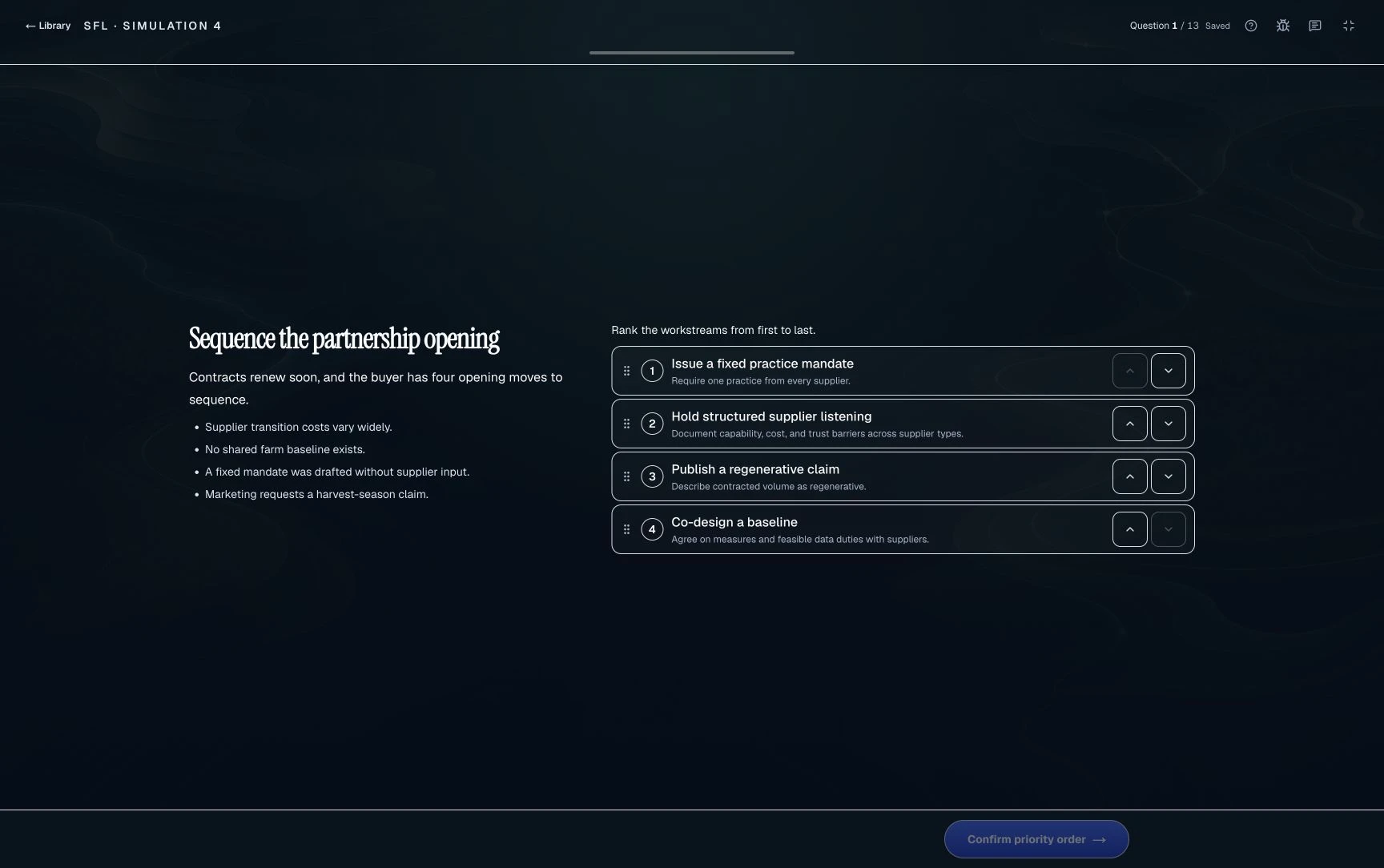
Original fictional practice. This five-action task belongs to Solve Game Prep. It is not a leaked question, an official answer key or a claim about McKinsey's scoring. Some searches use “Sustainable Future Lab”; this guide uses Sustainable Futures Lab, or SFL.
What is Sustainable Futures Lab practice preparing you to do?
McKinsey's current public Solve material does not publish an SFL workflow or scoring rubric. Preparation providers describe SFL as decision-making under uncertainty, with priorities, stakeholders and later information affecting earlier plans. Current providers also report more than one workflow in circulation: a connected scenario with an opening ranking and later choices, and a newer team-management style experience. These are third-party observations, not official guarantees.
The invitation duration may help a preparation provider guess which reported version a candidate could see, but it is not an official module map. Use any modules named in your own invitation, then follow the live tutorial. Do not memorize an assumed answer key. The transferable task is to make a defensible choice from the facts available, explain the trade-off, and revise the choice when a relevant fact changes.
A simple decision frame
- Objective: what outcome is the team responsible for now?
- Constraints: what limits action, such as time, budget, capacity, dependencies or approval?
- People: whose information or cooperation changes delivery?
- New evidence: which assumption changed, and which decisions should move because of it?
How should you practice Sustainable Futures Lab decisions?
Public SFL guides describe evolving scenarios and decisions involving stakeholders, priorities and uncertainty. That is useful context, not a guarantee of the exact format in your assessment. The official sources linked below do not publish a universal SFL ranking rubric.
Our training goal is narrower: make a choice that fits a stated objective, show which constraint it respects, and explain what would change your mind. A convincing explanation names a consequence. “Stakeholders matter” is too broad; “residents need the next update time so they do not rely on a repair date we cannot promise” is specific.
Use three layers of reasoning. First, separate facts in the brief from your assumptions. Second, compare impact, feasibility, timing and stakeholder consequences. Third, update only the parts of your plan affected by new evidence. Third-party guides describe more than one reported SFL workflow in circulation, which is another reason to practise the decision process rather than memorize a screen sequence.
The scenario: restore a town's reliable water supply
You coordinate a fictional town response team. Its objective is to reduce water-service disruption over the next 48 hours without committing to an unverified permanent solution. An inspection is needed to confirm a suspected leak and a connection point for temporary storage. The repair part is initially believed to be available.
- Your immediate budget is 60 funding units.
- You have two crew members. For this exercise, actions are performed sequentially, one at a time; do not assume parallel crews.
- Actions B and D cannot begin until inspection A finishes.
- A replacement part is required for B. Permission for temporary storage D is already granted.
- The permanent plant cannot be completed or funded within this response window.
Rank all five actions by priority. This is a priority list, not a promise that every item will be executed now. Put infeasible long-term work after the immediate response.
Scroll horizontally on a small screen to compare action costs, duration and conditions.
| ID and action | Cost | Hours | Crew | Condition |
|---|---|---|---|---|
| A: Verify the baseline with a site inspection | 4 | 4 | 1 | No prerequisite. Confirms the leak location and tank connection. |
| B: Repair the confirmed leak | 24 | 16 | 2 | Needs A and an available replacement part. |
| C: Brief residents and publish the next update time | 2 | 2 | 1 | No prerequisite. State uncertainty rather than promising a fix. |
| D: Install a temporary storage pilot | 30 | 24 | 2 | Needs A. Permission is already granted in this fictional scenario. |
| E: Build a permanent treatment plant | 120 | 480 | 2 | Separate funding and approval. Not feasible in this response window. |
Write your order before revealing ours. For your top two actions, name the dependency or risk that determines their position. Which action would you defer even if it sounds most ambitious?
Reveal one defensible initial ranking
A → B → C → D → E is a defensible order, not the only possible answer.
- A first: verify the condition before choosing a repair or connecting a storage pilot. A unlocks B and D.
- B next: the part is initially available, and repairing the confirmed leak addresses the suspected source of disruption.
- C next: explain what is known, what remains uncertain and when residents will hear more. It should not promise a result that the team has not verified.
- D next: temporary storage adds resilience while the team monitors the response. It is feasible but does not fix the leak itself.
- E last: the permanent plant costs 120 units and takes 480 hours. It requires separate funding and approval, so it does not fit this immediate mandate.
The first four actions cost 4 + 24 + 2 + 30 = 60 units and take 4 + 16 + 2 + 24 = 46 sequential hours. No action needs more than two crew members. E is deferred, not squeezed into the remaining two hours.
Stakeholder challenge: improve communication without inventing certainty
A residents' representative says: “We have heard promises before. Why are we only hearing from you after the repair work?” Choose a response before revealing the discussion:
- Keep the order without discussion because technical work is more important.
- Promise that the water problem will be solved tonight to reassure the group.
- Acknowledge the information gap, agree a concrete update time, and consider moving C earlier while preserving the inspection dependency.
Reveal the response and an alternative defensible order
Option 3 addresses the concern without inventing certainty. For example: “You need a dependable update, not another unsupported promise. We will explain what the inspection will check and publish the next update time. We will report what it finds before confirming the repair plan.”
C → A → B → D → E can also be defensible when the immediate communication gap is causing harm. C has no prerequisite, costs two hours, and the first four actions still fit the 48-hour window. A still precedes B and D. Another reasonable order is A → C → B → D → E if the initial inspection result is important to the first briefing.
Option 1 ignores a relevant operational risk. Option 2 offers a deadline unsupported by the evidence. Moving C is not automatically right in every situation; explain why its benefit justifies delaying another action here.
New evidence: the repair part will arrive in 72 hours
Before work starts, the supplier corrects its stock report: the part required for B cannot arrive until 72 hours from now. The 48-hour response window and budget are unchanged. A and D remain feasible, and the storage connection still needs inspection.
Revise your order. What changed, what stayed the same, and which earlier assumption was invalidated? Do not invent a second crew or assume the supplier can deliver sooner.
Reveal the revised plan and explain the change
A → D → C → B → E is one defensible revision. A still provides the required evidence. D becomes the feasible near-term intervention because B cannot start within the window. C explains the temporary approach and the known part delay. B is planned after delivery; E remains a separate long-term proposal.
The executable first three actions cost 4 + 30 + 2 = 36 units and take 30 sequential hours. Reserve the remaining 24 units rather than pretending B has been completed. The 60-unit budget has not increased.
Moving C before D can again be reasonable if prompt communication is critical. What is not defensible is keeping B ahead as an executable immediate action while ignoring its unavailable part, or skipping A when D still depends on it.
Before and after: what moved, and why?
The new supplier fact changes one action's feasibility. It does not erase the inspection dependency, increase the budget or make the permanent plant fit the response window.
Initial information
Part believed available
- 1AVerify the baseline with a site inspection
- 2BRepair the confirmed leak
- 3CBrief residents and publish the next update time
- 4DInstall a temporary storage pilot
- 5EBuild a permanent treatment plant
Revised information
Near-term plan changes
- 1AVerify the baseline with a site inspection
- 2DInstall a temporary storage pilot
- 3CBrief residents and publish the next update time
- 4BRepair the confirmed leak · wait for delivery
- 5EBuild a permanent treatment plant
Use an explanation rubric, not an invented official score
Review your reasoning using four questions. This is our editorial checklist, not a McKinsey percentile or pass mark:
- Objective: does the action reduce near-term disruption, or did a grander but infeasible project distract you?
- Feasibility: did you check budget, hours, crew capacity, prerequisites and approvals?
- Stakeholders: did you answer the actual objection without promising facts you cannot establish?
- Updating: can you point to the new fact that changed the plan, rather than switching randomly?
A different priority list can be strong when its assumptions are explicit and consistent with the brief. A polished explanation cannot repair a broken hard constraint. If you propose parallel work, an extra budget or an accelerated delivery, you have changed this exercise rather than solved it.
Connect the practice to your next step
Try writing a two-sentence rationale before comparing it with the explanations: “I prioritize X because Y. I would change that order if Z.” Review whether Z actually appears in the new evidence. This makes the exercise useful even without an automatic score.
The independent SFL practice destination continues the decision-making theme. This article does not promise that its exact scenario, question count or ranking screen appears in the real assessment. Use the practice link below to continue in Road to Offer.
For arithmetic rather than prioritization, try the Red Rock study. For rules with definite validity checks, try Sea Wolf combinations. Keep preparation separate from the actual assessment using the test-day checklist.
Sources and evidence boundaries
McKinsey's official Solve page and its August 2025 FAQ were checked September 20, 2026. Follow those assessment-conduct rules and your own instructions. They do not certify this practice rubric.
Our benchmark included Solve Games Guide's SFL guide and SolvePrep's SFL guide. Those are third-party practice interpretations. We have not treated reports of a new timed or team-management variant as verified product coverage.