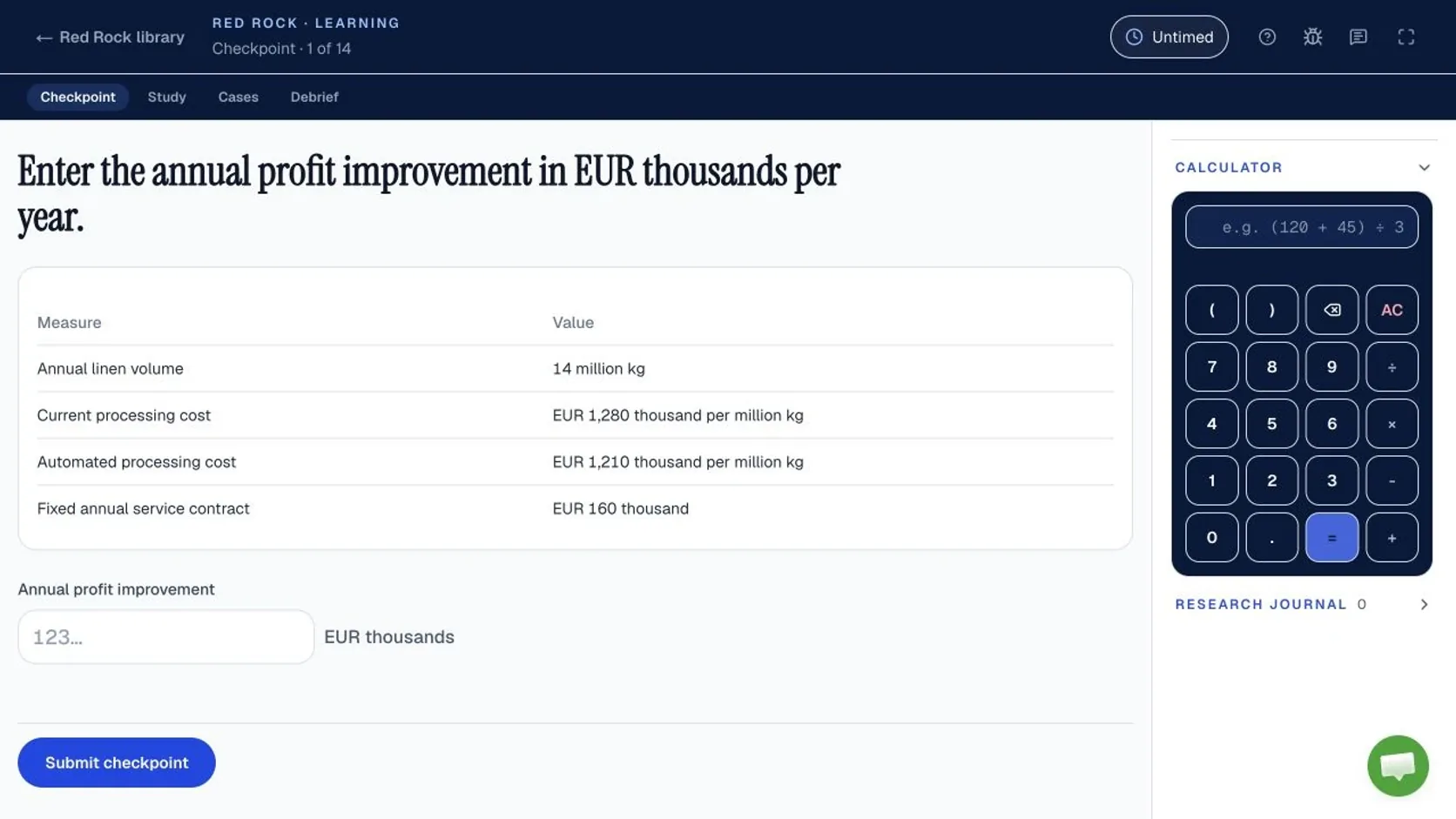
McKinsey publishes no Solve sample questions, so the three below are original, one per game. Each shows the question, the working, the tempting wrong answer and the one check that catches it. For more items per game, follow the link under each example.
| Game | Item type | The check that catches the usual error | More practice |
|---|---|---|---|
| Redrock | A combined rate across two groups | Rebuild the counts before you divide | Six worked Redrock practice questions |
| Sea Wolf | Which trio of microbes passes a site | Traits first, then sum targets | McKinsey Sea Wolf game guide |
| Sustainable Futures Lab | Rank four opening actions | Nothing above its own dependency | SFL ranking task, worked |
What does a McKinsey Redrock sample question look like?
A typical Redrock item gives you a small exhibit and asks for one number, and the trap is usually the base, not the arithmetic. This one asks for a share across two groups of different sizes, a pattern the Redrock math guide covers in more depth.
Question. A reef survey splits its quadrats into two zones. In the north zone, 25% of 40 quadrats show bleaching; in the south zone, 10% of 160. What share of all surveyed quadrats show bleaching?
Made-up survey data for this guide.
Reveal the answer and working
13% of all quadrats show bleaching. Turn each percentage back into a count (10 and 16), add them, and divide by all 200 quadrats.
Combined share
Equal-weight trap
Averages 25% and 10%, which treats 40 quadrats as if they counted as much as 160.
Rebuild the counts
Weights each zone by its size: total bleached over total surveyed.
The check: a combined rate must sit between the two group rates and closer to the bigger group. 13% is near the south zone's 10%; 17.5% sits halfway, which only happens when the groups are the same size. For six more items with worked answers, use the McKinsey Redrock practice questions.
What does a McKinsey Sea Wolf sample question look like?
A Sea Wolf item asks whether a set of three microbes meets a site's rules: each attribute's average must fall inside its range, and the trait rules must hold. The fastest reliable check reads the traits first, then turns each average range into a sum range so you add instead of divide.
Question. The site needs an average breakdown from 4 to 6 and an average containment from 5 to 7. At least one microbe must have cold recovery, and none may have rapid bloom. Which trio passes?
| Microbe | Breakdown | Containment | Trait |
|---|---|---|---|
| Alder | 3 | 7 | Cold recovery |
| Birch | 8 | 4 | None |
| Cedar | 5 | 6 | Rapid bloom |
| Dune | 6 | 5 | None |
| Elm | 4 | 3 | Cold recovery |
Options: A) Alder, Cedar, Dune; B) Birch, Dune, Elm; C) Alder, Birch, Dune.
Reveal the answer and working
The answer is C: Alder, Birch, Dune. Its sums are 17 and 16, both inside the targets of 12 to 18 and 15 to 21, it includes a cold recovery microbe, and none has rapid bloom.
| Option | Rapid bloom? | Cold recovery? | Breakdown sum (12 to 18) | Containment sum (15 to 21) | Result |
|---|---|---|---|---|---|
| A | Yes: out | Yes | 14 | 18 | Fails |
| B | No | Yes | 18 | 12 (outside) | Fails |
| C | No | Yes | 17 | 16 | Passes |
- Target sum15 to 21
- A18Inside
- B12Outside
- C16Inside
Option A's numbers pass; it fails on a trait, which the sums cannot show.
The check: option A is the tempting one, because both its sums land inside the targets. It still fails, since Cedar carries the excluded trait. Scanning traits before any arithmetic removes it in one glance. The McKinsey Sea Wolf game guide works two fuller puzzles, and the Sea Wolf sum method shows the conversion step by step.
What does a Sustainable Futures Lab sample question look like?
The opening Sustainable Futures Lab task, as candidates describe it, asks you to rank a few actions for a project brief, and later decisions build on that order. A defensible ranking serves the objective and never puts an action above something it depends on.
Question. Objective: cut water lost to leaks across the network before summer demand peaks. Constraints: one crew and a fixed budget this quarter; no baseline: nobody knows how much water each main loses today; the city council wants a public savings figure. Rank these actions from first to last: fit flow meters on the three largest mains; repair the leaks the meters locate; run a customer campaign on household leaks; publish a savings figure for the council.
Reveal a defensible order and the reasoning
- Fit flow meters on the three largest mains. Nothing else can be targeted or reported without a baseline, so it unlocks the rest.
- Repair the leaks the meters locate. This is the action that actually cuts leakage, the objective, and it needs the meter data to find the leaks.
- Run a customer campaign on household leaks. Cheap and independent, but it targets household leaks, a smaller and unmeasured part of the objective.
- Publish a savings figure for the council. Only defensible once there is a baseline and repairs to measure against it.
Tempting order
Claim before meters and repairs
Run a customer campaign on household leaks, then Publish a savings figure for the council, then Fit flow meters on the three largest mains, then Repair the leaks the meters locate. It looks responsive to the council, but it breaks 2 dependencies: the figure would come before anything was measured or fixed.
Dependencies first
Meters, repairs, campaign, claim
Baseline, then the fix the objective needs, then the side action, then the claim the evidence now supports.
The check: for each action, ask whether anything ranked below it is something it needs first. If the answer is yes, swap them. The order above passes; the tempting one fails twice. The SFL ranking task guide works a longer example with the same check, and the McKinsey Sustainable Futures Lab guide covers both reported formats.
How should you use McKinsey Solve sample questions?
Attempt each item on paper before you open the working, then name the error if you missed: base, trait, sum or dependency. A named error is what transfers to your sitting, because McKinsey's FAQ says scenarios vary between candidates and your numbers will not match these.
Then move from single items to a full run under time. The McKinsey Solve game practice page lists one free run of each format: Red Rock, Sea Wolf, SFL Classic and SFL Island.
Where do these sample questions fit in your preparation?
They are a diagnostic: the item you got wrong tells you which game to open first. For the full sequence by days, read how to prepare for McKinsey Solve; for every game on one screen, the McKinsey Solve cheat sheet lists the check order per game. For the format of the whole assessment, start with the McKinsey Solve guide.
Sources and evidence boundaries
- Official: McKinsey's Solve page and the August 2025 Solve FAQ, linked from it: no practice questions or answer key are published, and scenarios vary so that no two candidates share the same parameters and data.
- Reported: the item types (a combined rate in Redrock, a three-microbe treatment in Sea Wolf, an opening ranking in the Sustainable Futures Lab) follow how candidates describe the games. McKinsey has not confirmed them.
- Original: every name, number and answer on this page was made up for this guide and checked by a script in the site's test suite.