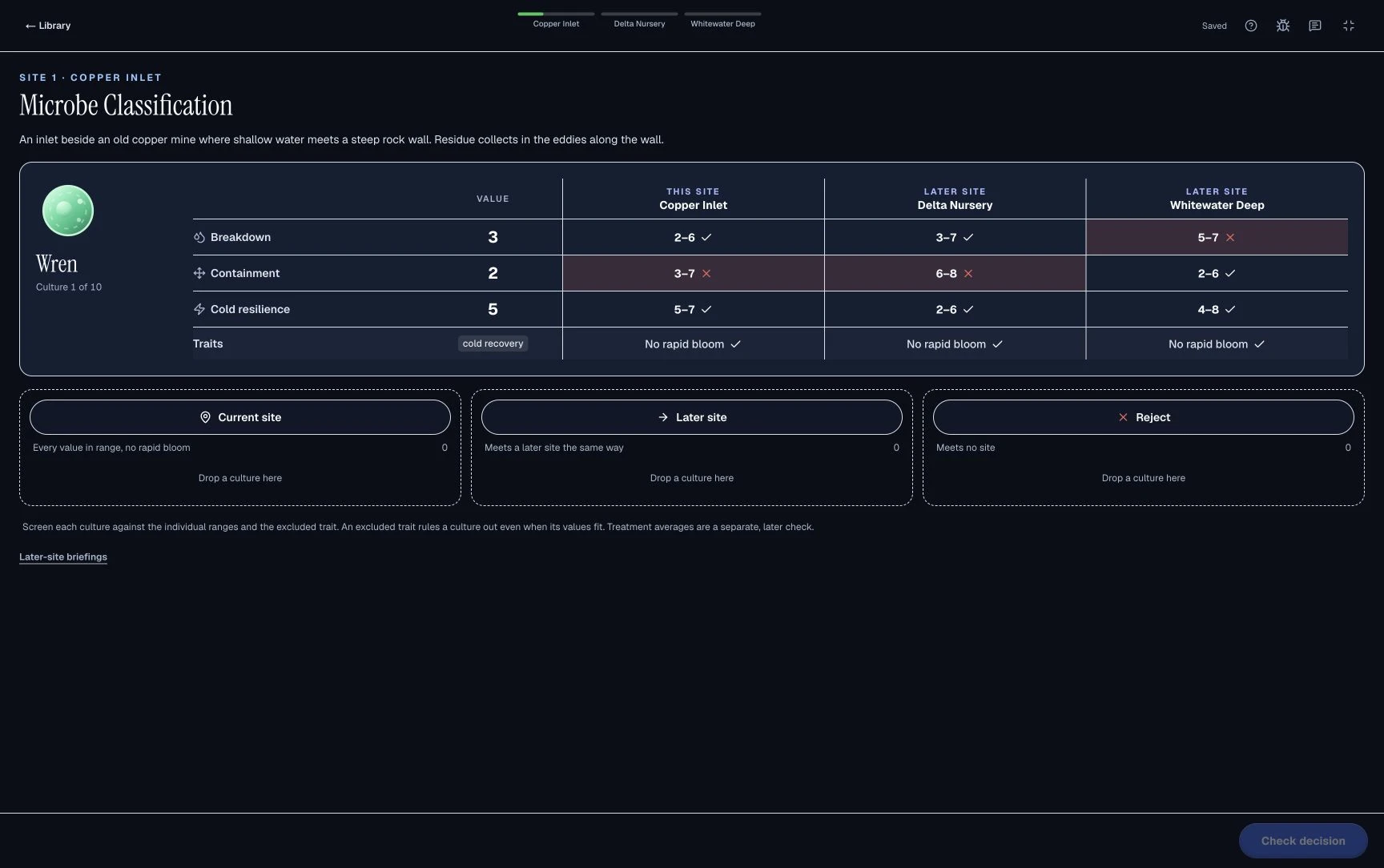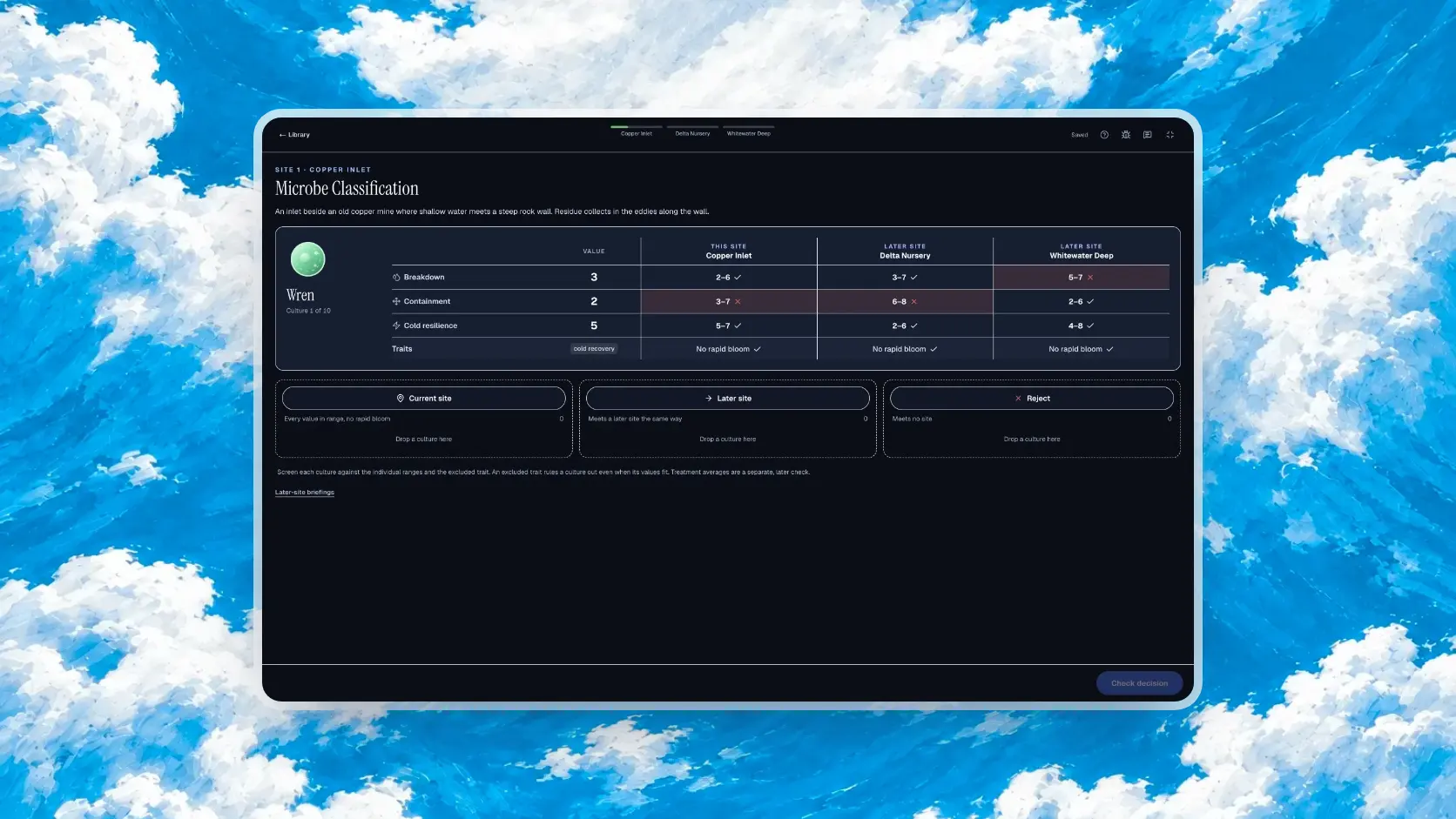
For a reported Sea Wolf treatment of 3 microbes, multiply each site's average-range bounds by 3, reject forbidden traits, secure the required trait, and compare trio sums with the resulting windows. McKinsey has not published the detailed Sea Wolf rules, so the method below is demonstrated on an original fictional pool and must yield to your tutorial.
| Point | What you can rely on | Status |
|---|---|---|
| Sea Wolf premise | McKinsey names Sea Wolf and describes selecting and evaluating microbes to clean contaminated sites. | Official, July 2025 blog |
| Treatment arithmetic | Candidates report 3 microbes per site, with averaged attributes checked against ranges and trait rules. | Reported, not an official specification |
| Site count and clock | Candidates report 3 sites in about 30 minutes. | Reported; your invitation and tutorial govern |
| Outside tools | McKinsey bans applications, websites, AI tools and prepared notes during Solve, absent an approved accommodation. | Official, Solve FAQ |
| Exact values and scoring | McKinsey does not publish Sea Wolf's attribute names, ranges, penalties or pass mark. | Not published in the checked sources |
This page solves a narrower question than the full Sea Wolf rules and strategy guide: how to test a possible treatment quickly when you cannot use a spreadsheet or solver during the assessment. McKinsey's official Solve page describes a game-based recruiting assessment, and its July 2025 blog names Sea Wolf. The detailed treatment rules below are candidate reports. Every letter, value, range and trait in the worked exercise is original practice content, not a recovered test question. If you met this task under another name, the guide to Ocean Treatment and Ocean Cleanup versus Sea Wolf sorts out the labels, and the Sea Wolf cheat sheet compresses the rules on this page into one screen.
How do you turn Sea Wolf averages into sums?
For the reported 3-microbe treatment, multiply both ends of each average range by 3 and compare the total with that inclusive window; this is exact arithmetic for our fictional pool, while McKinsey has not published the real Sea Wolf ranges. You do the conversion once when you read the site, then add candidate values as whole numbers and never divide.
The reported rule, written for three microbes a, b and c
Multiply every part by 3
This is algebra, not a trick. The inequality signs do not change and inclusive ends stay inclusive.
A fictional site called Cove asks for three averages. Each one becomes a window for the total of the three values you pick.
Lift: average 4 to 6
Stability: average 4 to 6
Flow: average 5 to 7
Keep those three windows as a short row of totals. A sum that lands exactly on a bound passes that attribute in this exercise; a sum that misses by one cannot be rescued by dividing later. The values you will add come from this pool, which every example on the page shares.
| Microbe | Lift | Stability | Flow | Trait |
|---|---|---|---|---|
| A | 2 | 8 | 7 | Binder |
| B | 5 | 5 | 5 | Neutral |
| C | 8 | 2 | 6 | Neutral |
| D | 6 | 7 | 3 | Binder |
| E | 4 | 9 | 2 | Fouler |
| F | 7 | 4 | 8 | Neutral |
| G | 3 | 6 | 9 | Neutral |
Do not judge a microbe in isolation. The site asks about the trio, so a value outside the average range can be balanced by its partners.
- Cove average range4 to 6
- A alone2Outside
- C alone8Outside
- A + B + C average5Inside
Fictional values. A and C each sit outside the range, yet the trio they form with B sits inside it.
Lift average of A + B + C
Screens one microbe
Compares A's lift with the average floor of 4 and discards a member that a valid trio needs.
Checks the trio
Adds the three lift values and compares the total with the window of 12 to 18.
A microbe with the wrong trait is different: another member cannot remove that trait from the selection. For the full list of slips this habit prevents, see the errors that break a Sea Wolf treatment; for why the reported game feels hard under a clock, see where Solve candidates lose points.
Which Sea Wolf rule should you check first?
In this original pool, check the forbidden trait first, then whether a plausible trio can include the required trait, then test the tightest numerical window; that order avoids arithmetic on unusable options, but McKinsey has not published an official elimination order. Cove requires Binder and excludes Fouler. The drawing follows one search: A and B are fixed, and the order decides which of the other five can be the third member.
- Remove the forbidden trait (Fouler)
E carries Fouler. No partner can cancel a trait, so it leaves before any addition.
ABCDEFoulerFG4 of 5 candidates left
- Secure the required trait (Binder)
Only A and D carry Binder. A is already in the pair, so the third member is free on this rule.
ABinderBCDBinderEFG4 of 5 candidates left
- Test the tightest window (stability 0 to 5)
The stability value is printed under each candidate. D and G sit above the ceiling of 5.
ABC2D7EF4G62 of 5 candidates left
- Check the remaining windows (lift 5 to 10, flow 3 to 9)
Lift and flow are printed under each survivor. C and F fit both, so each completes a valid trio.
ABC8 / 6DEF7 / 8G2 of 5 candidates left
Filled circles are the fixed pair, outlined circles are still possible, red is removed at that step, dashed was removed earlier. Original teaching order on fictional values, not a claimed McKinsey scoring rule.
The same order pays off across the whole pool. Count how many of the 35 possible trios are still worth adding up after each check.
The two trait checks remove 19 of 35 trios before a single addition. Counts are a property of this fictional pool only.
Running the sums first costs more than time. A trio can pass every window and still be invalid.
Sums first
All three totals fit their windows, so the trio looks valid after three additions. It contains Fouler and no Binder.
Traits first
E is Fouler. Reject the trio.
One look at the trait column removes E. No addition is needed for any trio that contains it.
“Tightest” means the smallest feasible window in the pool after your other choices, not simply the shortest-looking site range. A quick first filter creates a shortlist, not a final verdict: the candidates that survive stability still owe a lift and a flow check.
There is an exception to the simple trait-first habit during early prospecting: a candidate you will not use at the current site may be relevant to another reported site. The Sea Wolf guide owns the reported phase flow. The elimination order here applies to choosing a treatment from a stated pool, and to checking whether an added prospect can complete one. If you are deciding which game deserves your first session, Red Rock versus Sea Wolf: which to practise first compares the two.
How can two microbes tell you what the third must be?
For any fixed pair in this fictional treatment, subtract both values from each target-sum bound to get the third member's allowed window; the reported Sea Wolf averaging rule motivates this, but the values here are original. Start with A and B at Cove. The third microbe must satisfy all three windows at once and must not introduce Fouler.
Window for the third member
Floor and ceiling are the sum window. Pair is the total of the two fixed microbes for that attribute.
Lift: A + B already total 7
Stability: A + B already total 13
Flow: A + B already total 12
A negative lower bound is only a mathematical remainder: on this exercise's 0 to 10 scale, any low stability value fits, and the lift ceiling stops at 10. Start with stability because it keeps the fewest candidates, then check the survivors on the other two lines.
E is left out because it carries Fouler. All three windows must hold for the same microbe.
C and F fall inside every window, so A + B + C and A + B + F are both fully valid at Cove. The same picture catches a common false positive: a candidate may fit the first attribute and fail the second. Do not stop after the easiest total.
If neither member of your fixed pair supplies Binder, the third member must be A or D in this exercise. Apply that trait requirement before searching numeric windows. If your pair already contains E, abandon it for a fully valid treatment. These are deterministic statements about the original pool, not claims about McKinsey's unpublished scoring. For broader Solve habits under a clock, the tips guide covers the other games as well, and Red Rock math works the percentage and ratio questions of the other reported game in the same equation-first style.
What does a complete Sea Wolf treatment check look like?
A complete check tests every attribute total and both trait rules for the same trio; A + B + C at fictional Cove and B + D + F at fictional Channel pass, while McKinsey does not publish the real site's figures. The same pool serves three fictional sites, and only the windows change.
| Site | Lift | Stability | Flow |
|---|---|---|---|
| Cove | 4 to 6, total 12 to 18 | 4 to 6, total 12 to 18 | 5 to 7, total 15 to 21 |
| Channel | 5 to 7, total 15 to 21 | 4 to 6, total 12 to 18 | 5 to 7, total 15 to 21 |
| Reef | 4 to 6, total 12 to 18 | 7 to 8, total 21 to 24 | 8 to 9, total 24 to 27 |
Every site here requires Binder and forbids Fouler. Add each attribute for the trio, then place the total on its window. The line in each drawing runs from the lowest to the highest total any three microbes of this pool can reach.
Traits: A supplies Binder and no member carries Fouler. Fictional values.
The check is only complete when the last attribute is done. Swap C for D and the first total still looks fine.
Stops after lift
Lift fits 12 to 18, so the trio is submitted on one passing total.
Finishes the check
Stability is above the ceiling of 18. One failed window makes the whole trio invalid.
Channel raises the lift range and keeps the other two. The trio that passes there includes D, whose flow of 3 is below Channel's average floor of 5: F's higher flow balances it. Screening every individual value against the site range would discard a useful member.
Traits: D supplies Binder and no member carries Fouler. Fictional values.
The pool contains 35 distinct three-member sets. The accompanying test recomputes all of them against each site's stated rules, not just these illustrated answers. It finds 8 valid trios at Cove and 7 at Channel. That count is a property of this small fictional dataset only. It is neither a practice score nor a forecast of how many options a candidate sees in Solve. The selected members must be the same throughout the check: never mix one promising attribute from one trio with a trait carried by a different trio. For the skills this kind of checking is reported to exercise, read what McKinsey Solve measures in each game.
How do you prove that no valid trio exists?
For fictional Reef, the pool has 0 valid trios: only A + F + G can meet the flow minimum, and that trio misses the stability minimum; this proof concerns our original pool, not a claim about real Sea Wolf sites. Start from the tightest rule. Reef asks for an average flow of 8 to 9.
Reef flow floor
Only the three highest values can add up to 24. Fictional values.
The three highest flow values
Exactly the floor of 24, so A + F + G passes flow.
Next best: C + F + G
Below 24. Every other trio is lower still, so flow forces A + F + G.
One trio is left to test. It carries Binder through A and contains no Fouler, so the traits hold. Now place its three totals on Reef's windows.
Original finite-pool proof. McKinsey publishes neither real site pools nor a frequency of impossible treatments.
Stability stops 3 short of its floor, and the flow rule leaves no other trio to try. That is a proof, not a guess from scanning the cards, and the exhaustive test reaches the same result across all 35 triples. The tempting reaction is to repair the failed attribute with a swap.
Tempting swap
Swapping F for D lifts stability to 21, but flow falls below the floor of 24.
Forced trio
Only A + F + G reaches the flow floor, so no swap is available and the pool has 0 valid trios.
If an actual pool seems impossible, first check that you read the tutorial's rule correctly, including inclusive bounds and how traits apply. Then look for a forced constraint like Reef's flow floor. Do not infer a real scoring penalty or an optimal near-miss from this page: McKinsey has not published the Sea Wolf penalty model. The scores and results guide explains that wider evidence boundary, and the pass-rate guide covers unsupported cutoff claims.
How should you divide your Sea Wolf practice time across sites?
For a practice run modeled on candidate reports of 30 minutes across 3 sites, start with 10 minutes per site and reserve the largest part of each site's budget for combining and checking the pool; McKinsey does not publish a Sea Wolf clock or a per-site allocation. This is an editorial rehearsal plan, not a test instruction.
Even split of the reported clock
- Read1 min
- Screen2 min
- Build and test5 min
- Verify1 min
- Buffer1 min
- Minute 1Traits noted and every average range rewritten as a total.
- Minute 3Forbidden traits removed, a required-trait route kept, the tightest window chosen.
- Minute 8One trio that passes, or a short proof that none can. Stop random swaps.
- Minute 10Every total and both traits rechecked. Move to the next site.
The parts sum to 10 minutes for a practice site. Your Solve invitation, not this guide, states your actual assessment length.
Our completed free Sea Wolf run includes your score, where points went and worked feedback on each submitted decision, with constraint and treatment visuals. No payment is required for the first run or its worked review. Sea Wolf is one of four practice formats we offer, alongside Red Rock, SFL Classic and SFL Island, each with a complete free run. Paid Learning mode provides coaching and feedback at each step, untimed in the clocked games, with the matching game pack, Solve pack or Annual access. The separate free Solve plan asks your invitation length and test date, then gives dated practice steps for up to 28 days; create a free account to view and save it. After a run, separate a slow conversion from a slow search. If the multiplication costs you time, rehearse range-to-sum conversion on new fictional ranges. If search costs you time, practice the pair-to-third window. If you missed a trait, put the trait scan ahead of the math next time. The Solve prep plan helps place that drill among other games, which games a 65, 85 or 95 minute invitation contains tells you how much of your sitting Sea Wolf is reported to take, and the test-day checklist covers the official device and integrity rules.
Can you use a spreadsheet or Sea Wolf solver during Solve?
No: McKinsey's official Solve FAQ prohibits applications, websites, AI tools and prepared notes during the assessment except for an approved written accommodation, so a spreadsheet or outside solver is not an authorized live aid. McKinsey's broader assessment integrity page also disallows outside calculators while permitting pen and paper for calculations. That is why this guide teaches small sums you can check mentally or with permitted scratch work. An in-game calculator is something candidates report for the other game, covered in the Red Rock calculator and journal guide; do not assume Sea Wolf offers one.
A solver can be useful while preparing, and the Sea Wolf solver and Excel guide explains what one does and where it stops, but it cannot replace your own decision process on test day. For this article, a local test exhausts the fictional pool so the published numbers can be checked. During independent practice, compare your own candidate trio with the exercise's complete rules, then explain the first condition it misses. This makes an error specific: a trait oversight, a sum below its floor, a sum above its ceiling, or time spent testing a pair that had no possible third member.
McKinsey says each task starts with an untimed tutorial, and the scenarios vary. Read that tutorial even if you know this method. It may show a different range, trait, selection count or interaction than this simplified exercise. For the invitation's stated length and support route, read the Solve invitation guide. For a broader comparison of methods across games, use the complete Solve guide, and for one-line answers on rules and tools, the Solve FAQ with 30 short answers. When you are ready to rehearse, choose a practice game.
Sources and evidence boundaries
- Official, checked October 11, 2026: McKinsey's Solve page calls Solve a game-based recruiting assessment and states the ban on outside applications, websites, AI tools and prepared notes. Its July 2025 blog names Sea Wolf and describes selecting and evaluating microbes to clean contaminated sites.
- Official, checked October 11, 2026: the August 2025 Solve FAQ says each task begins with an untimed tutorial, the invitation states the total length, and scenarios vary. The assessment integrity page covers pen and paper, outside calculators and one-screen conduct for assessments generally.
- Reported, unverified: candidates describe three sites, three selected microbes per site, averaged attribute ranges, desired and undesired traits, and about 30 minutes. McKinsey does not publish those details. This guide makes no claim about phase counts, penalty percentages, process scoring, a pass mark or whether the real pool always has a fully valid trio.
- Original exercise: Cove, Channel, Reef, their attributes, the 0 to 10 scale, traits, values, site timing plan and all treatment calculations are invented for teaching. The local node test checks every three-member combination against the exercise rules. They are not an official task, assessment screenshot, score or prediction.