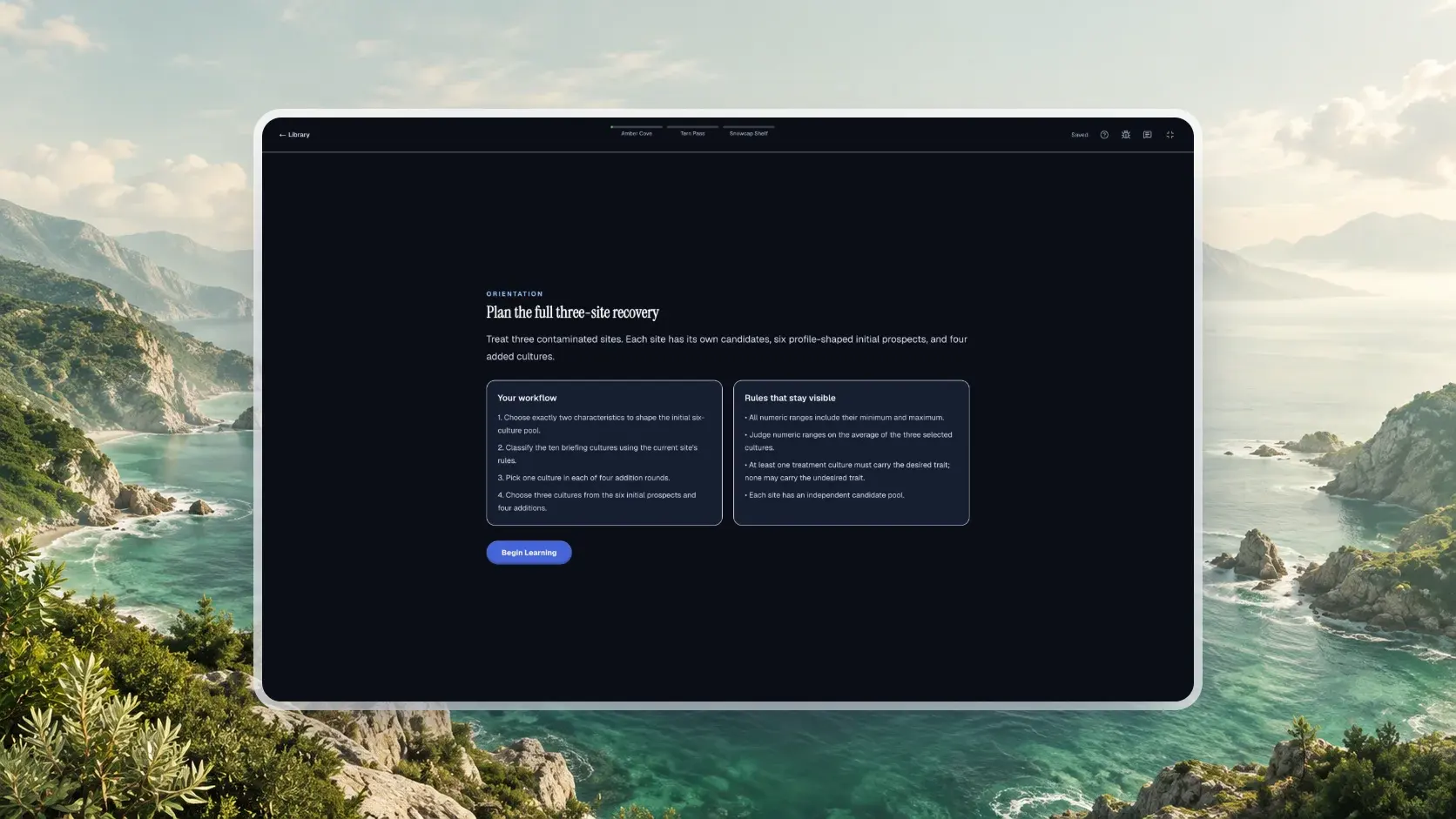
McKinsey Solve is McKinsey's online, game-based problem-solving assessment, which McKinsey's July 2025 blog says is given to around 300,000 early-career candidates a year. As of October 3, 2026, candidates report three McKinsey Solve versions: 65 minutes (Red Rock about 35 plus Sea Wolf about 30), 85 minutes (plus a standard Sustainable Futures Lab of about 20) or 95 minutes (plus a newer Sustainable Futures Lab of about 30, first described by a candidate on September 11, 2026), each game preceded by an untimed tutorial. McKinsey's August 2025 Solve FAQ says only that your length is stated in your invitation email and that no preparation or business knowledge is needed; McKinsey publishes no pass mark or pass rate.
| Version or fact | Games and minutes | Evidence |
|---|---|---|
| 65-minute invitation | Red Rock about 35 + Sea Wolf about 30 | Candidate-reported |
| 85-minute invitation | Red Rock about 35 + Sea Wolf about 30 + standard Sustainable Futures Lab about 20 | Candidate-reported |
| 95-minute invitation | Red Rock about 35 + Sea Wolf about 30 + new Sustainable Futures Lab about 30 | Candidate-reported: invitations from August 24, 2026; new SFL first described September 11, 2026; looks like a pilot |
| Tutorials | Untimed, one before each game, outside the minutes above | Official (August 2025 FAQ) |
| Your length | Stated in your invitation email; McKinsey does not name the games | Official (August 2025 FAQ) |
| Device and aids | PC or Mac; no apps, websites, AI tools or pre-prepared notes | Official (August 2025 FAQ) |
| Pass mark | None published; results weighed with your whole application | Official (August 2025 FAQ) |
| Takers per year | Around 300,000 early-career candidates | Official (McKinsey blog, July 9, 2025) |
Checked October 3, 2026. Every claim below is labelled as official McKinsey guidance, candidate-reported, or prep-site reconstruction. McKinsey publishes very little about Solve, so where something is unknown, this guide says so instead of filling the gap.
What is McKinsey Solve?
McKinsey Solve is the screening step McKinsey uses between your application and first-round interviews: a set of two or three short, timed simulation games played online in one sitting. There is no business knowledge to learn. You prepare by learning each game's rules and interface, practising under the clock, and building a few reasoning habits that hold up under time pressure.
The official facts are short. McKinsey's Solve page and its August 2025 FAQ say:
- Solve is a game-based assessment, and your assessment length appears in your invitation email.
- Each task starts with an untimed tutorial, so the minutes in your invitation are game time, not reading time for instructions.
- No business or gaming knowledge is needed. The FAQ's answer to "How should I prepare?" is "No preparation is needed".
- You take it on a PC or Mac (not an iPad or phone). A mouse is optional and sound is not needed.
- You work alone. You may not use applications, websites, AI tools or pre-prepared notes, or record or screenshot any part of it. Breaking these rules can lead to exclusion, a rescinded offer, restrictions on future applications or legal action.
- Scenarios vary, so no two candidates get the same data, and you may be asked at random to take an extra task in person or explain your logic.
- Your results are considered together with the rest of your application and any other assessments, not on their own.
- The FAQ lists English, Spanish, Portuguese and Japanese as assessment languages.
Everything else in circulation (game timings, question counts, scoring models, pass rates) comes from candidates and prep providers. Some of it is consistent and reliable enough to plan around. Some of it is guesswork presented as fact. This guide keeps the two apart, and the rest of this site goes deeper on each topic. If you only have five minutes, read the table below, check the minutes in your invitation, and open the guide for the first game you will face.
What do the McKinsey Solve games look like?
Each McKinsey Solve game is a short, self-contained simulation with its own clock and an untimed tutorial first. McKinsey does not publish screenshots or game names, and its Solve page offers a short official video captioned "see what it will feel like to play" rather than a playable demo. The screens below come from our independent practice simulation, built from candidate and prep-site descriptions.
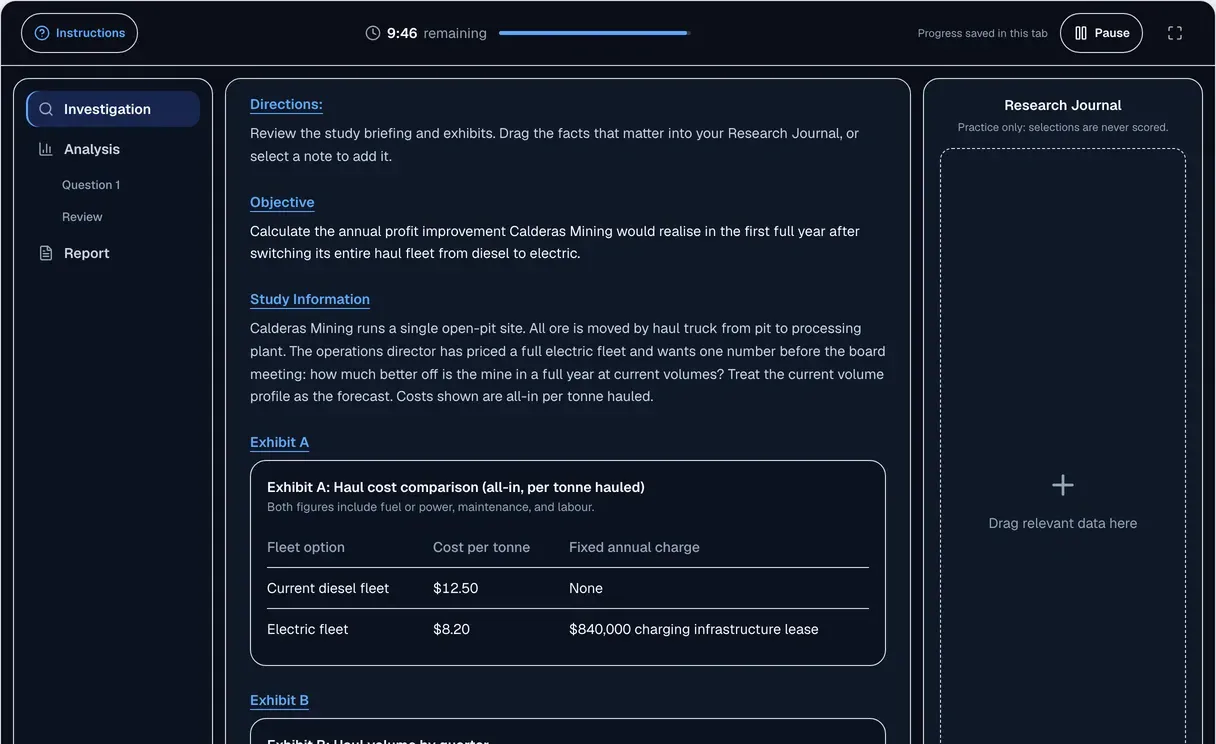
Red Rock about 35 min
Save the facts that matter to a research journal, answer calculation questions, report a conclusion, then solve short cases. Red Rock guide
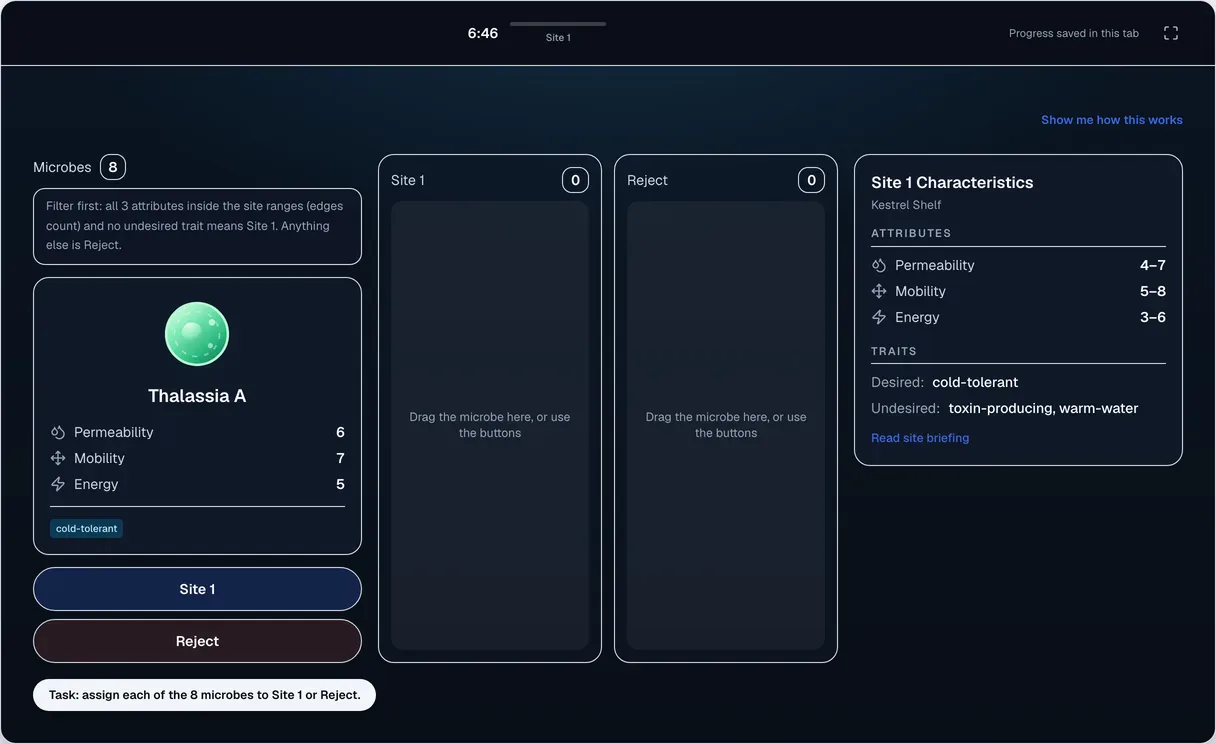
Sea Wolf about 30 min
Screen microbes against a site's numeric ranges and trait rules, then build a treatment whose averages fit, across three sites. Sea Wolf guide
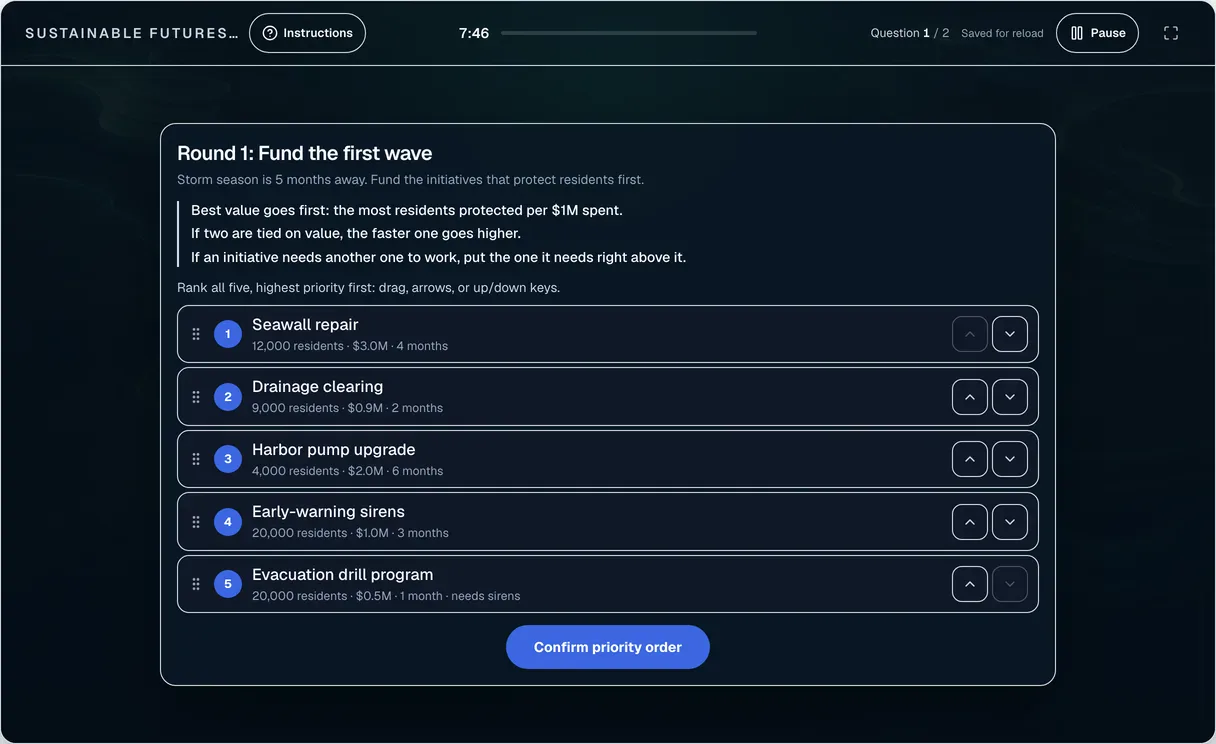
Sustainable Futures Lab 20 or 30 min
Rank actions for a sustainability project, then make linked decisions that stay consistent as facts change. Only in longer invitations. SFL guide
Practice-simulator screens from Road to Offer, not McKinsey screenshots. Game times are candidate-reported. The real interface may differ in layout and wording; the untimed tutorial in each game is the place to check the controls.
Which games are in McKinsey Solve in 2026?
McKinsey Solve has two or three games in 2026, according to candidate reports: Red Rock (about 35 minutes) and Sea Wolf (about 30 minutes) in every invitation, plus a Sustainable Futures Lab of about 20 or 30 minutes in longer invitations. McKinsey does not name the games in its own Solve materials. Times below are candidate-reported game clocks, excluding the untimed tutorials.
Scroll horizontally on a small screen to see every column.
| Game | Reported time | What it tests | Guide and free practice |
|---|---|---|---|
| Red Rock | About 35 minutes, every invitation | Finding relevant data, calculating accurately, choosing a correct chart or conclusion | Red Rock practice questions; one free full run in the practice hub |
| Sea Wolf | About 30 minutes, every invitation | Checking combinations against numeric ranges and trait rules, managing a limited pool | Sea Wolf rules and puzzles; one free full run in the practice hub |
| Sustainable Futures Lab (standard) | About 20 minutes, 85-minute invitations | Prioritising actions, consistent decisions across a linked scenario, updating on new facts | SFL: both versions and practice; one free full run in the practice hub |
| Sustainable Futures Lab (new) | About 30 minutes, 95-minute invitations | Leading a team: buying information, assigning people, resolving dilemmas, rating performance | The 95-minute invitation; practice coming soon, and the standard SFL trains the shared habits |
Two things follow from the table. First, everyone sits Red Rock and Sea Wolf, so those two games deserve practice time whatever your invitation says. Second, the Sustainable Futures Lab is the moving part: whether you get it, and which version, depends on your invitation length.
What is the McKinsey Solve pass rate, and what if you fail?
McKinsey publishes no pass rate, pass mark or retake period for McKinsey Solve. The figures in circulation are prep-site estimates without data: about 20% passing (CaseBasix, August 2026), 20% to 30% (Case Prep, August 2026), about 70% failing (SolvePrep, September 2026) and a wait of about a year before reapplying (JobTestPrep, December 2025).
- Pass rate
- Prep-site claim, unverified McKinsey publishes no pass rate or pass mark. Prep sites quote about 20% passing (CaseBasix, August 2026), 20% to 30% (Case Prep, August 2026) or about 70% failing (SolvePrep, September 2026). None shows data. Our pass rate guide traces each figure.
- If you fail
- Prep-site claim, unverified McKinsey's FAQ publishes no retake or reapplication period; it mentions "restrictions on future applications" only as a penalty for breaking the rules. Prep sites say you wait a year (JobTestPrep, December 2025) or 6 to 12 months depending on location (CaseBasix, August 2026). Ask your recruiter; the timeline guide covers what coaches report.
- Should you prepare?
- Official McKinsey's Solve page says "There's no need to prepare" and asks you to "approach it with curiosity and creativity". That is true for knowledge: nothing in Solve tests business facts. Practice still removes surprises in the interface, the clock and the rules, which is where most points go. See the prep plan.
- Official demo
- Official McKinsey's Solve page hosts a short video showing what playing feels like. We found no official playable practice game.
How long is McKinsey Solve in 2026?
McKinsey Solve lasts about 65, 85 or 95 minutes of game time in 2026, according to candidate reports, plus untimed tutorials. McKinsey's August 2025 FAQ says only that your length is stated in your invitation email; candidates and prep providers have mapped each length to a set of games, shown to scale below.
- Red Rock
- Sea Wolf
- SFL
- New SFL
Candidate-reported game times, drawn to scale. The extra 10 minutes in a 95-minute invitation are the longer SFL, not spare time. Tutorials are untimed and sit outside these bars.
- About 65 minutes: Red Rock (about 35) and Sea Wolf (about 30). No Sustainable Futures Lab.
- About 85 minutes: Red Rock, Sea Wolf, and the standard Sustainable Futures Lab of about 20 minutes: one ranking task, then about 12 linked scenario decisions.
- About 95 minutes: Red Rock, Sea Wolf, and a new Sustainable Futures Lab of about 30 minutes in which you lead four researchers across four workstations over three simulated days.
The 95-minute invitation is new. On a public PrepLounge thread, a candidate asked about a 95-minute invitation on August 24, 2026; the next day another candidate reported an 85-minute one, and on September 11 a candidate described the new 30-minute SFL. Both lengths were still being sent in late September 2026, and no region or office pattern has been established. McKinsey has announced nothing, so treat the 95-minute version as a pilot that may become standard, change or disappear.
For the full decision logic, including what to do if your email shows a different number, read McKinsey Solve 65, 85 or 95 minutes. To read every part of the invitation (deadline, duration, tutorials, support contact) without guessing, use the invitation guide.
Run one free timed simulation of each Solve game
What is Red Rock in McKinsey Solve?
Red Rock is the McKinsey Solve game every candidate sits: a data investigation of one Study followed by six short Cases on a single clock of about 35 minutes, according to candidate reports. It is the game most like a classic consulting test. You are a researcher working through a scientific research scenario, with exhibits, notes and charts to read, in one Study and six standalone Cases.
- The Study runs in three phases. In Investigation you read the brief and drag the facts that matter into a research journal. In Analysis you answer calculation questions using what you saved. In Report you present a conclusion, often by choosing or building a chart and completing a short written finding.
- The Cases are faster, self-contained questions: a small data set, one calculation or interpretation, and an answer to enter or choose.
- Tools: candidates report an in-game calculator. You do not need mental arithmetic tricks, but you do need to set up the right calculation quickly.
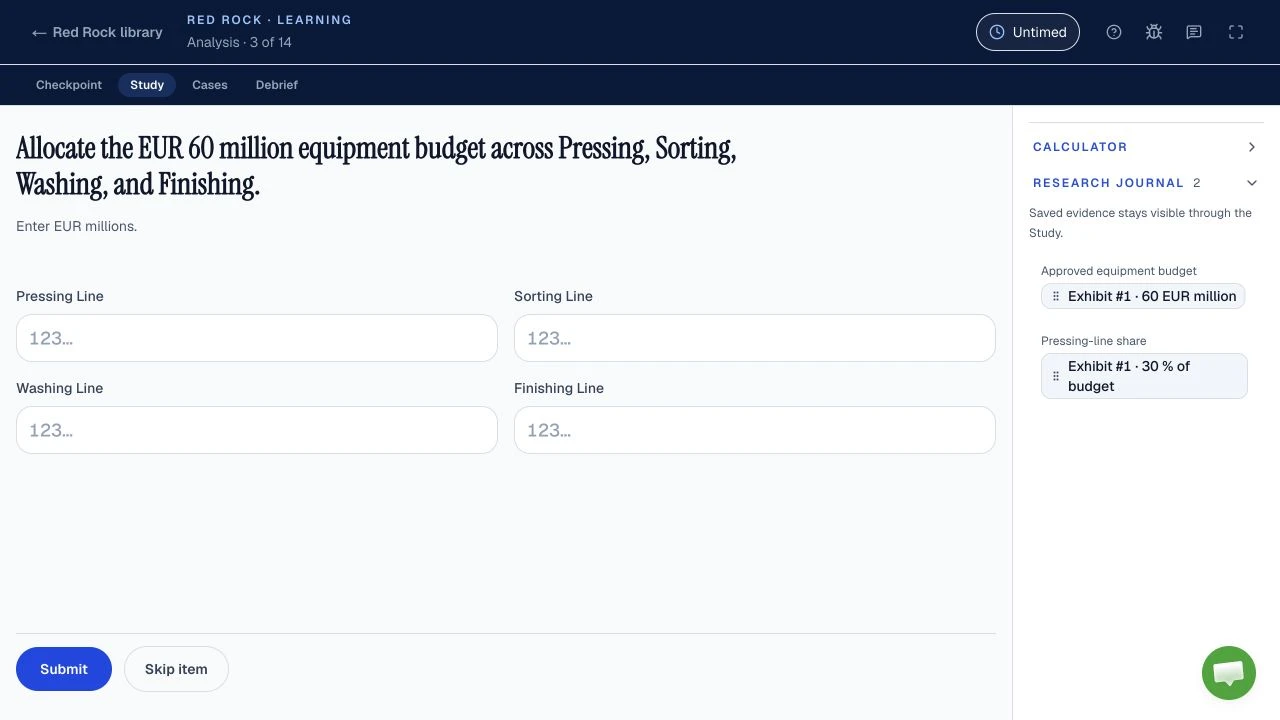
Where Red Rock points are lost
The maths in Red Rock is rarely hard. The traps are in reading: units (thousands versus millions, per hectare versus total), denominators (share of what?), and irrelevant facts placed next to relevant ones. A quick worked example shows the most common trap.
An exhibit says a region's revenue grew from 40 to 50 while its margin fell from 20% to 18%. Did profit fall? Profit went from 40 × 20% = 8 to 50 × 18% = 9, so profit rose by 12.5%. And the margin fell by 2 percentage points, which is a 10% relative decline. Answer options often include both "2%" and "10%" for the margin change, and the question wording ("by how many percentage points" or "by what percentage") decides which is right. Read the question's unit before you touch the calculator.
The habit that protects you: before each calculation, write one line stating the quantity you want, its unit and its denominator. Then check that every number you pull from the journal matches that unit. The Red Rock practice guide has original worked questions on evidence selection, percentage change, weighted averages and chart choice, with a denominator map you can reuse on test day.
Run the free Red Rock simulation
How does Sea Wolf work in McKinsey Solve?
Sea Wolf is the second McKinsey Solve game in every invitation, with a reported clock of about 30 minutes for three sites. You treat polluted ocean sites by choosing microbes. Candidates describe three sites, each with acceptable ranges for several numeric attributes and rules about traits (some desirable, some excluded). For each site you build a treatment so that the average of each attribute across your chosen microbes falls inside that site's range, while the trait rules still hold.
Prep-site reconstructions describe the game in two motions: screening candidate microbes as they appear (keep, set aside or reject), then assembling the final treatment from your pool. Choices early in a site can limit what is available later, which is why rushing the screening step is expensive.
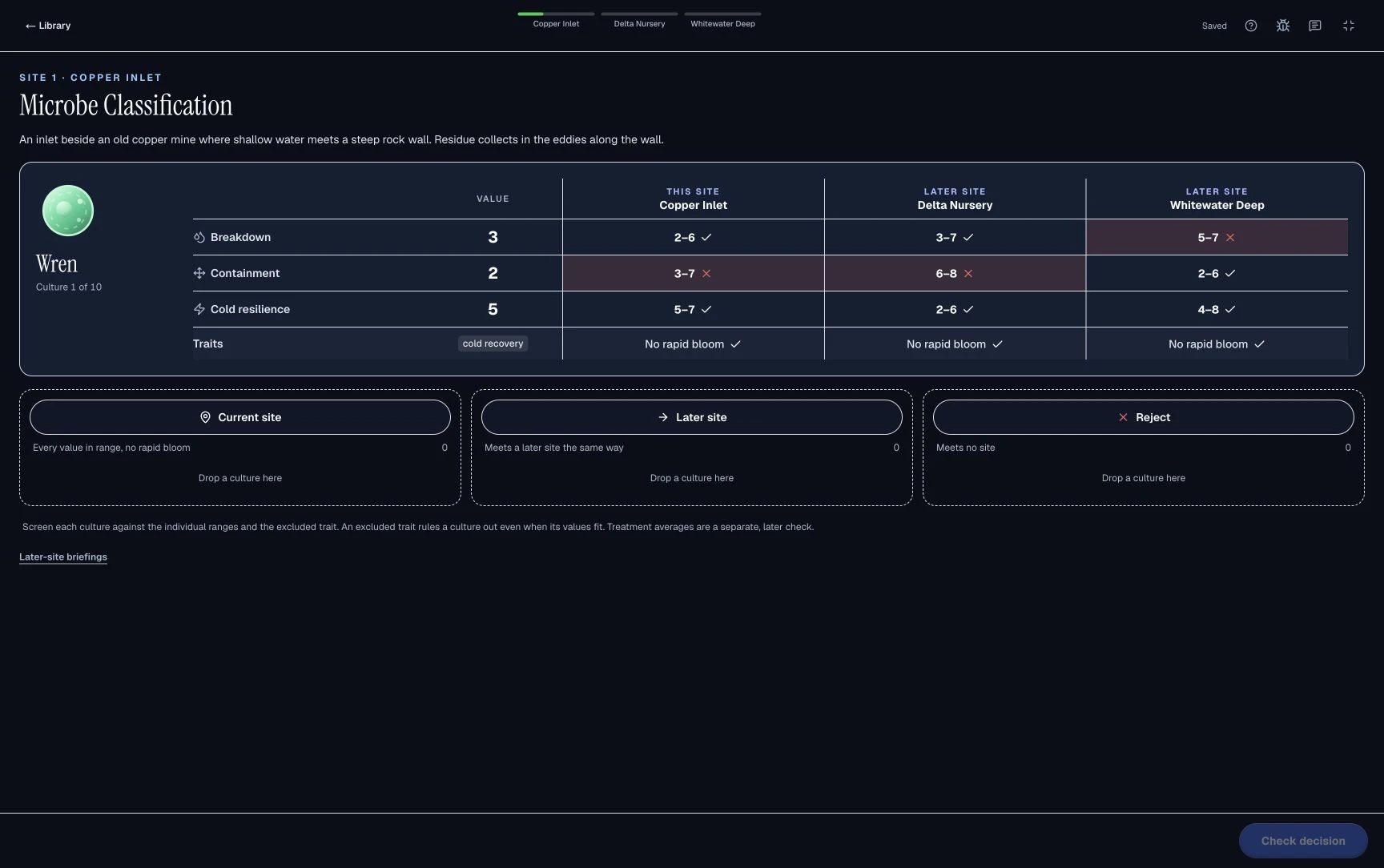
The averages shortcut
Because the rule applies to averages, a microbe that is out of range on its own can still belong in a valid treatment. Suppose a site needs an average "breakdown" between 4 and 6, and you are choosing three microbes. That is the same as needing their sum between 12 and 18. Microbes with 3, 5 and 8 sum to 16: valid, even though 3 and 8 are individually outside the range. Swap the 8 for an 11 and the sum becomes 19: invalid. Converting each range into a sum range once, at the start of the site, saves repeated division and makes swaps easy to test.
The two errors that cost the most are forgetting an excluded trait (a combination can be numerically perfect and still invalid) and fixing one attribute while silently breaking another. Check every attribute and every trait rule after each swap, not only the one you were trying to fix. The Sea Wolf practice guide walks through original puzzles with explained mistakes.
What is the Sustainable Futures Lab in McKinsey Solve?
The Sustainable Futures Lab (SFL, sometimes searched as "Sustainable Future Lab") is the third McKinsey Solve game, and it only appears in longer invitations: a standard version of about 20 minutes in 85-minute invitations, and a newer version of about 30 minutes in 95-minute invitations, first described by a candidate on September 11, 2026. The SFL has no calculator and no data exhibits. Instead, it tests judgment: setting the objective, respecting constraints, handling people and changing course when evidence changes.
| Standard SFL | New SFL (reported pilot) | |
|---|---|---|
| Invitation length | About 85 minutes | About 95 minutes |
| Game time | About 20 minutes | About 30 minutes |
| Structure | One ranking task, then about 12 linked scenario decisions | Onboarding, then three simulated days, each with Explore, Assign, Support and Reflect stages |
| Your role | Team member on one sustainability project | Leader of four researchers across four workstations |
| Evidence base | Many candidate reports through 2026 | One first-hand forum report plus prep-site reconstructions |
In the standard version, you read a short project brief, rank a set of actions, then answer a sequence of decisions that follow the same project. Each option is a full sentence describing a course of action, and later questions carry your earlier choices forward, so consistency matters: an answer that contradicts the priorities you set two questions ago is hard to defend.
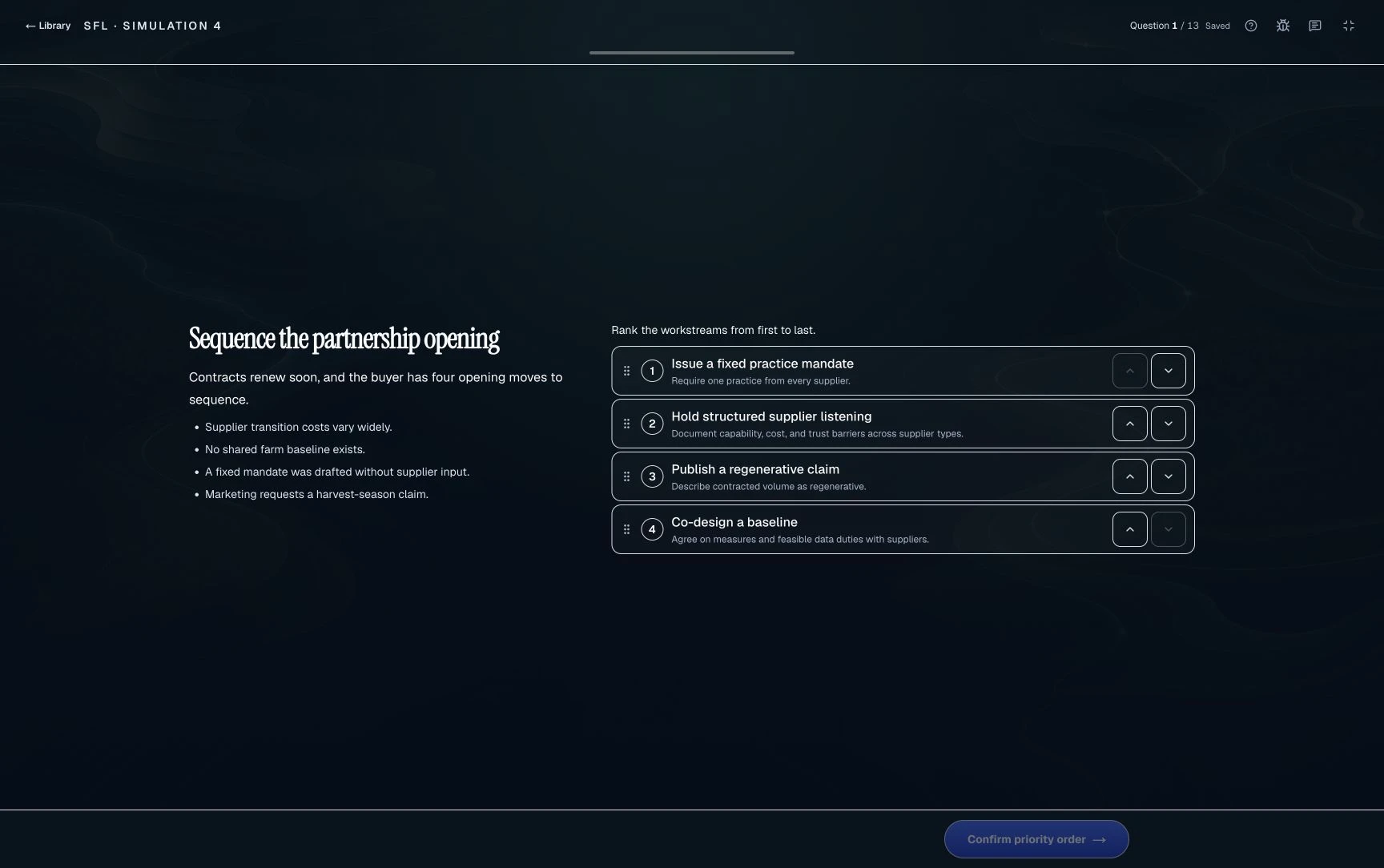
In the new version, scarcity changes the feel. Instead of seeing every fact, you spend a limited number of information requests on researchers or workstations, then assign people, answer a researcher's workplace dilemma and rate each team member. Reports describe Day 1 focused on the researchers' needs, Day 2 on the workstations and Day 3 on balancing both. McKinsey has confirmed none of these details.
A four-part frame works for both: objective (what is the team responsible for now?), constraints (time, budget, capacity, approvals), people (whose information or cooperation changes delivery?) and new evidence (which assumption just changed, and which decisions should move with it?). The Sustainable Futures Lab guide applies that frame to an original ranking exercise and a revision when a key fact changes.
Practice coverage: the independent simulation linked from this site follows the standard SFL. Practice for the 30-minute version is coming soon; until then, the standard simulation trains the shared judgment.
Practice the standard SFL free
What skills does McKinsey Solve measure?
In McKinsey's own words, Solve measures problem-solving. The Solve page calls it "a gamified assessment created to showcase your problem-solving abilities". A July 2025 McKinsey blog post says it "measures analytical thinking and problem-solving", and McKinsey's 2018 post on the original pilot says it was designed to measure "how they approach and solve problems". None of these McKinsey sources lists named sub-skills.
The five-skill list you will see on most prep sites is a different matter. JobTestPrep (December 2025) and CaseBasix (August 2026), among others, name the same five. We could not find the list on McKinsey's Solve page, its August 2025 FAQ or either blog post, so treat it as a prep-site description, not McKinsey's wording.
- Critical thinking
- Sorting relevant from irrelevant information and judging what it supports. Clearest in Red Rock's Investigation and Analysis.
- Decision making
- Committing to an option under time pressure and incomplete information. Every game ends in choices.
- Metacognition
- Checking your own approach and pace, and correcting course. Visible in how you manage one clock across many steps.
- Situational awareness
- Noticing when facts or conditions change and what that changes next. Central to the SFL.
- Systems thinking
- Seeing how parts interact, such as one microbe swap moving several Sea Wolf averages at once.
The game links are our reading of where each skill is most visible, not a published McKinsey mapping. Prep sites also say McKinsey scores the process as well as the answer; McKinsey has not published a scoring model.
For preparation, the list changes little. Every game rewards the same behaviour: read the rule or question exactly, decide deliberately, and keep checking against the clock.
How is McKinsey Solve scored?
Nobody outside McKinsey knows exactly how McKinsey Solve is scored: McKinsey publishes no pass mark, no pass rate, no score scale shown to candidates and no scoring weights, and its August 2025 FAQ says only that Solve results are considered together with the rest of your application. This is the topic with the most confident claims and the least evidence; here is how the common claims sort out.
| Claim you will see | Status | How to use it |
|---|---|---|
| Results are weighed with your whole application | Official (McKinsey Solve page and FAQ) | A strong CV and a strong Solve run both matter; neither is the whole decision |
| Both your answers and how you reach them are measured | Widely reported by prep sites; McKinsey has not published the model | Work deliberately and avoid random clicking, but do not perform for an imagined tracker |
| There is a fixed pass score | Unverified; no official number exists | Ignore any precise cutoff you read |
| A specific share of candidates fails (figures such as 70% or 80% circulate) | Unsourced estimates from prep providers | Treat as marketing, not data |
| A practice score predicts your result | False for any provider, including ours | Use practice scores to find weak habits, not to forecast an offer |
The practical takeaway is simple. You cannot optimise for a number you cannot see, so optimise for what every scoring model would reward: finishing each game, making valid choices, and keeping your reasoning consistent. If you receive a result or feedback, the scores and results guide explains what it can and cannot tell you. For a careful look at where circulating failure percentages come from, read McKinsey Solve pass rate: what is known.
How long does McKinsey Solve take from invitation to results?
McKinsey publishes no standard window from a McKinsey Solve invitation to results; your deadline is in your own invitation email. Prep sites estimate results within 7 to 14 days (CaseBasix full guide, August 23, 2026), though CaseBasix's scoring page (August 17, 2026) says 2 to 14 days; both are unverified. The process has five stages, and timings vary by office, role and recruiting season.
- Application. You apply through McKinsey's careers site. Candidates report that a recruiter screens the application before any Solve invitation, and McKinsey does not publish who is invited or why.
- Invitation. An email states your assessment length and a completion deadline. The deadline in your own email is the only one that counts. The invitation guide shows how to read each part.
- Preparation window. The time between the invitation and the deadline is your prep window. Plan it around the games your length implies, using the prep plan.
- Test day. One sitting on a PC or Mac, games back to back, each with an untimed tutorial first. See the test-day checklist.
- Results. McKinsey does not promise one universal results window. Candidates report hearing back at very different speeds, and what they receive varies: some report only a next-step decision, others a score band.
The McKinsey Solve timeline guide separates what is official from what candidates report at each stage, and explains when it is reasonable to contact your recruiter.
How should you prepare for McKinsey Solve?
Prepare for McKinsey Solve by running one timed simulation of each game in your invitation, learning the rules you broke, drilling the weakest game and finishing with a timed rehearsal. Good Solve preparation is short and specific. You are not learning content; you are removing surprises (the interface, the clock, the rules) and fixing the two or three habits that cost you points. A plan that works for most candidates:
- Baseline. Run one full, timed simulation of each game your invitation includes. Note where you ran out of time and which errors were rule errors versus calculation errors.
- Learn the rules properly. Read the deep guide for each game. Most Sea Wolf losses are rule losses (an excluded trait, one attribute broken by a swap), and most Red Rock losses are reading losses (units, denominators).
- Targeted drills. Spend most of your remaining time on the weakest game. One honest review of a run teaches more than three rushed runs.
- Pacing. Practise with the real clock. Decide in advance how long you will spend on Investigation in Red Rock and on each site in Sea Wolf.
- Rehearsal and setup. Finish with a timed rehearsal in the same conditions you will use on the day, then check your device and connection.
| Time before deadline | Focus | Guide |
|---|---|---|
| A week or more | Baseline every game, learn the rules, two drill cycles on the weakest game, one full rehearsal | 7-day plan |
| Three days | Baseline on day 1, targeted drills on day 2, rehearsal and setup on day 3 | 3-day plan |
| 48 hours | One timed run per game, read the rules you got wrong, test-day setup, sleep | 48-hour plan |
For habit-level advice, the 15 McKinsey Solve tips pair each tip with the specific mistake it prevents. If you want to know where well-prepared candidates still lose points, read Is McKinsey Solve hard?.
Is McKinsey Solve hard?
McKinsey Solve is demanding but not obscure. The individual tasks are learnable: a percentage change, an average inside a range, a priority order. What makes Solve hard is the combination of an unfamiliar interface, a single clock across many small decisions, and rules that punish one careless step. Candidates who struggle usually describe running out of time in Red Rock's Investigation phase, a Sea Wolf combination that failed on a trait they forgot, or SFL answers that drifted away from the priorities they set at the start. All three are habits, and habits respond to deliberate practice. The detailed breakdown is in where candidates lose points.
What are the McKinsey Solve test-day rules?
McKinsey Solve's test-day rules are the clearest official part of the assessment. McKinsey's page and FAQ say you take the assessment on a PC or Mac, alone, without applications, websites, AI tools or pre-prepared notes, and without recording or screenshotting it. In practice that means:
- Use a computer you trust, on a stable connection, with updates and notifications paused.
- Plan one uninterrupted block covering your full invitation length plus tutorial time.
- Read each tutorial. It is untimed, and it is the last chance to check controls before the clock starts.
- Keep outside tools away. No external solvers, prepared notes, other people or AI assistance. The in-game calculator is the tool Red Rock gives you.
- Know the support route. If graphics fail or your link does not work, contact Solve support (the FAQ gives [email protected] and a live chat) at the time it happens. The FAQ says support can offer extra time or a reset, but not if you never contacted them.
The test-day checklist covers setup, conduct rules and what to do if something breaks mid-assessment.
Is McKinsey Solve the same as the PSG or Imbellus test?
Yes. If a guide calls it the Problem Solving Game, the PSG, the Imbellus test or the McKinsey digital assessment, it is describing the same screening step now called Solve. McKinsey replaced its paper Problem Solving Test (PST) with the game-based format around 2019 to 2020, built on technology from Imbellus, an assessment company McKinsey acquired. Sources disagree on exact dates, and McKinsey has not published a version history.
The names matter because they date the advice. Early versions featured Ecosystem Building (building a food chain that survives in a chosen location) and Plant Defense (protecting a plant from invaders on a grid). Some prep sites also name Disaster, Disease and Migration Management mini-games from the early years, with thinner evidence. Candidates in 2026 no longer report any of these; their places are taken by Red Rock, Sea Wolf and the SFL. A guide that centres Ecosystem Building or Plant Defense is describing an older test. The PSG, Imbellus and Solve guide explains how to spot outdated advice, and the Ecosystem Building guide covers how that game worked and which current game trains the same skills.
How does McKinsey Solve compare with BCG and Bain assessments?
McKinsey Solve is a set of simulation games, while BCG uses the Casey chatbot case and Bain an online test, so preparation does not fully transfer between them. BCG and Bain details below are reported by candidates and vary by office.
| Firm | Assessment | Format | Reported length |
|---|---|---|---|
| McKinsey | Solve | Two or three games (Red Rock, Sea Wolf, SFL) | About 65, 85 or 95 minutes |
| BCG | Casey | Chatbot case with structured questions, about 8 to 10 | About 25 to 30 minutes |
| Bain | SOVA online assessment | Verbal, numerical, logical and situational-judgment sections | Varies by office |
Red Rock's data work overlaps most with BCG Casey's numerical questions and Bain's numerical section. Sea Wolf has no close equivalent elsewhere. The SFL's judgment questions resemble situational judgment more than case maths. The McKinsey vs BCG vs Bain assessment guide covers format, timing and how to split preparation if you applied to more than one firm.
What changed in McKinsey Solve in 2026?
Four McKinsey Solve changes are reported, none announced by McKinsey: the Sustainable Futures Lab is now the third game in 85-minute invitations (its start date is disputed, from mid-2025 to March 2026); 95-minute invitations have been reported since August 24, 2026; a new 30-minute SFL has been described since September 11, 2026; and 2026 candidates no longer describe Ecosystem Building or Plant Defense. The dated McKinsey Solve update log records each change with its source and evidence label, compares which prep site dates which change to when, and covers the reported Red Rock and Sea Wolf adjustments.
Which McKinsey Solve myths should you ignore?
Ignore six common McKinsey Solve myths: a known pass score, slack in the 95-minute invitation, needing business knowledge, speed above all, practising Ecosystem Building, and practice scores that predict a result. Much of the Solve advice online is outdated or overconfident. These six beliefs come up repeatedly in forums and prep material, and each one leads candidates to prepare for the wrong thing.
- "There is a known pass score." There is not. McKinsey publishes no cutoff, and any precise threshold you read is an estimate. Prepare to perform well, not to clear a number someone invented.
- "The extra time in a 95-minute invitation is slack." Candidate reports point the other way: the extra minutes belong to a longer, more complex SFL. Plan your energy for a third game that needs more attention, not less.
- "You need consulting or business knowledge." McKinsey states that none is needed, and the games are built around ecosystems, research labs and sustainability projects precisely so that background knowledge does not help. Reasoning habits help.
- "Speed is everything." Finishing matters, but a fast invalid Sea Wolf treatment or a fast Red Rock answer in the wrong unit earns nothing. The goal is a steady pace that leaves time to check the rule you are most likely to break.
- "Ecosystem Building is the game to practise." It was, in earlier versions. Candidates in 2026 report Red Rock, Sea Wolf and the SFL. Practising a game no longer reported uses time you do not have.
- "A good practice score means you will pass." No practice tool, ours included, can predict a McKinsey decision. A practice score is useful because it shows which habit broke, which is exactly what you should drill next.
The common thread is evidence. When a claim about Solve has no source, treat it as a hypothesis, and spend your limited preparation time on what is consistently reported: the games, their rules, the clock and the setup.
Every Solve guide on this site
Each guide below goes deeper on one question. They are grouped by when you will need them.
Start here
Before the test
The games
Preparation
After the test
History
Ready to practise? The practice hub lists the free simulations for Red Rock, Sea Wolf and the standard SFL. This guide is written and reviewed by Esteban Ronsin, founder of Road to Offer and Solve Game Prep.
Sources and evidence boundaries
Official: McKinsey's Solve assessment page and the McKinsey Solve FAQ (August 2025). We read the FAQ PDF directly on October 3, 2026; the live Solve page did not respond to our automated check that day, so its quotes come from the Internet Archive capture dated September 28, 2026. They confirm the game-based format, "no need to prepare", that length appears in the invitation, untimed tutorials, no required business or gaming knowledge, PC or Mac, the banned aids (applications, websites, AI tools, pre-prepared notes, recording, screenshots), the support route, the listed languages, and that results are considered with the rest of the application. They do not name the games, give timings, list sub-skills, or publish any score, cutoff, pass rate or reapplication period. McKinsey's blog posts of January 16, 2018 and July 9, 2025 (read from Internet Archive captures dated April 20 and June 17, 2026) supply the wording on what Solve measures.
Candidate reports: the PrepLounge timing thread (posts dated August 24, August 25 and September 11, 2026) for the 85 and 95 minute invitations and the new SFL. Game structures and timings above reflect consistent candidate reports through 2026.
Prep-site reconstructions reviewed October 3, 2026, including SolvePrep's 2026 guide and Solve Games Guide's new-SFL write-up. The five-skill list, pass-rate figures and reapplication waits come from JobTestPrep (updated December 9, 2025), CaseBasix (updated August 23, 2026) and the prep pages named in the pass rate guide, all read October 3, 2026. We use these as reports, not authority. Their scoring models and failure percentages are not verified by McKinsey and are not repeated here as fact. BCG Casey and Bain SOVA details are candidate-reported and vary by office. Practice screens shown on this page come from the independent Road to Offer simulation and are not McKinsey screenshots.