Each game rewards one habit: in Redrock, name the base and unit before you calculate; in Sea Wolf, check traits before sums; in the Sustainable Futures Lab, never rank an action above what it depends on. This sheet is for preparation. McKinsey's Solve FAQ bans pre-prepared notes during the sitting.
What is on a McKinsey Solve cheat sheet?
Three things per game: how long it reportedly runs, the order to check your work in, and the one check that prevents the most common error. The table below is the whole sheet in one view; the sections after it give each game's steps and link to its full guide.
| Game | Reported clock | Check order | The one check | Full guide |
|---|---|---|---|---|
| Redrock | About 35 minutes for the Study and six Cases | Read the question first → Save figures with labels → Write the setup in words → Sense-check the result → Watch the clock at each Case | Name the base and the unit before you calculate | McKinsey Redrock game guide |
| Sea Wolf | About 30 minutes for three sites | Read every site rule → Screen each microbe → Fill the gaps in your pool → Check the trio → Re-read the next site | Traits first, then every sum target | McKinsey Sea Wolf game guide |
| Sustainable Futures Lab | About 20 minutes in 85-minute invitations, about 30 in 95-minute ones | State the objective → List the constraints → Order by dependency → Weigh the people → Update on new evidence | Nothing ranked above what it depends on | McKinsey Sustainable Futures Lab guide |
Which games you get depends on your invitation length; the 65, 85 or 95 minute guide maps the reported lineups.
What should you check, in order, in McKinsey Redrock?
Read the question before the exhibit, save every figure with its label, write the setup in words, then sense-check the result. Most lost Redrock points come from a wrong base or unit, not from hard arithmetic.
- Read the question first. Know if it wants a percentage, a share, a rate or a choice before you open the exhibit.
- Save figures with labels. Group, period and unit beside every number in the journal.
- Write the setup in words. "Change over the start", "part over its whole", then substitute.
- Sense-check the result. A combined rate sits between the group rates; a share is under 100%.
- Watch the clock at each Case. Leave the Study with time for all six Cases.
| Calculation | Setup | Trap |
|---|---|---|
| Percentage change | (new − old) ÷ (old) | Dividing by the new value |
| Percentage points | new % − old % | Reporting it as a percent change |
| Share of a total | (part) ÷ (whole) | Dividing by the rest instead of the whole |
| Combined rate | (all parts) ÷ (all wholes) | Averaging the group rates |
| Start value from a change | (new) ÷ (1 + change) | Subtracting the percentage from the new value |
Go deeper with the McKinsey Redrock game guide, then Redrock math: 8 calculation types, Redrock practice questions and Redrock time budget.
What should you check, in order, in McKinsey Sea Wolf?
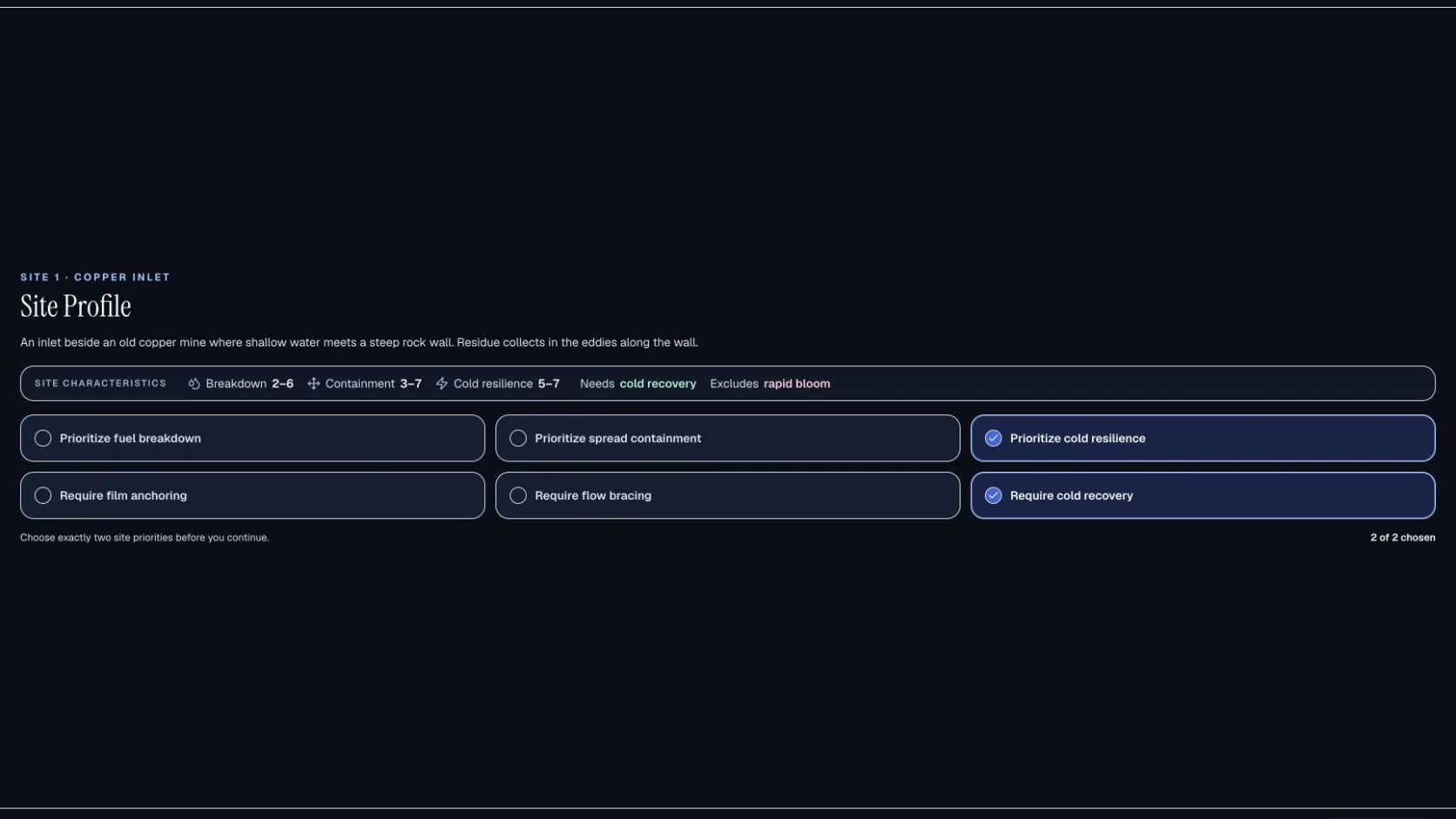
Read every site rule first, screen microbes for excluded traits, then test a trio against sum targets rather than averages. A trio can hit every number and still fail on one trait, which is why traits come first.
- Read every site rule. All ranges and all trait rules before any microbe.
- Screen each microbe. Drop excluded traits; keep near-misses that could balance a trio.
- Fill the gaps in your pool. Prefer a choice that adds a missing trait or fixes the tightest range.
- Check the trio. Required trait present, excluded trait absent, each sum inside its target.
- Re-read the next site. Its rules can change which saved microbes still fit.
Average range to sum range
An average of 4 to 6 across 3 microbes means their values must add up to 12 to 18.
This page only summarises. The Sea Wolf cheat sheet walks each step on a worked site, the Sea Wolf sum method shows the conversion in full, and the McKinsey Sea Wolf game guide covers the rules and two puzzles.
What should you check, in order, in the Sustainable Futures Lab?
State the objective, list the constraints, order actions so nothing sits above what it needs, weigh the people involved, and change only what new evidence touches. Later decisions reportedly build on your opening ranking, so consistency counts as much as any single answer.
- State the objective. What the team is responsible for now, in one line.
- List the constraints. Time, budget, capacity and approvals.
- Order by dependency. An action never sits above something it needs first.
- Weigh the people. Whose information or cooperation changes delivery.
- Update on new evidence. Move only the decisions the changed fact touches; stay consistent with the rest.
For a worked ranking, read the SFL ranking task; for both reported formats, the McKinsey Sustainable Futures Lab guide; for the newer format, the 30-minute SFL.
Can you use a cheat sheet during McKinsey Solve?
No. McKinsey's Solve FAQ bans pre-prepared notes, along with applications, websites and AI tools, unless McKinsey has approved an accommodation in writing. Blank paper and a pen are the only note tools its integrity page names, so the habits on this page have to be in your head by test day.
For the full rules, including camera and desk setup, read is McKinsey Solve proctored; for ChatGPT, Excel and calculators, can you use ChatGPT on McKinsey Solve.
How should you use this cheat sheet before the test?
Read one game's check order, then do a timed run and mark which step you skipped when you lost points. After two or three runs the order becomes automatic, which is the point: you will not have the sheet in the sitting.
The McKinsey Solve sample questions give one worked item per game to try the checks on, and the McKinsey Solve game practice page lists one free run of each format. For a day-by-day schedule, see how to prepare for McKinsey Solve.
Sources and evidence boundaries
- Official: McKinsey's Solve page and the August 2025 Solve FAQ (pre-prepared notes, applications, websites and AI tools banned), and the assessment integrity expectations (blank paper and a pen).
- Reported: the game clocks and formats summarised here, as candidates describe them and as this site's game guides document them. McKinsey publishes no per-game clock or format.
- Editorial: the check orders are this site's teaching method, not McKinsey rules or a scoring guide.