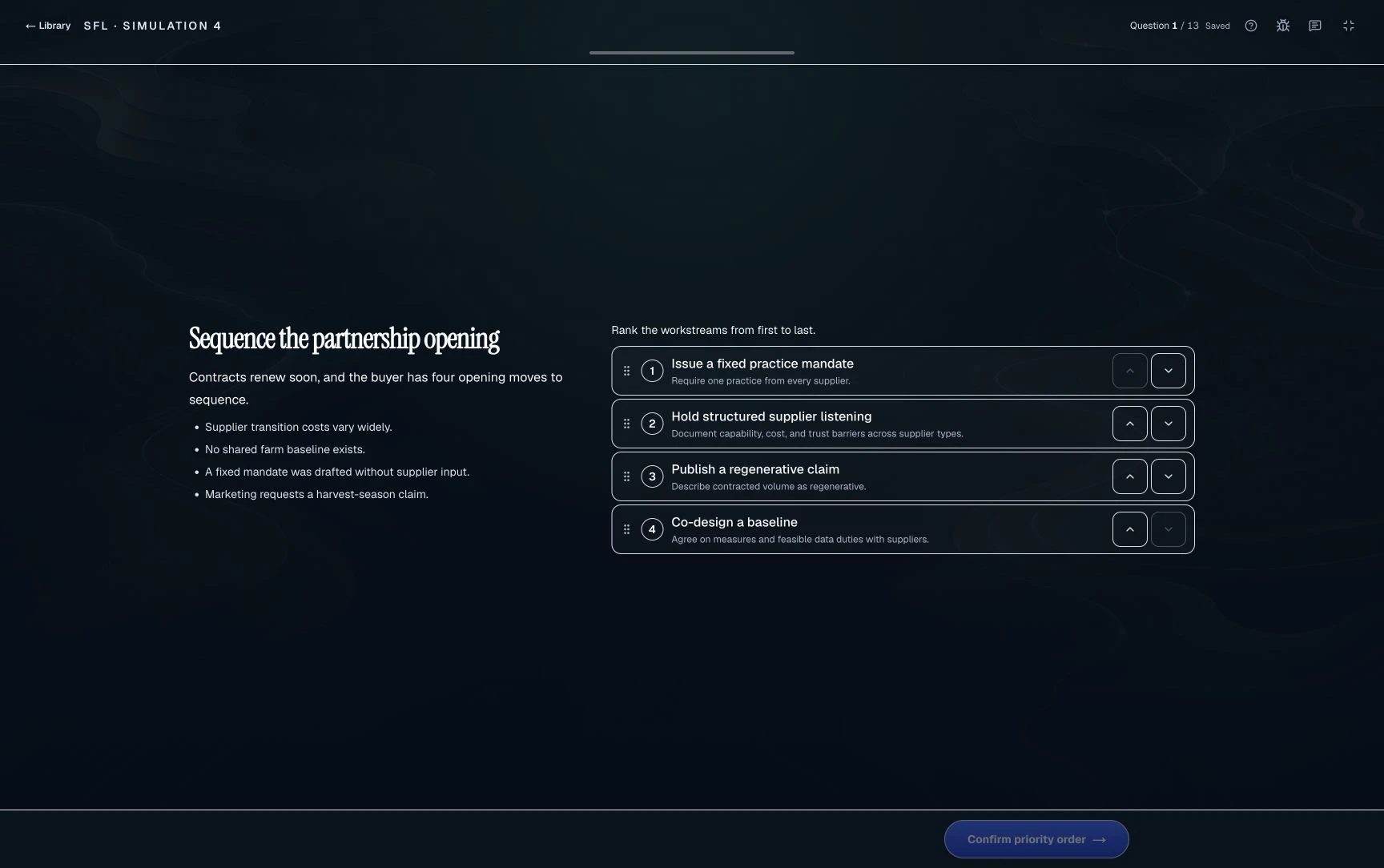
For the first Sustainable Futures Lab ranking, candidate reports describe ordering actions before a sequence of related decisions. In practice, rank against the mission, the deadline, prerequisites and the people affected; then revise only when a new fact changes a premise. McKinsey has not published the SFL task or its scoring rule.
| Point | Answer | Status |
|---|---|---|
| Assessment length | McKinsey says the length is in your invitation and each task begins with an untimed tutorial. | Official |
| Standard SFL | Candidates with an 85-minute invitation report an opening ranking and about 12 linked decisions. | Reported |
| Exact ranking interface | McKinsey has not published the actions, drag behavior or number of items. | Not published |
| Scoring | McKinsey has not published the ranking weight, answer key or consistency rule. | Not published |
How do you approach the first Sustainable Futures Lab ranking question?
For the candidate-reported opening Sustainable Futures Lab ranking, use the brief to choose an order that serves its immediate objective, fits its constraints and respects prerequisites; McKinsey has not published a required method or answer key. Start by writing a short decision rule in your head: what must happen before the deadline, what makes another action possible, and what information would change the order? This is our preparation method, not a description of hidden scoring.
Read the whole brief before ordering anything. Underline the deliverable and time boundary, then distinguish an action that directly changes the outcome from one that only sounds important in general. A permanent solution may matter to the project but be useless for today's deadline. A communication step can be urgent without being first if it would announce an unconfirmed plan. Conversely, a people-facing action can move earlier when the brief says delay itself creates harm. There is no universal rule that “inspect first” or “communicate last.” The exact brief controls.
Candidates describe a ranking followed by later choices, so preserve a reason for each position, not just the letters. If the assessment presents a different objective or fresh facts, start over from those facts. For an overview of both reported SFL versions and a separate exercise, use the SFL practice method. The invitation-length guide owns the difference between the reported 85- and 95-minute formats, and the complete Solve guide places this game beside the other two.
- Name the outcome
What must be true by the deadline? That is narrower than everything the project would like to improve.
- Check what is ready
Can the action work before the deadline, and is the room, approval or route it relies on confirmed?
- Find what it unlocks
An early check can earn its place because it makes a later protective move and a later notice reliable.
- Record the change trigger
Note the one fact that would move this action up or down. The goal stays; the order may not.
Original practice method Our preparation path, not a McKinsey scoring flowchart.
Which criteria should decide the order?
For a candidate-reported SFL ranking, a useful practice grid asks whether each action protects the stated outcome, fits the deadline, unlocks another step and gives affected people a workable plan; these are our criteria, while McKinsey's scoring criteria are unpublished. Check each action against the same questions before you place it. That prevents a vivid but low-value option from winning because its description sounds decisive.
Use the following original fictional brief. A city operates 3 after-school centres and expects a heat alert in 36 hours. Only 2 coordinators are available. The objective is to reduce children's exposure during that alert. An existing cooled hall has approval for use, but staff still need to verify its capacity and the route. No building retrofit can be approved before the alert. You are ranking proposed actions, not making a claim about McKinsey's actual questions or public-health protocol.
| Action | Needs first | Work |
|---|---|---|
| A. Verify which rooms are hottest and confirm the cooled hall capacity | Nothing | 3 hours, 1 coordinator |
| B. Open the approved cooled hall and move the exposed group | A | 6 hours, 2 coordinators |
| C. Send families the confirmed hall, route and update time | B confirmed | 2 hours, 1 coordinator |
| D. Add temporary shade to the outdoor waiting area | A | 8 hours, 2 coordinators |
| E. Commission a permanent roof retrofit | New approval | 120 hours, 2 coordinators |
Now read every action against the same four questions. The bars below are our marks on a scale from 0 to 3, where 3 means the action clearly does that job in this brief and 0 means it does not.
Original judgment marks Marks from 0 to 3, set by us for this fictional brief. They are not added up, not weighted, and not a McKinsey scoring scale.
Read the picture by row and by column. B has the longest bar under the outcome, because the brief defines exposure during the imminent alert as the objective. A has the longest bar under “unlocks”, because the hall move and the shade both wait on it. C leads on a workable plan for families. E is empty on every question that this deadline asks. The bars make a judgment visible; they do not turn it into arithmetic, and no total decides the order. If the brief instead asked for a long-term building investment, E's row would fill. If the cooled hall were already verified, A's “unlocks” bar would shrink. State the condition; do not memorise a letter order.
What order works for the original heat-alert example?
For this original fictional heat-alert brief, a defensible order is A → B → C → D → E: verify capacity, open the cooled hall, send the confirmed plan, shade the waiting area, then start the roof proposal; this is a teaching answer, not a McKinsey key. The order serves the immediate objective and puts each action after what it needs. Another order could be defensible if the brief changes the exposure risk or says a route is already confirmed.
Original fictional schedule Hours from now, one job after another. A planning illustration, not a claim about an SFL timer.
Add the first three jobs, then compare the total with the window before the alert.
Hours for A, B and C
Time left before the alert
So A, B and C take 11 elapsed hours and leave 25 hours of slack. The roof retrofit fails the same check on its own, even before its new approval:
Roof retrofit against the window
E needs 84 hours more than the whole window, which is why it comes last for this objective.
One staffing trap hides in the middle of the order. B and D each need both coordinators, so they cannot run at the same time.
Tempting schedule
Counts only the longer of B and D. Running both at once needs 4 coordinators and the brief gives 2.
Staffed schedule
One full-team job after the other. It still ends 17 hours before the alert, so D fits without displacing B or C.
The close call is C versus D. D does real work, but it protects only the outdoor queue. C helps families actually reach the confirmed cooled space. After A and B, place C first. If the brief instead says people must wait outside for a long period before the hall opens, D may move earlier. This is the point of a ranking explanation: the adjacent choices depend on a stated fact, not a secret preference for one action label.
How do prerequisites change a ranking?
In the original example, prerequisites put A ahead of B and D, and a confirmed B ahead of C; this is a reasoning constraint in the fictional brief, not a McKinsey ranking rule. If you put B first before checking capacity, you are assuming the existing hall can take the exposed group. The brief deliberately withholds that confirmation. If you put C before B is settled, the notice may name a room or route that cannot be used.
A Verify rooms and hall→B Open cooled hall→C Send confirmed plan
A Verify rooms and hall→D Shade waiting area
New approval, not available before the alert→E Retrofit roof
Read each arrow as “must be settled before”. The chains come from the “needs first” column of the fictional brief.
A prerequisite is different from a vague preference. Ask whether doing the later action first is impossible, unsafe or merely less efficient. A cannot be skipped if it supplies the missing capacity and route facts. D can be prepared after A, but its benefit is smaller than B's for indoor exposure. You might rank a quick warning ahead of B if the brief says families are already travelling toward an unsafe site; that would be new information, and your reason should say so. The method is to trace the chain of consequences instead of applying a fixed “data before people” slogan.
The original SFL method guide uses a different project to show how a prerequisite works. For a wider habit of tracking dependencies across Solve games, see the Solve tips guide; the same discipline of checking every rule before you commit is what the Sea Wolf mistakes guide drills. Here the ranking itself is the unit of practice: explain every neighboring pair, especially B versus C and C versus D.
How should the ranking guide the next two decisions?
For the candidate-reported chain of SFL decisions, carry your opening objective and prerequisites into each later choice, but treat consistency as our coaching check because McKinsey has not published an SFL scoring criterion. The fictional heat-alert story now continues. These are original follow-up prompts, not recalled assessment content.
- The reason behind the opening order
Direct protection at a place confirmed as usable, then a notice families can act on.
- The cooled hall loses power
Which option still leads to a usable protected place?
- Breaks the reasonAnnounce the original hall anywayThe notice names a room that cannot be used.
- Breaks the reasonMove the group there despite the faultCopies the old position and drops its safety condition.
- Keeps the reasonCheck the partner hall and route, then revise the noticeSame objective, new place, confirmed before anyone moves.
- Families ask for an immediate update
Which option tells people only what is confirmed?
- Breaks the reasonSay the move is confirmedCreates a destination that may not exist.
- Breaks the reasonStay silent until every detail is knownLeaves families with no time for the next answer.
- Keeps the reasonSend a short status update with the next update timeHonest about what is being checked, useful now.
Original follow-up prompts Consistency is our coaching check. McKinsey has not published how later choices are assessed.
Follow-up decision: the hall loses power
After A verifies capacity, a power fault closes the cooled hall before B can open. A partner hall may be available, but its capacity and accessible route are unconfirmed. Choose between announcing the original hall anyway, moving the group there despite the fault, or checking the partner hall and route before issuing a revised notice. The third choice preserves the actual objective: reduce exposure at a usable place. It changes the operational plan because B's premise failed; it does not abandon the priority of direct protection.
The first choice looks “consistent” with C only if you ignore why C was third. C was a confirmed notice, not any announcement. The second choice copies the original ranking letter while discarding its safety condition. If the partner hall cannot be confirmed in time, the next defensible step is to find a feasible safe option or seek the authorized decision maker, not invent certainty. What matters in this practice exercise is the condition attached to the choice.
Follow-up decision: families ask for an immediate update
While the partner hall is being checked, families ask where to go. Choose between saying the move is confirmed, staying silent until every detail is known, or sending a short status update that says what is being checked and when the next update will arrive. The third choice respects C's purpose without claiming the new route is ready. Once staff confirm the place and route, send the actionable notice. The first option creates a false destination; the second leaves people without a useful time for the next answer.
These two choices test the same reasoning twice: use accurate evidence to protect people and communicate the plan at the right level of certainty. They are not a prediction of how branching or grading works in the real assessment. For the broader question of how SFL fits into an invitation, use the invitation guide rather than inferring the next screen from this exercise.
When should new evidence change your first order?
In this fictional ranking, change the order when a new fact removes a prerequisite, makes an action infeasible or changes the exposure risk; candidate reports describe linked SFL decisions, but McKinsey does not say that keeping the same order earns points. A power failure removes B as an immediate protective action. A verified partner hall could restore a version of B. A transport problem could make route verification more urgent than shade. Each revision needs a one-sentence explanation of which original assumption broke.
- 1Verify rooms and hall
- 2Open cooled hall
- 3Send confirmed plan
- 4Shade waiting area
- 5Retrofit roof
- 1Verify rooms and hallSame place
- 2Check partner hallNew step
- 3Open partner hallWas 2
- 4Send confirmed planWas 3
- 5Shade waiting areaWas 4
- 6Retrofit roofWas 5
Original fictional revision One new check enters at second place. Nothing overtakes anything else, because the objective did not change.
The revision costs time, so check it against the window again. The partner check takes 4 hours with 1 coordinator.
Hours for the revised first four steps
Time left before the alert
The revised plan still protects people before the alert, which is what the opening order was for.
Do not treat “consistent” as “never change your mind.” That would lock you into the failed hall. Also do not treat every emotional or vivid statement as a new operating fact. If someone is upset but the hall remains safe and accessible, acknowledge the concern and keep the protective sequence. If someone provides evidence that the route excludes a group, the sequence changes because access to the protection has changed. You need not know a hidden weight to distinguish a changed fact from changed pressure.
Keeps the label
Hall without power→Move group→Send notice
“I ranked the cooled hall second, so everyone goes there.” The position survives; the reason for it does not.
Keeps the reason
Check partner hall→Move group→Send notice
“I ranked direct protection second.” The objective stays and the means are updated.
Both lines are written for this original exercise. McKinsey has not published whether or how such choices are scored.
What mistakes make a plausible ranking fail?
In this original exercise, a ranking fails its own brief when it mistakes a long-term project for an alert response, announces a plan before confirmation, or treats a dependency as optional; these are our diagnoses, not measured McKinsey failure patterns. Each of the three orders below sounds reasonable until you test it against the deadline and the dependencies.
E→A→B→C→D
Roof first. Sounds ambitious, but the retrofit cannot protect anyone during this alert.C→A→B→D→E
Notice first. Sounds caring, but it may send families to a room nobody has confirmed.A→D→B→C→E
Shade before the hall. Improves the queue while the indoor exposure stays, and holds both coordinators.
Letters refer to the five actions in the fictional brief. These are our diagnoses for this exercise, not measured failure patterns.
Before settling the order, test every action with three short questions: what does it change before the deadline, what must already be true, and whom does it leave out? If two options both pass, compare their effect on the stated outcome. If the brief gives no way to choose, acknowledge uncertainty and identify the deciding fact. It is better to have a conditional reason than to invent a universal priority formula. The Solve difficulty guide covers pressure across games, while the prep plan helps allocate practice without turning this one ranking into your whole preparation. For the arithmetic-heavy game, the seven Red Rock mistakes follow the same pattern of a plausible answer that fails one check.
A common temptation is to reverse-engineer hidden scoring from practice screens. McKinsey has published no SFL pass mark, ranking weight or trait formula. For what McKinsey does say about the skills behind the games, read what Solve measures in each game; for what can actually be said about outcomes, use the scores and results guide and the note on how the Solve result is used. Your job here is to defend an order against the facts you have, then update it when the facts change.
How can you practise the ranking without memorising a script?
For the candidate-reported standard SFL ranking, practise explaining why each action comes before the next, then change one premise and rerank; this is independent preparation, and McKinsey says no preparation is required. Try the fictional heat brief without looking at the worked schedule. Say the objective aloud, name the constraint, choose an order, and explain the weakest adjacent pair. Then suppose the hall is closed and decide which part of the plan survives. That exercise trains a reason you can transfer to a different story.
The practice page offers a complete free SFL Classic run with all 13 linked decisions: one ranking and twelve situational decisions, with no countdown. SFL Island has its own complete free run: onboarding and all three project days, with Explore, Assign, Support and Reflect each day on a 30-minute Simulation clock. These are two of our four practice formats, alongside Red Rock and Sea Wolf, each with a complete free run. Start without an account; create a free account to finish and keep your score, points breakdown and worked feedback on each submitted decision, with decision and dependency diagrams in Classic and evidence chains, placement maps and team feedback in Island. No payment is required for these first runs or their worked reviews. This independent practice cannot predict your official score. For what candidates report about that version, read the 30-minute Sustainable Futures Lab guide; for invitation differences, follow the 85 versus 95-minute guide. If your invitation has no SFL at all, which game to practise first, Red Rock or Sea Wolf, is the better next read. For practical setup and rules, read the test-day checklist and the system requirements and tech issues guide before your sitting.
Do this preparation before the assessment. McKinsey's official rules say to take Solve alone without websites, applications, AI tools or prepared notes, except an approved written accommodation. During the live test, let its untimed tutorial and actual brief govern the task. If format reports change, the dated Solve update log separates reported changes from what McKinsey confirms, and the short Solve FAQ answers the common rule questions in one place.
Sources and evidence boundaries
- Official, checked October 11, 2026: McKinsey's Solve page says Solve is a gamified recruiting assessment, preparation is not needed, and the result is considered with the rest of the application. The August 2025 Solve FAQ says your invitation states the assessment length, each task begins with an untimed tutorial, and outside aids and prepared notes are prohibited except an approved written accommodation.
- Candidate-reported: The Sustainable Futures Lab name, its appearance in some 85-minute invitations, an opening ranking and about 12 linked decisions. McKinsey does not describe this game in the official sources above. The reported 95-minute team-management version is a different question covered in our invitation-length guide.
- Not published: McKinsey's SFL tasks, exact ranking interface, answer key, scoring weights, pass mark, treatment of later consistency and whether any one order is uniquely correct. The criteria grid and its judgment marks, the heat-alert dataset, the schedule, the order and the follow-ups on this page are original fictional teaching material; the figures come from the accompanying dataset and are recomputed by its test. They do not reproduce assessment content or a scoring model.