
McKinsey says Solve measures analytical thinking and problem solving, as an additional data point in recruiting. It says the games show how people think rather than what they already know. McKinsey does not publish a list of scored subskills, a game-by-game rubric or scoring weights, so the narrower skill labels in this guide are ways to practise, not official score dimensions.
| Question | Answer | Status |
|---|---|---|
| Overall abilities | Analytical thinking and problem solving | Official, McKinsey July 2025 article |
| Role in hiring | An additional data point, considered with the rest of the application | Official, article, Solve page and FAQ |
| Named game | Sea Wolf, selecting and evaluating microbes for contaminated sites | Official, McKinsey July 2025 article |
| Other game tasks | Red Rock and Sustainable Futures Lab formats described by candidates | Reported, not an official game list |
| Subskills and weights | No public dimensions, game-specific rubric or weightings | Not published in the McKinsey materials checked |
What does McKinsey officially say Solve measures?
McKinsey officially says Solve measures analytical thinking and problem solving, but it does not publish narrower dimensions or weights. Its July 2025 account of its game-based innovation lab states both the abilities and the role of the result in one sentence, quoted below; the lab's leader says the firm wanted to measure "how people think, as opposed to what they know." McKinsey's Solve page calls it a gamified assessment that showcases problem-solving abilities.
"It measures analytical thinking and problem-solving as an additional data point in recruiting."
Those statements are broad. Analytical thinking can mean selecting relevant evidence, comparing options under constraints and checking whether a conclusion follows from the data. Problem solving can mean turning an unfamiliar goal into a sequence of decisions. These are our plain-language interpretations of the official wording, not additional McKinsey categories. You can use them to decide what to practise without imagining that each interpretation receives a separate score.
- OfficialBroad purpose
McKinsey says Solve measures analytical thinking and problem solving.
- ReportedVisible task
Candidates describe data selection in Red Rock, rule checking in Sea Wolf and linked choices in the Sustainable Futures Lab.
- Practice inferenceTrain the moment
Ask whether your evidence, calculation or choice meets the stated objective. This is useful practice, not McKinsey's scoring formula.
The source status changes at each step. A reported task can illustrate the official purpose without revealing a scored dimension.
If you want the full format before choosing a game, start with the complete Solve guide, or scan the 30 short answers in the Solve FAQ. The dated update log tracks variant reports. For hands-on work, the practice chooser shows the independent modules available now.
Road to Offer offers one complete free run each of Red Rock, Sea Wolf, SFL Classic and SFL Island. Red Rock includes the full Study and six Cases, with 13 scored responses worth 36 points on a 35-minute practice clock; Sea Wolf includes all three sites on a 30-minute Simulation clock. Start without an account; create a free account to finish and keep your score, points breakdown and worked feedback on submitted decisions, with no payment for the first run or review. Visual explanations include highlighted Red Rock calculations and charts, Sea Wolf constraint and treatment visuals, Classic decision and dependency diagrams, and Island evidence chains, placement maps and team feedback. These use our practice rubrics, not McKinsey's scoring dimensions. Paid Learning mode adds step-by-step coaching and feedback across all four formats, untimed in the clocked games, with the matching game pack, Solve pack or qualifying Annual access. The separate free Solve plan asks invitation length and test date, then gives dated practice steps selected for that invitation for up to 28 days; a free account is required to view and save it.
Why does McKinsey use a game to observe those abilities?
McKinsey says it uses Solve to observe analytical thinking and problem solving in context, while its published account does not claim that the game reveals every consulting skill. The July 2025 article says the firm previously used a quantitative multiple-choice test and that its game lab grew from the acquisition of Imbellus; the Problem Solving Test guide says what is known about that earlier test. It describes Sea Wolf as an example in which selecting and evaluating microbes exposes analytical thinking during a task.
Consider the difference between recalling a formula and using one. If a question asks for an overall rate across unequal groups, a formula remembered in isolation is not enough; you still have to identify the right numerator and denominator. The fictional Red Rock survey below illustrates that distinction. A game can put the decision inside an unfamiliar scene, yet McKinsey has not published which observations, if any, become separate scored variables.
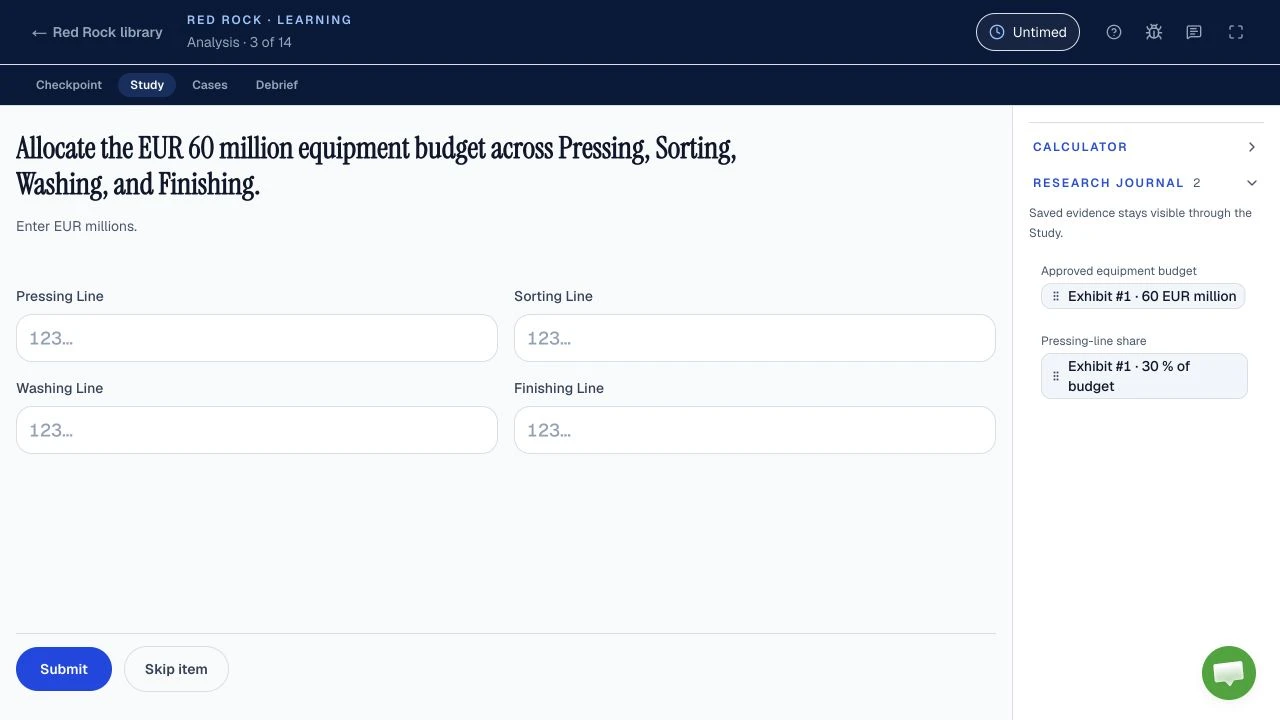
Red RockReported name
- Moment
- Pick the figures that answer the question from the exhibits, then calculate.
- Our reading
- Analytical thinking: choosing evidence and the right base.
- Check to practise
- Did I use the quantity and the denominator the question asks for?
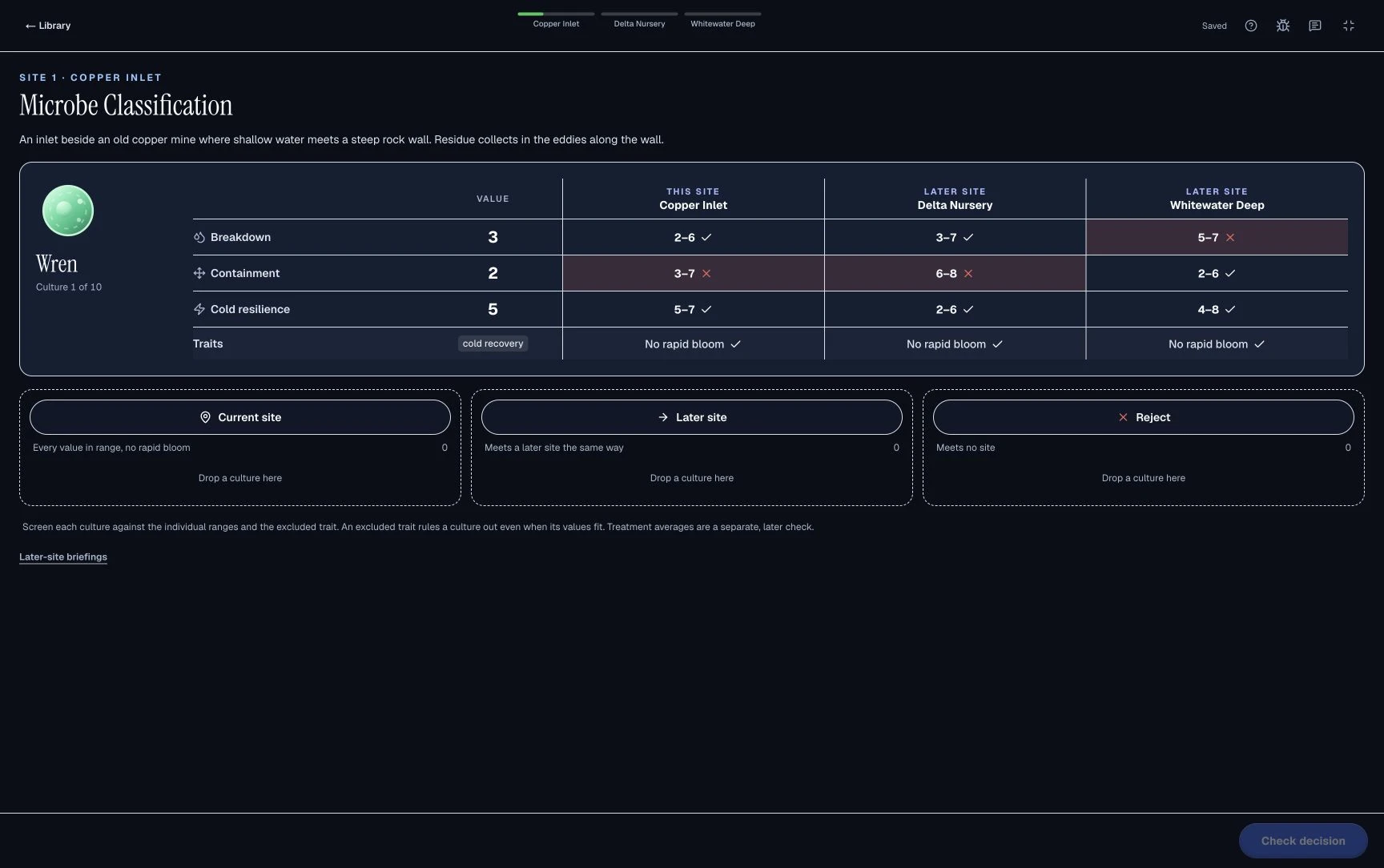
Sea WolfOfficial name
- Moment
- Screen microbes, then build a set of three that meets every range and trait rule.
- Our reading
- Analytical thinking and problem solving: testing a whole set against several conditions.
- Check to practise
- Do both averages and every trait condition hold after this swap?
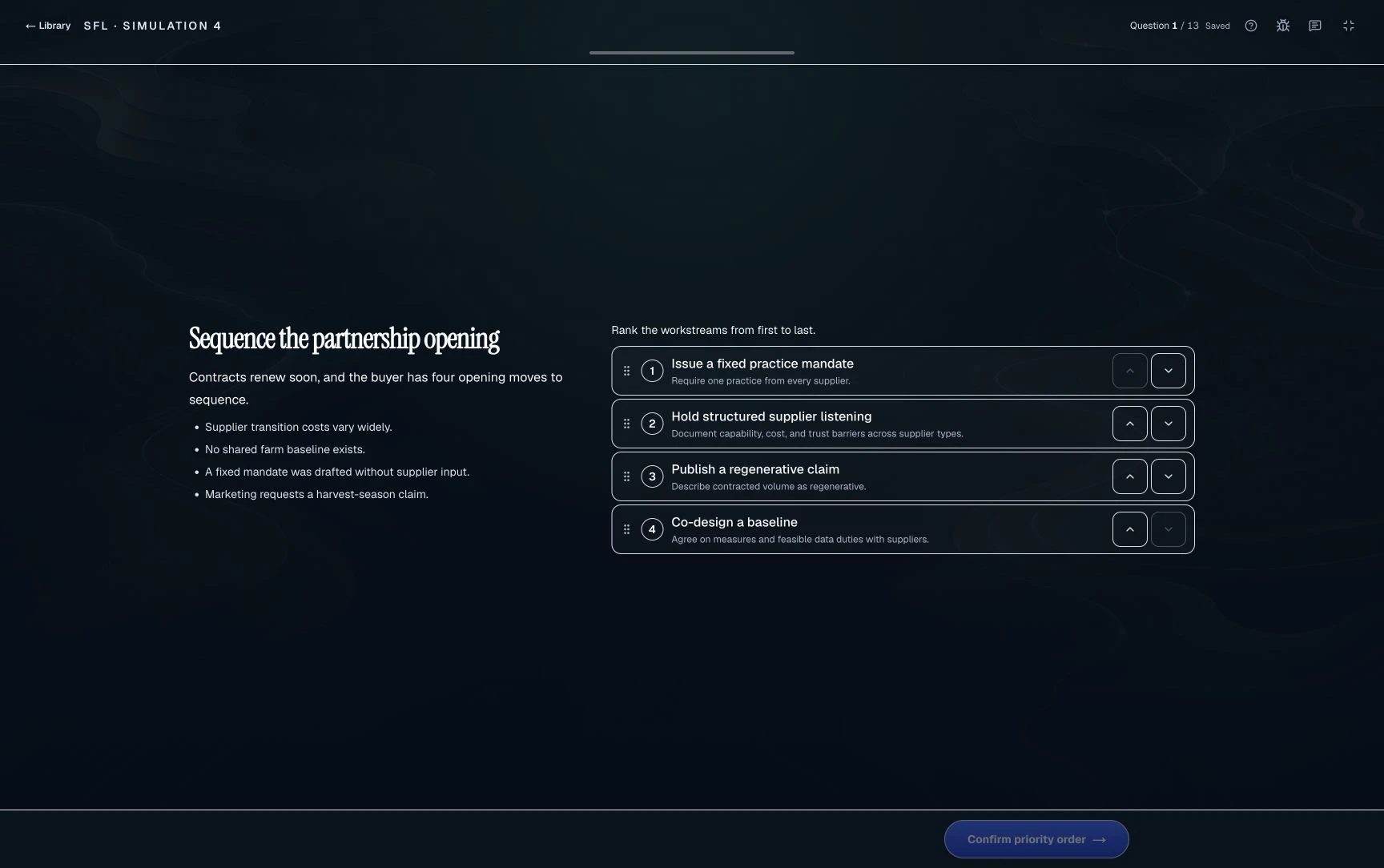
Sustainable Futures LabReported name
- Moment
- Rank options, then make linked choices as constraints change.
- Our reading
- Problem solving: turning a goal into a sequence of decisions.
- Check to practise
- Does this choice still serve the stated objective under the current constraints?
Screens are from independent practice on Road to Offer, not McKinsey's interface. The moments are candidate-reported and the readings are our interpretation of the official wording. None of the rows is a published score dimension.
McKinsey's August 2025 FAQ says no previous business knowledge or gaming experience is required and that every task begins with an untimed tutorial. Consulting facts and fast gaming controls therefore are not prerequisites in McKinsey's guidance. For the earlier test and names, see the guide to PSG, Imbellus and Solve as one test with many names. If you are unsure which of the two timed number games to open first, Red Rock versus Sea Wolf compares them.
What analytical thinking is visible in a reported Red Rock task?
Candidate-reported Red Rock tasks make evidence selection, denominator choice and numerical checking visible, but McKinsey does not publish Red Rock as a scored dimension or name it in the sources checked. Candidates describe a Study with investigation, analysis and a report, followed by short cases. The useful skill-to-moment map is: find the evidence that answers the question, keep its units, then test the conclusion before moving on.
Original fictional example, not an assessment question: a city survey asks what share of all inspected drains need repair. Harbor has 12 flagged out of 40 inspected, while Upland has 9 flagged out of 60. Start with each district's own rate.
Flagged rate by district
A tempting move is to average those two rates. The question asks about all drains, though, and the districts are different sizes, so the rates do not carry equal weight.
- Harbor40 drains · 40%
- Upland60 drains · 60%
- All inspected drains100 drains · 100%
Fictional survey. Upland supplies more of the whole, so its lower rate pulls the overall rate down.
Combine the counts first, then divide once.
Overall flagged rate
Overall rate, 21%
All numbers are invented for this guide and computed from its dataset. The overall rate sits nearer the larger district's rate.
Equal-district trap
Averages the two rates, which gives Harbor's smaller sample the same weight as Upland's larger one.
Pool first
All flagged drains over all inspected drains: the whole the question names.
The pair teaches a denominator check, not McKinsey's marking.
The exception is a question that asks for the average district rate, where each district gets equal weight by definition. Read the requested quantity before doing arithmetic. Eight worked Red Rock calculation types take this pooled-rate setup further, and the Red Rock Study guide teaches the full reported flow. For the slips themselves, see the seven Red Rock errors and their fixes; where candidates lose points covers the wider traps without making them scoring claims.
What problem solving is visible in Sea Wolf?
McKinsey officially names Sea Wolf as a microbe-selection game that shows analytical thinking in context, but its published description does not give a scoring rubric. Candidates further report choosing microbes for contaminated sites under numeric ranges and trait rules. The visible practice moment is checking the whole proposed treatment against every condition, rather than selecting a promising microbe by one attractive property.
Original fictional example, not an assessment question: a site needs a trio whose average mobility is 5 to 6 and average resilience is 6 to 7. It also needs a Filter trait and forbids Toxic. Candidate A has mobility 4 and resilience 8, B has 6 and 6, and C has 7 and 6. Take A, B, C together and average each attribute.
Average mobility of A, B, C
Average resilience of A, B, C
- Site range for the average5 to 6
- A alone4Outside
- A, B, C average5.67Inside
- Site range for the average6 to 7
- A alone8Outside
- A, B, C average6.67Inside
Fictional values from this guide's dataset. The range applies to the average of the three, so A's own values do not disqualify the set.
The result is valid under these fictional rules even though A's individual values are outside the allowed average ranges. A supplies Filter, and none has Toxic. Now swap A for D, whose numbers look safer, and run the averages again.
After the swap: D, B, C
| Rule | A, B, C | D, B, C |
|---|---|---|
| Average mobility 5 to 6 | 5.67, inside the range | 6, inside the range |
| Average resilience 6 to 7 | 6.67, inside the range | 6.33, inside the range |
| Has Filter | Yes | No |
| Free of Toxic | Yes | No |
| Valid treatment | Yes | No |
The swap removes the required Filter and adds the forbidden Toxic, regardless of the numeric averages. The method is to separate rules that apply to each member from rules that apply to the combination, then check both after any swap. This does not imply that McKinsey awards points for that particular sequence of checks.
McKinsey's own article confirms Sea Wolf's name and broad purpose. The range and trait mechanics above are candidate-reported, so check the untimed tutorial you actually receive. A quicker way to run the numeric check is to compare sums: an average of 5 to 6 across three members is a total of 15 to 18, and A, B, C total 17. The sum shortcut and elimination order are worked in full in the Sea Wolf math guide, the Sea Wolf rules and strategy guide explores the full reported rule set, and the errors that break a treatment lists what goes wrong after a swap. If you have seen the task called by another name, see Ocean Treatment and Ocean Cleanup versus Sea Wolf.
What decision making is visible in the Sustainable Futures Lab?
Candidate reports describe the Sustainable Futures Lab as a series of linked decisions under constraints, while McKinsey does not name this game or publish what it scores. In the reported standard version, an initial priority choice is followed by further project decisions. A newer version described by candidates uses a different work and team scenario. The useful common practice is to state the objective, test the current constraints and update a choice when one of those constraints changes.
Original fictional example, not an assessment question: a community building has up to $70,000 for an energy project. Insulation costs $58,000, saves 18 MWh in a year and takes 4 weeks. Control tuning costs $44,000, saves 12 MWh and takes 1 week. The goal is the most energy saved per $1,000 spent, so compute that for each option.
Yearly energy saved per $1,000
Fictional decision path with values computed from this guide's dataset. Checks 1 and 2 favour insulation; check 3 only applies once a deadline exists.
Both options fit the budget, and insulation leads on savings per $1,000, so it is the defensible choice while there is no deadline. Now add a firm 2-week completion deadline. Insulation no longer qualifies, while control tuning still does. A consistent decision changes because the constraint changed, not because the earlier ranking was meaningless. If the deadline is flexible, the earlier savings comparison remains useful. This is a decision method for an invented project, not a prediction of how McKinsey evaluates any Sustainable Futures Lab answer.
The Sustainable Futures Lab guide separates its reported variants, and the worked ranking-task example walks through the reported opening task. If your invitation shows a longer sitting, the guide to 65, 85 and 95 minute invitations explains what candidates report, with the uncertainty attached, and the 30-minute Sustainable Futures Lab guide covers the team-management version in particular. Do not infer a game from a generic skill list: your invitation and tutorial have better information about your task.
Are five cognitive skills an official Solve scoring rubric?
No official five-skill Solve rubric appears in the McKinsey sources checked October 11, 2026; lists with labels such as critical thinking, decision making, metacognition, situational awareness and systems thinking circulate on prep sites, unverified. These labels may be useful descriptions of how a person approaches a task, but the official statement remains analytical thinking and problem solving. McKinsey does not say those five are measured separately, given equal weight or translated into a candidate score.
Official Stated by McKinsey
- Analytical thinking
- Problem solving
Source: McKinsey's July 2025 article. No weights given.
Unverified Circulates on prep sites
- Critical thinking
- Decision making
- Metacognition
- Situational awareness
- Systems thinking
Not in any McKinsey source checked October 11, 2026.
The right-hand labels may describe real habits. Nothing public says they are measured separately, weighted or converted into a score.
Here is a safer way to use a label: replace it with a checkable question. Instead of trying to raise a supposed "systems thinking score" in Sea Wolf, ask whether your selected microbes meet all site constraints together. Instead of guessing whether an SFL click signals metacognition, ask whether new information changes the option that best meets your objective. A specific check gives you something to improve; a claimed hidden dimension does not.
The exception is any wording in your own McKinsey invitation or tutorial, which you should follow if it differs from candidate reports. McKinsey says scenarios vary, so no two candidates have the same parameters and data combinations. Its FAQ also says a candidate may be asked at random to complete an extra task in person or explain the logic used. Neither statement discloses the internal dimensions or weights. For score claims, see what your Solve result can tell you instead of treating a skill list as a marking key.
How does McKinsey use the Solve result in a recruiting decision?
McKinsey officially treats Solve as an additional recruiting data point alongside the rest of your application and any other assessments; it does not publish the weight of that data point. The Solve page and August 2025 FAQ agree that the result is considered in conjunction with other information. The FAQ explicitly says a recruiter makes the decision using multiple factors.
That boundary matters after an uneven sitting. One awkward Sea Wolf choice does not let you calculate your outcome, because the public sources provide no per-game scoring rule, cutoff or conversion from a game action to a recruiting decision. Likewise, a strong practice result is evidence about an independent exercise, not a forecast of McKinsey's result. Does Solve matter? looks at how the result is used in more depth, the scores and results guide owns score interpretation, and the invitation-to-results timeline owns when candidates may hear back.
If you are preparing rather than waiting for a result, make one practice run diagnostic: note whether you missed evidence, a condition or a changed constraint, then drill that error. McKinsey's official FAQ says no preparation is needed, and the untimed tutorial explains each task; independent practice is an optional way to rehearse the reasoning moments described here. The 7-day, 3-day and 48-hour prep plans and the test-day checklist cover scheduling and setup. The practice chooser is the next step if you already know which game to try.
Sources and evidence boundaries
- Official, checked October 11, 2026: McKinsey's July 2025 game-lab article supplies the analytical thinking and problem-solving wording, the "how people think" purpose, Sea Wolf's name and the additional-data-point description. The Solve page describes a gamified problem-solving assessment and says its result is considered with the rest of the application. The August 2025 FAQ confirms no required business or gaming knowledge, untimed tutorials, scenario variation, the possibility of an additional task or logic explanation, and multi-factor recruiting decisions.
- Reported, not official: Red Rock and Sustainable Futures Lab names and tasks, and detailed Sea Wolf range and trait rules, come from candidate descriptions summarized in the source ledger. Your own invitation and tutorials govern your sitting. This page gives no claim about a fixed lineup or game-specific scoring.
- Unknown: McKinsey does not publish a five-skill rubric, named subdimensions, weights, per-game scoring, a pass mark or a practice-to-hiring conversion in the materials checked. Every numerical example above is original and fictional, computed from this guide's dataset. It is a teaching device, not assessment content or observed candidate performance.