Official: McKinsey says Solve is a game-based assessment of problem solving, your invitation states its length, and your result is considered with the rest of your application. Not published: McKinsey gives no universal date for results, passing score, retake period or complete game list. Start with your invitation and recruiting messages, then use the answers below for the specific question you have.
| Question | Short answer | Status |
|---|---|---|
| What is Solve? | A game-based assessment used in consultant recruiting. | Official |
| How long is it? | Your invitation states the length; McKinsey publishes no universal minute count. | Official / not published |
| When are results sent? | No universal response time is stated publicly. | Not published |
| What is the pass mark? | No cutoff or score scale is stated publicly. | Not published |
| Which device works? | A PC or Mac; the link runs a technical check. | Official |
When will McKinsey Solve results arrive, and how can you tell what they mean?
McKinsey does not publish a universal Solve result date or score disclosure policy, so your recruiting correspondence is the only reliable schedule for your application. Candidate waits differ, and a quiet inbox alone gives no verdict. The invitation-to-results timeline and score and results guide handle the longer version of these questions.
How long after Solve will McKinsey reply?
Not published McKinsey gives no universal number of days after Solve. If your recruiter gave you a date, use that; otherwise, ask for the next expected update rather than treating someone else's wait as a forecast. The invitation, deadline and results timeline sets out each stage.
Why have I heard nothing since submitting Solve?
Not published No public McKinsey rule makes silence a pass or rejection. Confirm that your submission was acknowledged, check the portal and the inbox used for your application, then follow up with your recruiter if a stated update date passes. The results guide covers how to write that follow-up.
Do Solve results come out in batches?
Not published McKinsey does not describe a batching schedule for Solve results. Candidate reports of different waits do not establish a batch system; the only actionable clock is the one in your own recruiting messages. Read the timeline guide before inferring an outcome from the calendar.
Can I ask for my Solve score or feedback?
Not published The reviewed McKinsey sources do not promise a numerical score, decile or feedback on request. You may ask your recruiter whether anything can be shared for your application; the answer may depend on the recruiting process you are in. The scores guide explains what to do if you receive a number.
What is a good McKinsey Solve score?
Not published McKinsey publishes no good-score threshold, score scale or passing mark. A number from independent practice measures that exercise only, and a cutoff circulating online is unverified. Use the score guide to interpret what is actually disclosed, and the pass-rate guide for what is and is not known about how many candidates advance.
Does an interview invitation mean I passed Solve?
Official An interview invitation tells you that your application advanced, but McKinsey says Solve is considered with the rest of your application, so it does not establish a standalone Solve pass mark. If a decision message is unclear, ask the recruiter what stage comes next. The guide on how the Solve result is used separates application outcome from score claims.
- InvitationOfficialRead the assessment length
McKinsey says it appears in your invitation. Your own email is also where to look for a deadline and recruiter contact; no universal deadline is published.
- Before startingOfficialRun the technical check
The link checks whether your PC or Mac meets the requirements. Each task then opens with an untimed tutorial.
- During the sittingOfficialReport a fault when it happens
McKinsey says game support can diagnose the link and may add time or reset it, and that no reset exception is made if you do not contact them.
- After submissionNot publishedWait for recruiting communication
McKinsey states no universal result interval or score disclosure schedule. Keep the confirmation and follow any date your recruiter gives you.
- If a stated date passesYour actionAsk the recruiter for an update
Quote your application reference and the date you completed Solve. Do not infer a result from silence.
Only the first three steps have an official rule behind them. This is a decision timeline, not a published McKinsey response timetable.
Choose a game to practise while you prepare
What is McKinsey Solve, and what does it measure?
Official: McKinsey describes Solve as a game-based consultant recruiting assessment that showcases problem solving and measures analytical thinking and problem solving, without publishing a detailed scoring formula. It is one data point alongside the rest of your application, as the complete Solve guide explains.
What is the McKinsey Solve game?
Official Solve is McKinsey's gamified assessment in consultant recruiting, built to show how you solve problems. It is an assessment step, not an interview or a publicly playable official practice game. See the Solve overview, or the comparison with the BCG and Bain assessments if you are applying to several firms.
Which skills does Solve test?
Official McKinsey names analytical thinking and problem solving in its July 2025 account of Solve. It does not publish a five-skill rubric or the weighting of individual behaviors, so use those broad skills rather than a supposed hidden checklist. The guide to what Solve measures in each game explains that boundary.
Is Solve scored on both answers and clicks?
Not published McKinsey has not published a product-versus-process scoring formula or a rule for individual clicks. Candidate and prep-site descriptions of process scoring are reported reconstructions, not a reason to optimize mouse movements. Follow the task objective and check your answer; the score guide examines the claim.
Do I need consulting or gaming experience?
Official McKinsey says Solve requires no previous business knowledge or gaming experience. Each task begins with an untimed tutorial, which gives you a chance to learn that task's controls before its timed work. The prep plan shows how to rehearse the underlying reasoning, and is McKinsey Solve hard? shows where the time pressure tends to bite.
Is Solve the same as the PSG or Imbellus test?
Official McKinsey says its game lab joined after it acquired Imbellus and that Solve replaced an earlier multiple-choice test; it does not provide a current naming dictionary. Reported Candidates use PSG and Imbellus for this assessment history, so check the date of any advice you read. The names and history guide handles the distinction, and the Ecosystem Building guide covers the older game that advice from that period describes. The Problem Solving Test guide covers the multiple-choice test itself.
Which Solve games and timings should you expect?
Reported: candidates describe Red Rock and Sea Wolf in shorter invitations, with a Sustainable Futures Lab version in longer ones (the 30-minute Sustainable Futures Lab guide collects what is reported about the newer one), but McKinsey does not publish a complete game list or per-game timings. Official: your invitation states your assessment length; the length guide maps the reported versions without turning that map into a promise.
Which games are in McKinsey Solve in 2026?
Reported Candidates describe Red Rock, Sea Wolf and, in longer sittings, Sustainable Futures Lab; McKinsey's July 2025 blog explicitly names only Sea Wolf. Your invitation and each live tutorial outrank the reported lineup. The dated 2026 update log tracks changes to it, and the Ocean Treatment and Ocean Cleanup guide explains the older names candidates still use around the microbe task.
Is Solve 65, 85 or 95 minutes long?
Reported Candidates describe invitations of about 65, 85 and 95 minutes, while McKinsey says only that your length is in your invitation email. The reported mapping is useful for planning but cannot identify your modules with certainty. Read the 65, 85 and 95 minute guide.
- Red Rock
- Sea Wolf
- SFL
- New SFL
Candidate-reported minutes per game for invitations of about 65, 85 and 95 minutes. McKinsey publishes none of these figures and says only that your length is in your invitation. The longest length was first reported in late August 2026. Untimed tutorials sit outside the bars, and the bars show composition, not playing order.
Do tutorials use the timed game minutes?
Official McKinsey calls the tutorial at the start of each task untimed, but does not state how every invitation displays total sitting time. Reserve more time than the number in the email for setup and reading, then follow the on-screen clock. The test-day guide maps the sitting.
What happens in Red Rock?
Reported Candidates describe a data Study followed by short Cases on a shared clock, with an in-game calculator and research journal; McKinsey has not published those mechanics. Use the tutorial to check navigation and answer confirmation in your version. The Red Rock guide owns the format; eight worked calculation types, a 35-minute time budget and the seven common Red Rock errors each have their own page.
What are Sea Wolf and Sustainable Futures Lab?
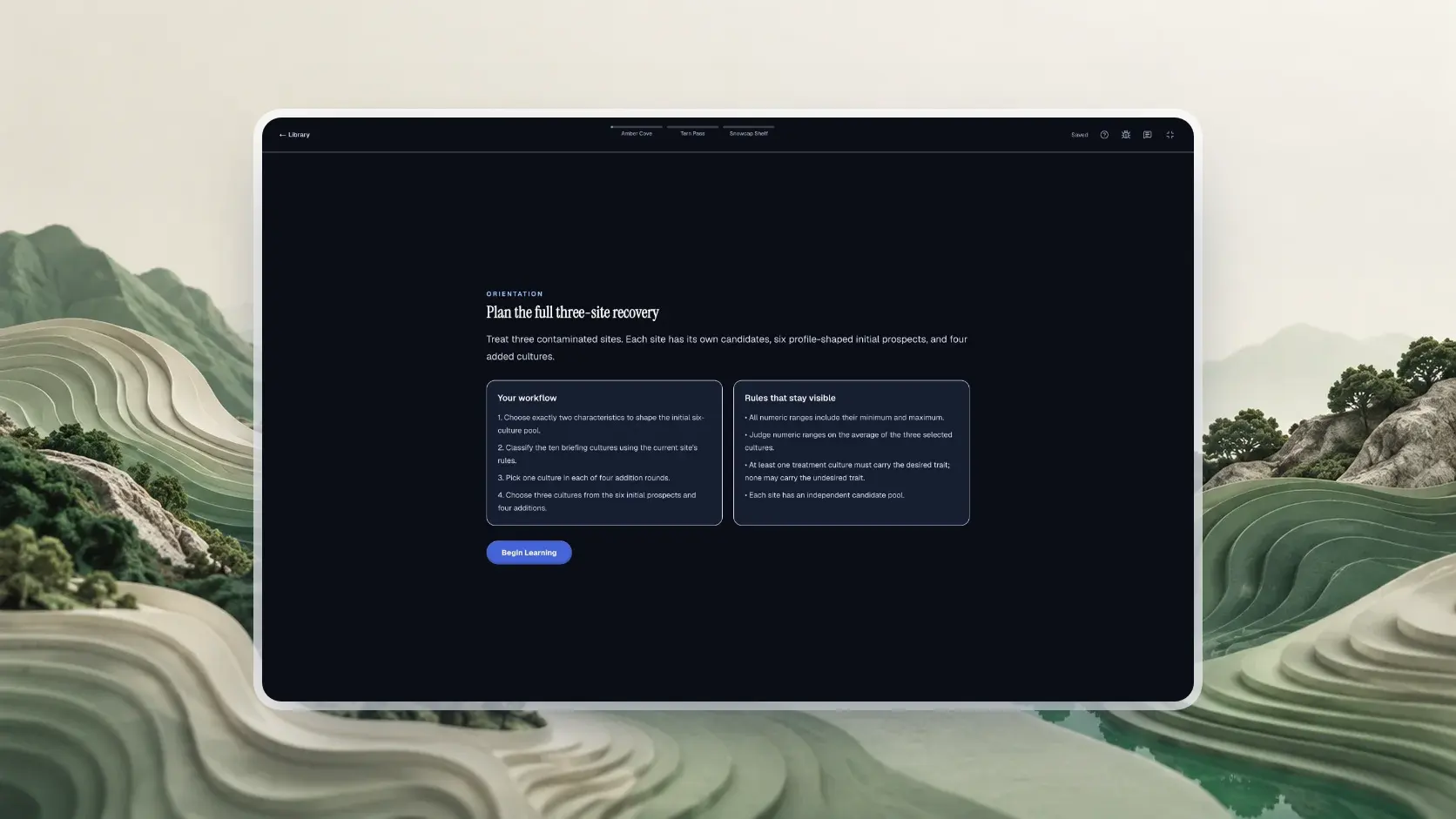
Official McKinsey names Sea Wolf and says it involves selecting and evaluating microbes for contaminated sites. Reported Candidates describe Sustainable Futures Lab as a separate decision task in some longer invitations; McKinsey does not name it in the reviewed sources. Read the Sea Wolf guide and SFL guide for their respective tasks. For Sea Wolf, the step-by-step cheat sheet, the sum shortcut and elimination order and the errors that break a treatment go deeper; for SFL, start with the worked ranking example.
What should you do after a Solve invitation?
Official: McKinsey says your invitation states the assessment length and the link runs a technical check; it publishes no universal invitation schedule or deadline. Read your own email for the calendar cutoff and contact route, then use the invitation guide to plan your sitting.
Do all McKinsey applicants receive Solve?
Not published McKinsey does not state a universal invitation rule by role, office or applicant in the reviewed sources. A missing link cannot by itself tell you whether you passed a CV screen; check your program's messages and ask your recruiter if a promised date passes. The guide does everyone get the Solve invitation? covers that situation; experienced hires and MBA candidates have their own pages, and McKinsey online assessments by role sets out what is known beyond consultant recruiting.
How long after applying does the Solve invitation arrive?
Not published There is no McKinsey-wide number of days from application to Solve invitation. Use the date in your program's correspondence; if none was given, a short status question to the recruiter is more useful than comparing offices online. See the timeline guide.
How many days do I have to complete Solve?
Not published McKinsey gives no universal link deadline in its public Solve FAQ. The FAQ's statement that the assessment length is in the invitation concerns sitting duration, not days until the link closes; copy the actual deadline and timezone from your email. The invitation guide explains the difference.
Can I postpone or extend my Solve deadline?
Not published McKinsey publishes no general rescheduling or deadline-extension entitlement for Solve. If an exam, travel or health issue conflicts with your window, ask your recruiter before the cutoff rather than assuming the link can be reopened. Use the deadline, extensions and late starts guide for the details to include.
Should I prepare if McKinsey says preparation is unnecessary?
Official McKinsey says no preparation, business knowledge or gaming experience is required. Independent practice can still help you learn a timed task format, but its questions and scores are not McKinsey's. Choose the relevant game in the prep plan or on the practice page; Red Rock vs Sea Wolf helps you decide which to practise first, and the 15 habits list collects the routines worth keeping.
What equipment, rules and support apply during Solve?
Official: McKinsey requires a PC or Mac, runs a technical check, forbids outside assistance and directs Solve technical problems to its game support team; its public FAQ gives no hardware specification list. Use the test-day checklist for setup and save the support route before starting.
Can I take Solve on a phone or tablet?
Official No: McKinsey's FAQ says Solve is available only on a PC or Mac, not an iPad or phone. The link runs a technical check that tells you whether your particular device meets the minimum requirements; McKinsey does not publish a complete spec list. See the system requirements and tech issues guide.
Do I need a mouse or sound?
Official McKinsey says sound is unnecessary and a mouse is optional. It does not turn that into a promise about every device configuration, so use the link's technical check and the tutorial controls on your actual computer. The test-day guide covers the check.
Can I use a calculator, notes or AI?
Official McKinsey's integrity rules forbid outside calculators, applications, websites, AI tools and prepared notes; they allow pen and paper for notes and calculations unless your approved accommodation says otherwise. Reported Candidates describe an in-game Red Rock calculator, which is distinct from an outside tool. Read the rules checklist and the Red Rock calculator and journal guide.
Allowed
- Pen and paper for notes and calculationsOfficial
- Whatever an accommodation approved in writing permitsOfficial
- Tools inside the game, such as the Red Rock calculator and journal candidates describeReported
Not allowed
- Your own calculatorOfficial
- Applications, websites and AI toolsOfficial
- Notes prepared in advanceOfficial
- Recording the session or taking screenshotsOfficial
- Help from another personOfficial
The calculator and pen-and-paper lines come from McKinsey's integrity expectations, which cover every assessment and interview, not Solve alone. Your invitation governs your sitting.
What if Solve crashes or the technical check fails?
Official Contact [email protected] or the live chat when the fault happens; McKinsey says support can diagnose your link and may add time or reset it depending on the issue. It also says no reset exception is available if you encounter a technical issue and do not contact support. The tech issues guide gives the immediate steps.
Who handles deadlines, accommodations or recruiting questions?
Official Your recruiter handles non-technical questions and accommodation requests, while Solve game support handles technical faults. McKinsey publishes no blanket deadline extension, so describe your situation and ask before the cutoff. See the deadline and extensions guide for what to include.
Is the link, the technical check or the game itself failing?
Yes, it is technical
Solve game support Official
[email protected] or the live chat, at the moment the fault happens
- The technical check says your device does not qualify
- The game will not load, freezes or crashes
- Your connection drops in the middle of a task
Support can run diagnostics on your link and may add time or reset it, depending on the issue.
No, it is about your application
Your recruiter Official
The contact named in your own recruiting correspondence, before your cutoff
- The invitation, deadline or timezone is unclear
- You need an accommodation, with any exception confirmed in writing
- You received two links, or want to know about another attempt
- A date you were given for a result has passed
McKinsey publishes no universal extension, retake or result timetable, so the answer comes from your recruiter.
A technical support contact cannot decide your application outcome. A recruiter is the route for recruiting and accommodation questions.
Can you retake Solve, and what happens next?
McKinsey does not publish a Solve retake period or a universal rule for what happens after a rejection; officially, the result is weighed with the rest of your application. The results guide and pass-rate guide separate the application decision from an imagined score cutoff.
If I struggled in one game, have I failed Solve?
Not published McKinsey gives no per-game cutoff or scoring weights, so a difficult Red Rock, Sea Wolf or SFL segment cannot establish a fail. The official decision considers Solve alongside other application information. Read the results guide before turning how a game felt into a verdict.
Can I still get an interview if I did badly in Solve?
Official McKinsey says Solve alone does not decide candidacy; it is considered with the rest of your application and other assessments. That does not promise an interview after a weak performance, because McKinsey does not publish the decision weights or your score. The guide does McKinsey Solve matter? covers how the result is used, and the pass-rate guide explains the missing denominator.
Can I retake Solve after a rejection?
Not published McKinsey's reviewed Solve materials contain no waiting period, retake guarantee or rule for carrying an old result into a new application. Waiting periods that circulate online are unverified; ask the recruiter for the rule that applies to your role and office. The retake and reapply guide has the wider context.
Will a new application give me another Solve invitation?
Not published McKinsey does not say that every new application triggers a new Solve link or that an earlier result always transfers. If you receive two links, do not guess which to use or start both; ask the recruiter to identify the active one. The invitation guide covers link and deadline checks, and the reapply guide covers what to ask about an earlier result.
| Topic | What McKinsey says | What remains outside official guidance |
|---|---|---|
| Game identity | Official: Sea Wolf is named in a July 2025 McKinsey article. | Reported: Red Rock and SFL names and the full 2026 lineup. |
| Length | Official: your invitation states your assessment length; tutorials are untimed. | Reported: 65, 85 and 95 minute maps and per-game clocks. |
| Scoring | Official: Solve is one data point in the application. | Not published: pass mark, scale, weights and result date. |
| Problems | Official: contact game support promptly for technical faults. | Not published: a universal extension or retake policy. |
Sources and evidence boundaries
- Official, checked October 11, 2026: McKinsey's Solve page describes the assessment, preparation, application role, integrity and support route.
- Official, checked October 11, 2026: Solve FAQ (August 2025) covers tutorials, devices, languages, technical problems, accommodations and the use of results.
- Official, checked October 11, 2026: assessment integrity expectations cover outside tools, notes, camera and screens across McKinsey assessments. The page is broader than Solve.
- Official, checked October 11, 2026: McKinsey's July 2025 game lab article names Sea Wolf and analytical thinking and problem solving.
- Reported: the 2026 game lineup, 65/85/95 minute maps, Red Rock interface and SFL formats come from candidate descriptions. The linked game guides keep the mechanics and their limits together.
- Not published in the reviewed McKinsey sources: a response timetable, pass mark or rate, public score scale, complete game list, retake period, invitation eligibility rule or universal deadline.