The 30-minute Sustainable Futures Lab is a candidate-reported format, first described in late August and September 2026, in which you lead four researchers across four workstations over three simulated days. McKinsey has published nothing about it, it may be a pilot, and it may change. Read your invitation, expect an untimed tutorial, and prepare the habits it appears to reward rather than a memorised layout.
| Question | Answer | Status |
|---|---|---|
| Does McKinsey describe this format? | No page, FAQ or blog we checked mentions it, or names the Sustainable Futures Lab at all. | Not published |
| How long is your assessment? | It is stated in your invitation email. McKinsey gives no public number of minutes. | Official |
| Is there a tutorial? | Each Solve task begins with an untimed tutorial that explains the objective and navigation. | Official |
| About 30 minutes, three days, four researchers | Described by candidates holding 95-minute invitations. | Reported |
| Scoring, pass mark, answer key | None published for any Solve game. | Not published |
Everything about the layout of this format is second-hand. The lab team, the numbers and every worked example below are original and fictional, written to teach decision habits, not to reproduce any screen.
What is the 30-minute Sustainable Futures Lab, and who has reported it?
The 30-minute Sustainable Futures Lab is a candidate-reported version of the third Solve game, first described in late August and September 2026 by people with a 95-minute invitation, in which you lead four researchers over three simulated days; McKinsey has not confirmed it. Reports say you decide who to ask for information, where each researcher works, how to answer their problems and how to read how they are doing.
The evidence is thin and recent. Candidates describe it on public forums and in write-ups that rebuild the screens from their accounts, so the finer details differ between sources. On the official side, McKinsey's Solve page says candidates do not need to prepare, and its August 2025 FAQ says the length of your assessment is in your invitation. That is all McKinsey states that applies.
Do not assume the format is settled. A new version can be trialled for a while, then adjusted or dropped, and the public record is only weeks old. The dated Solve update log tracks changes as they are reported, and the Sustainable Futures Lab guide covers both versions side by side.
Has McKinsey confirmed any of this?
No: in the sources we hold, McKinsey confirms that Solve exists, that your length is in your invitation and that tasks start with an untimed tutorial, but it does not mention a 30-minute Sustainable Futures Lab, a three-day structure or four researchers. Every detail of the format rests on candidate accounts, which is why each visual below carries a status label.
Official
- Your length is stated in your invitation email.
- Every task opens with an untimed tutorial.
- No preparation is needed.
- Notes, outside tools and help from others are banned.
Reported
- About 95 minutes in the invitation.
- About 30 minutes of lab, over 3 simulated days.
- Explore, assign, support and reflect each day.
- First seen in late August 2026.
Not published
- Scoring, weights and any answer key.
- Whether it is a pilot, or how long it lasts.
- Who receives it, and in which regions.
- Exact request limits and screen rules.
Official rows follow McKinsey's Solve page and August 2025 FAQ. Reported rows come from candidate accounts and are unverified. Figures that circulate on prep sites for scoring or pass marks are unverified and not used here.
One careful reading of McKinsey's own words helps. Its July 2025 game-based innovation lab post says Solve measures "analytical thinking and problem-solving as an additional data point in recruiting". That is a general statement about Solve, not a description of this format. For how the result is used overall, see whether Solve matters, and for the wider skills picture, what Solve measures.
How do you know whether your invitation includes the 30-minute version?
You cannot know for certain before you sit it: McKinsey says only that your Solve length is in your invitation email, and candidates link about 95 minutes to the newer lab, 85 to the standard lab and 65 to no lab. Treat that map as a reported pattern, then let the tutorial on screen settle which version you are playing.
- Read the length in your invitation. This is the one number McKinsey says is authoritative. If the email states no number, ask your recruiter.
- Compare it with the reported map. About 65 minutes is reported as no Sustainable Futures Lab, about 85 as the standard one, about 95 as the newer one.
- Prepare for the version the map suggests, and keep the habits general. The map is a pattern from candidate accounts, not a rule.
- Trust the on-screen tutorial last and most. It is untimed and explains the objective and navigation of whatever you actually get.
The arithmetic behind the map is simple, and it uses the reported minutes for each game. These are candidate figures, not McKinsey specifications.
Standard invitation, reported minutes
Red Rock, Sea Wolf, standard Sustainable Futures Lab.
Newer invitation, reported minutes
Red Rock, Sea Wolf, 30-minute Sustainable Futures Lab.
- Red Rock
- Sea Wolf
- SFL
- New SFL
Candidate-reported approximate minutes, not a McKinsey specification. The newer lab is first reported from late August 2026. Untimed tutorials and the technical check sit outside these bars, so reserve more of your evening than the number in your email.
The full map, with how it was assembled and where it breaks, is in the 65, 85 or 95 minute guide. What your invitation email contains is covered in the invitation guide, and the short Q and A in the Solve FAQ roundup handles neighbouring questions.
How does the reported three-day format work, day by day?
Candidates report that each of the three simulated days repeats the same four stages in order, explore, assign, support and reflect, and that what you learn and decide on one day carries into the next; this is reported, unverified and may differ on your screen. Day 1 is said to centre on the researchers, Day 2 on the workstations and Day 3 on balancing both.
Day 1
Reported focus: what each researcher needs
- Explore
- Assign
- Support
- Reflect
Day 2
Reported focus: what each workstation needs
- Explore
- Assign
- Support
- Reflect
Day 3
Reported focus: balancing both, with fewer requests
- Explore
- Assign
- Support
- Reflect
What you learned and where you placed people is reported to carry into the next day
- Explore. Spend a few information requests on researchers or workstations.
- Assign. Place each researcher at a workstation, giving a reason.
- Support. Answer each researcher's problem in turn.
- Reflect. Rate how each researcher seems to be doing.
Reconstructed from candidate accounts, which differ on details. The day focus lines, the request limits and the rating options circulate on prep sites and are unverified. McKinsey has published nothing about this format.
Explore: buy only the facts that change a decision
Reports describe a small, limited number of information requests per day, with fewer on the last day, and a choice between asking a researcher and asking a workstation. The exact limits are unverified, so do not plan around a number. The habit is general: before you spend a request, name the decision it could change.
Assign: move people when the evidence says to
You place researchers at workstations and, reportedly, give a reason from a short list. Some accounts say a workstation holds only a couple of people and that the arrangement starts fresh each morning. Treat both as unverified. Whatever the rule, a placement should follow something you were told, not a hunch.
Support and reflect: decide, then remember what you saw
In support, each researcher brings a problem and you choose a response. In reflect, you rate how each person is doing, and accounts mention an option to say you do not know. How McKinsey treats any of this is unpublished. A rating you can trace to something you saw is easier to defend than one you invented.
How does it differ from the standard 20-minute Sustainable Futures Lab?
The standard Sustainable Futures Lab is reported as about 20 minutes with a ranking task and a run of linked decisions, while the newer one is reported as about 30 minutes of team leadership across three days; both pictures come from candidates, and McKinsey has confirmed neither. The longer clock buys you more to operate, not obviously more to think about.
| Criterion | Standard (reported) | 30-minute (reported) |
|---|---|---|
| Invitation length | About 85 minutes | About 95 minutes |
| Lab time | About 20 minutes | About 30 minutes |
| Shape | One ranking, then linked decisions on one project | Three simulated days with four stages each |
| Your role | Team member choosing among written options | Leader placing people and answering them |
| What you control | Which option to pick | Whom to ask, where people work, how to respond |
| Evidence base | Many candidate accounts since 2025 | Few accounts since late August 2026 |
Two short calculations show why the pace feels different. The standard version is reported as a ranking plus 12 decisions, so 20 minutes spreads over 13 screens of reading. The newer one has 3 days of four stages, so 30 minutes spreads over 12 stages of operating a board. Both are averages from reported figures, not timers you will see.
Standard version, average per item
One ranking plus the reported decisions.
30-minute version, average per stage
Three days of four stages.
The lab also takes a bigger bite of the whole sitting. Using the reported minutes from the invitation sums above, the share of time spent in the lab rises from the standard version to the newer one.
Share of a standard invitation
Share of a newer invitation
Both bars use candidate-reported minutes and exclude untimed tutorials. A bigger share does not say the lab carries more weight in any result; McKinsey publishes no weights.
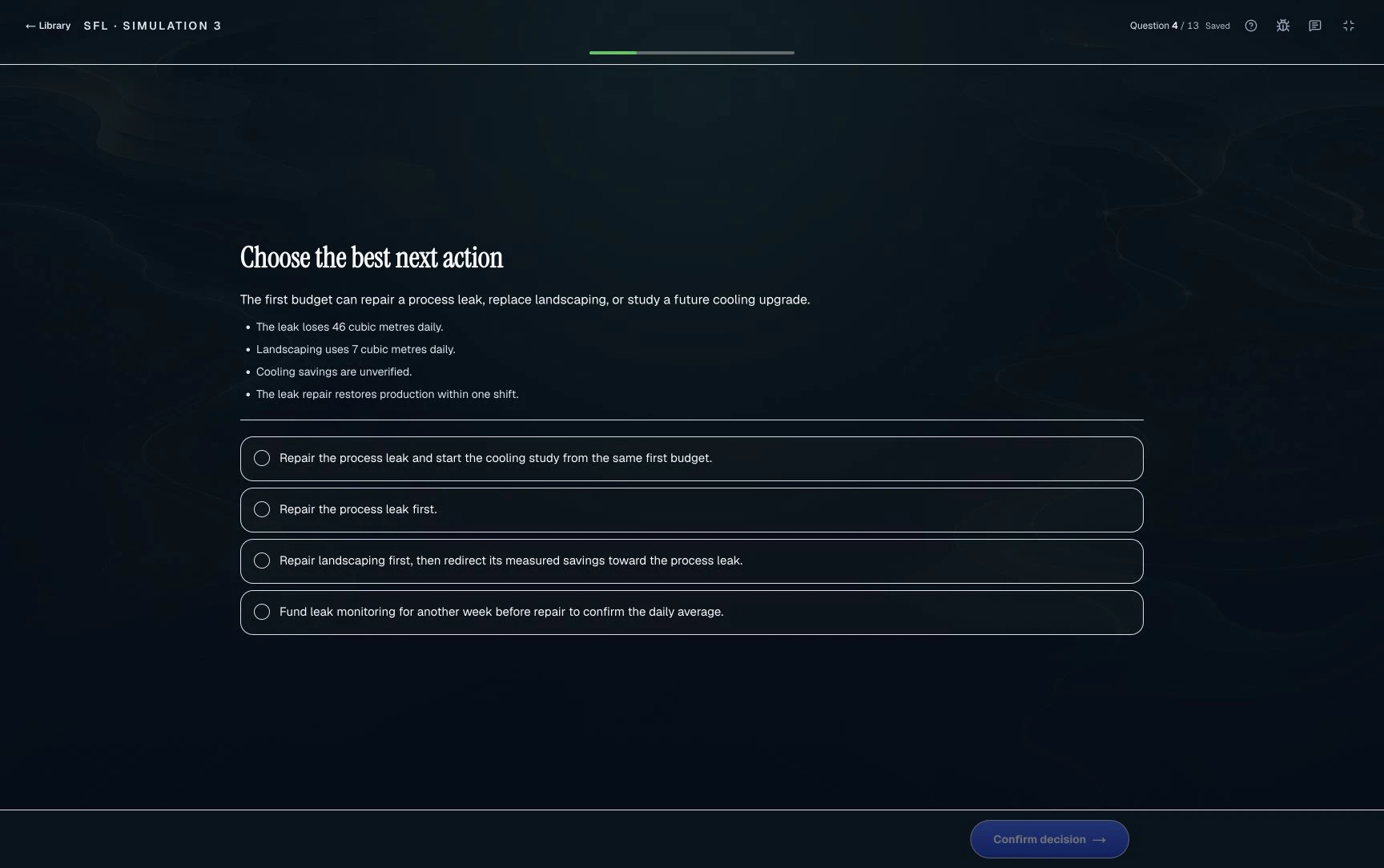
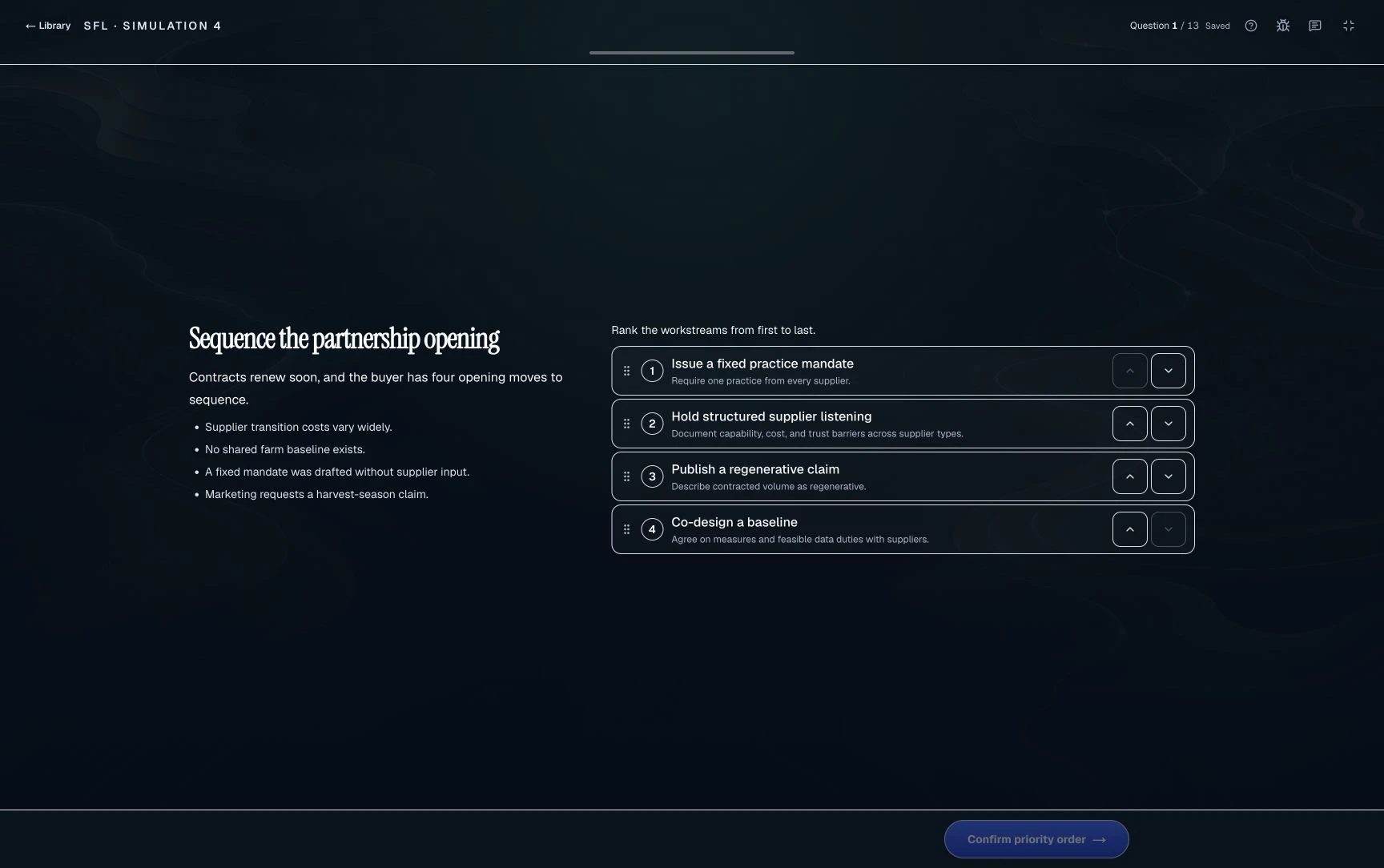
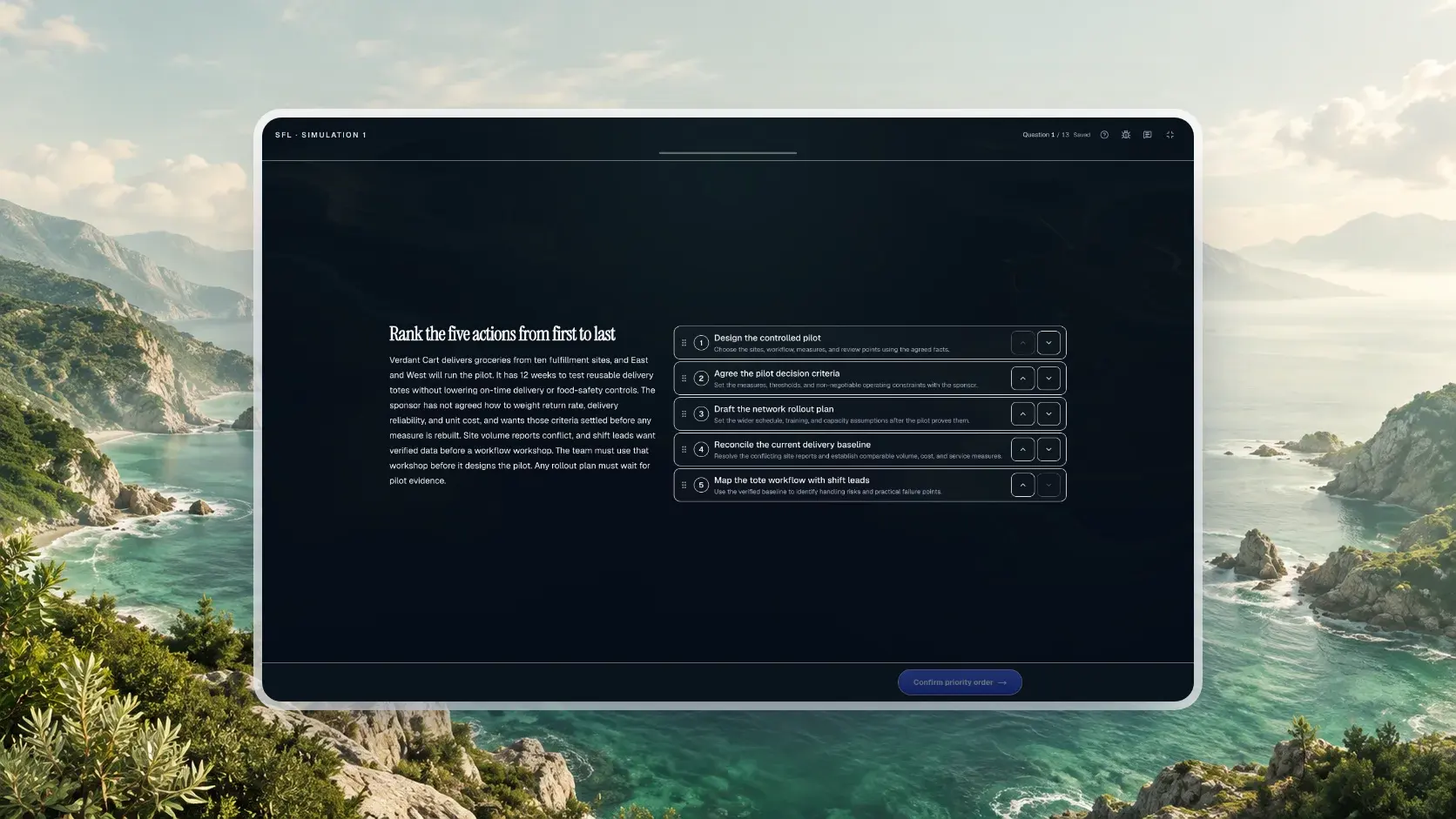
The skills overlap even though the screens do not. Both reward stating the objective, respecting limits, updating when a fact changes and handling people without dropping the plan. The ranking task worked example covers the opening ranking of the standard version in detail, and the Solve timeline guide places the whole sitting in the application process.
What does one day look like when you work it through?
On this original, fictional Day 2, your four researchers supply 24 hours and the four workstations ask for 24, yet the best placement covers only 22 because people move in whole blocks; the numbers and rules are invented to show the reasoning, not to match any screen. A day's real task is turning what you learned into a placement whose cost you can state.
Our fictional lab studies a coastal marsh. Each researcher works 6 hours at one workstation, and each workstation holds at most 2 people. Your explore requests told you the demand for each workstation today.
Step 1: compare total supply with total demand
Supply
Demand
Soil cores, Tide gauges, Data room, Community desk, in that order.
- Soil cores6 · 25%
- Tide gauges11 · 45.8%
- Data room5 · 20.8%
- Community desk2 · 8.3%
- All workstations24 · 100%
Original fictional Day 2. Tide gauges ask for more than one researcher can give; Community desk asks for little.
Supply matches demand exactly, which tempts you to keep everyone where they started. The split is the problem: Tide gauges needs 11 hours but a single researcher gives 6, while the Community desk wastes most of a block on 2 hours of work.
Step 2: cost each placement in covered hours
A workstation covers the smaller of its demand and the hours its people provide. Add that across the four workstations for each plan.
Keep the morning board
Out of 24 hours of demand.
Move Kofi to Tide gauges
Out of 24 hours of demand.
Move Tomas to Tide gauges
Out of 24 hours of demand.
All demand covered
Original fictional exercise. Neither the capacity rule nor the hours come from any McKinsey screen.
Step 3: state the trade you are making
Moving Kofi gives up the little work at the Community desk and gains most of the missing Tide gauges hours. Name the gain and the loss, then net them.
Net effect of moving Kofi
The gain is the extra Tide gauges coverage. The loss is the Community desk work left unstaffed.
That net of 3 hours is a reason you can give for the move, and it follows from facts you collected, not a feeling. It also leaves a loose end for the next stage: the Community desk now has nobody, so one of the researchers' problems in the support stage may be about exactly that. Reading Solve tips alongside this helps you keep the objective visible while you decide.
Which decisions tend to go wrong, and what is the better move?
Four decisions tend to go wrong in a team-leading task like this one: spending requests to confirm what you believe, moving people for a reason you cannot state, answering a problem by asking for more analysis, and rating a person you have no evidence about. These are our editorial reading of reported accounts and of general judgment practice, not a McKinsey rubric. Each pair below uses the fictional marsh lab.
Spending requests to confirm, not to decide
With 3 requests and 4 workstations, a request that could not change your placement is a wasted share of your coverage. Count what your requests cover before you spend them.
Confirm a known fact
Spends one of the requests on a researcher whose placement already looks settled, which leaves one workstation unseen.
Ask what could change the plan
Spends every request on a workstation, so most of the day's demand is visible before you place anyone.
Original fictional exercise, with an assumed budget of three requests on a lab of four workstations. Real limits are unverified.
Moving people without a stated reason
Placing someone because they seem keen is not a reason you could defend. The coverage numbers above are.
Move on a hunch
Takes Tomas off the Soil cores, so that workstation loses all of its work to gain Tide gauges hours.
Move on the shortfall
Takes Kofi off the Community desk, so only its small demand is lost for the larger Tide gauges gain.
Both plans are costed in the fictional exercise above. A researcher's own stated need would also count, and a single hour figure is not the only reason to move someone.
Answering a problem by asking for more analysis
A support problem usually arrives with incomplete facts. Asking for more analysis can look careful while leaving the person nothing to do next. A better answer names the trade-off, picks a course, says what would make you change it, and leaves the researcher able to act within the hour.
Hand it back
"Please gather more data on the tide readings and come back to me."
Leaves the researcher with the same problem and no action they can take.
Decide and say what would change it
"Use the readings you have to finish the Tide gauges run today. If the Data room flags a gap, tell me and we will revisit."
Gives a decision, the trade it makes, and the evidence that would reverse it.
Rating a person you have no evidence about
If the reflect stage lets you say you do not know, as accounts report, saying so about a researcher you never asked or heard from is more honest than a confident guess. How McKinsey scores that option is unknown, so treat it as a habit about evidence, not a trick.
Invent a confident rating
"Priya seems fine, so confident."
Fills the gap with a guess about someone who never raised a problem or answered a request.
Rate from what you saw
"I have nothing from Priya, so I do not know. Tomas flagged a deadline worry on Day 1, so doubtful."
Ties each rating to something that person said or did, and admits the gaps.
How should you spend the 30 minutes?
A reasonable coaching budget splits the reported 30 minutes evenly, about 10 minutes a day, with the support stage getting the largest slice; this is our editorial advice, not a McKinsey rule or a number you will see on screen. Candidates report, unverified, that the last day is where people rush, so a little early slack helps.
Minutes per day
Minutes per support problem
Four researchers, four problems per day, as reported.
- Explore2 min
- Assign2 min
- Support4 min
- Reflect2 min
- After ExploreWrite one line of notes per researcher or workstation you asked about.
- After AssignYou can state the reason for every placement you changed.
- After SupportEvery researcher left with a next step they can act on.
- End of dayRatings tied to something you saw, with gaps admitted.
A coaching split of 10 minutes a day for the reported 30. McKinsey publishes no stage timings and the tutorial is untimed, so adjust it to your own pace.
The stages add back to the day
The tutorial is untimed, so use it to learn where each control lives rather than rushing through it. For the same idea applied to another game, see the Red Rock time budget, and which game to practise first if your invitation holds all three.
How do you prepare for a format McKinsey has not described?
Prepare transferable habits, not a memorised layout: McKinsey says no preparation is needed, and the 30-minute format is reported only second-hand, so the safest practice is the judgment habits it appears to use. Road to Offer offers all four practice formats: Red Rock, Sea Wolf, SFL Classic and SFL Island, with one complete free run each. Red Rock includes the full Study and six Cases, with highlighted calculations and charts in its worked review; Sea Wolf includes all three sites, with constraint and treatment visuals. These are independent exercises and do not promise identical McKinsey screens. This is our advice, not McKinsey's.
- State the objective first. One line, in your own words, before any choice. The standard lab trains this directly, and the Sustainable Futures Lab method shows how.
- Collect only what changes a decision. Before you ask for any fact, name the choice it could change. This is the habit behind the explore stage.
- Cost a move before you make it. The marsh lab's covered-hours method is a template. Where there are no hours, use whatever limit applies.
- Keep notes as you go, and keep them yours. McKinsey bans pre-prepared notes and lists pen and paper as the only tools in assessments. Follow your invitation on what is allowed in your sitting.
- Decide, then say what would change your mind. A decision with a stated trigger beats a deferral.
- Set your device and room up the day before. The system requirements guide and test-day checklist cover the facts McKinsey publishes.
If you want a rehearsal slot, the prep plan shows how to fit one around Red Rock and Sea Wolf, which the Red Rock method and Sea Wolf method cover. Candidates also discuss their own sittings in public threads, so the check of ten Reddit claims shows how to weigh them. If you need adjustments, read Solve accommodations, and for camera and monitoring rules, whether Solve is proctored.
Choose Sustainable Futures Lab practice
None of this predicts a result. For what a result can and cannot tell you, see the scores and results guide, and for the claims about pass rates that circulate, read what is known about the pass rate and retake rules. Candidates in other roles may sit different assessments, summarised in McKinsey online assessments by role, and the Solve overview places this lab in the whole sitting.
Sources and evidence boundaries
- Official, checked October 11, 2026: McKinsey's Solve page and its Solve FAQ (August 2025 PDF). They are the source for length in the invitation, untimed tutorials, no preparation needed, banned aids and the recruiter and support contact routes.
- Official, checked October 11, 2026: the assessment integrity expectations, which apply to assessments and interviews generally, and McKinsey's July 2025 game-based innovation lab post, the source for the quoted line on what Solve measures.
- Reported: the 95-minute invitation, the about 30 minutes of lab, the four researchers, four workstations and three simulated days, and the explore, assign, support and reflect loop. They come from candidate accounts first seen in late August and September 2026 and are unverified, and accounts differ on request limits, workstation capacity and rating options.
- Unknown in the public sources reviewed: any McKinsey description of this format, whether it is a pilot, who receives it, how it is scored, whether tutorial and tech check fall inside the invitation length, and how long it will stay in use. The marsh lab, its hours and every plan are original fictional teaching material, not Solve content.