The McKinsey Ecosystem Building game is no longer part of standard McKinsey Solve invitations. Hacking the Case Interview, MConsultingPrep and PSG Secrets report it was removed around mid-2025, SolvePrep says early 2026, and McKinsey has announced no removal (sources checked October 3, 2026; dated list below). Prep sites describe the task as picking 8 species from a catalog of 39, plus a location, so that every species could live there and feed one another in a calorie-balanced food chain, in about 35 minutes. 2026 candidates report Red Rock, Sea Wolf and, in 85- or 95-minute invitations, the Sustainable Futures Lab instead; if you are preparing for McKinsey Solve today, practise Sea Wolf for the same constraint-checking skill.
| Fact | What is known | Source and status |
|---|---|---|
| Status in 2026 | Not in any 2026 candidate report we reviewed | Candidate forums; a PrepLounge coach, August 27, 2026 |
| Removal date | Around mid-2025, or early 2026 | Mid-2025: three prep sites. Early 2026: SolvePrep. No McKinsey date |
| Task | 8 of 39 species plus one location, in a sustainable food chain | Prep-site reported (MConsultingPrep, PSG Secrets) |
| Time | About 35 minutes | Prep-site reported; older pages say 30 |
| Origin | November 2017 London pilot with 520 candidates, built with Imbellus | Official (McKinsey blog, January 16, 2018) |
| Closest current game | Sea Wolf | Our assessment |
What was the McKinsey Ecosystem Building game?
The McKinsey Ecosystem Building game was a scenario-based task in what candidates called the McKinsey Problem Solving Game (PSG), the Imbellus test or the digital assessment. Those names all point to the screen McKinsey now calls Solve; our PSG, Imbellus and Solve name guide maps each label to its era.
McKinsey described the origin of the format in a January 16, 2018 post on its own blog, "Build a reef? Save a species?". The post says 520 candidates sat a scenario-based assessment at McKinsey's London testing site in November 2017, that the firm developed it with Imbellus and UCLA's CRESST research center, and that it was meant to show how candidates approach a problem rather than only whether they pick the right multiple-choice answer. It shows a screenshot labelled "Build a reef" and describes a forest scenario in which animals fall ill. It does not publish rules, a scoring model or a game list.
How did the Ecosystem game work, step by step?
In the Ecosystem game, prep sites report, you chose one location and 8 species from a catalog of 39 in about 35 minutes, so that every species tolerated the location and the food chain fed everyone without eating any species down to zero. Everything more specific than McKinsey's blog post comes from prep providers. The two most detailed, MConsultingPrep's Ecosystem deep dive and the Ecosystem section of PSG Secrets' Solve guide, agree on the core numbers. None of them is confirmed by McKinsey.
- Scenario
- One natural setting per sitting. MConsultingPrep names coral reef, forest and mountain.
- Catalog
- 39 species: 9 producers and 30 animals (both sources). MConsultingPrep says they fall into three groups of 13; species in a group share the same conditions and eat only within their group.
- Your pick
- 8 species that form one sustainable food chain (both sources).
- Location
- Each site lists 7 to 8 conditions. MConsultingPrep names depth or elevation, temperature, rainfall and wind speed, and says depth or elevation and temperature are the ones that matter; PSG Secrets says only 2 to 4 are relevant to your species.
- Clock
- 35 minutes (both sources). PSG Secrets suggests finishing a chain within 15 minutes to leave time to rebuild; MConsultingPrep gives 15 to 20 minutes as a prepared benchmark.
Prep-site reports reviewed October 3, 2026. McKinsey's 2018 post shows a reef scenario but publishes no rules, counts or clock.
Put together, the loop was: pick a location, pick 8 species that all tolerate it, and make the food chain sustainable, so that every consumer finds enough food among the chosen species and no species is eaten down to nothing. Older pages also give 30 minutes; the 35-minute figure is the one both detailed sources use.
What were the Ecosystem game rules?
Prep sites report five Ecosystem rules: consumers eat in order of calories provided, each eats from the richest available food source, eating lowers the prey's calories, a species survives only if its need is met and it stays above zero, and every species must tolerate the location. These descriptions come from prep providers, not McKinsey:
- Feeding order: the consumer with the highest "calories provided" value eats first, then the next highest, and so on. Producers (plants, algae, corals) do not eat.
- Choice of prey: each consumer eats from the food source among your chosen species that currently has the most calories provided. Some guides add that a tie splits the meal equally.
- Depletion: when a consumer eats, the prey's calories provided fall by the amount the consumer needs.
- Survival: a species survives if its calories needed are fully met and its calories provided stay above zero after everyone has eaten.
- Habitat: every species must tolerate every listed condition of the chosen location.
Two things follow from those rules. First, the order of eating is set by the numbers, not by where a species sits in a textbook food web, so a mid-sized grazer can eat before a large predator. Second, a predator that needs as much as its only prey provides wipes that prey out, even though the predator itself is well fed. That second trap is the one the worked example below is built to show.
A few guides also discuss how the result was judged, for example whether partial credit existed for a chain where most species survived, or whether the process (how many species you inspected, how you narrowed the list) mattered. McKinsey has never published Solve scoring weights, so those claims are informed guesses. Our guide to Solve scores and results explains what is and is not known about scoring today.
Should you choose species or location first in Ecosystem?
There is no agreed answer: coaches split between food chain first, depends on your style and test both, while PSG Secrets says species first and MConsultingPrep says build up from producers. In a PrepLounge thread from August 9 to 11, 2025, three coaches answered:
| Source | Position | Reason given |
|---|---|---|
| Francesco, ex-BCG coach (PrepLounge) | Food chain first | Some locations cannot support any working chain, so starting from terrain can waste the build |
| Julia, ex-McKinsey engagement manager (PrepLounge) | Depends on your style | Terrain first suits top-down thinkers; chain first suits people who gather building blocks first |
| Cristian, ex-McKinsey coach (PrepLounge) | Test both | No single method is best for everyone |
| PSG Secrets (prep site) | Species first | Not every location allows a sustainable chain |
| MConsultingPrep (prep site) | Build bottom-up from producers | Claims most users find it 20 to 30% faster (unverified) |
Our worked example below starts from the location because its catalog is tiny and the habitat check removes most species at once. In a 39-species catalog the trade-off changes, which is why the coaches split. MConsultingPrep adds two heuristics, both unverified: avoid "red flag" animals that need more than about 5,000 calories or provide about 1,500 or less, since they rarely survive, and spend no more than about 10 minutes testing any one group.
How do you build a valid Ecosystem food chain?
Filter the species by the location's conditions, secure a producer, run the feeding order consumer by consumer, then check that every need is met and no species ends at zero. The original worked example below does this with a five-species chain.
Original exercise. The locations, species and numbers below are invented by Solve Game Prep. The feeding rules follow the third-party descriptions above, simplified to a five-species chain. This is not a McKinsey question, a reproduction of the earlier game or an official scoring model.
The brief. Choose one of two locations, then choose exactly five species from the catalog that form a continuous food chain. Every chosen species must tolerate the location's depth and temperature, have its calories needed fully met, and finish with calories provided above zero.
Locations. Kelp Shelf: depth 20 m, water 12 °C. Warm Lagoon: depth 4 m, water 27 °C.
On small screens, scroll the table horizontally to see every column.
| Species | Provides / needs | Eats | Tolerates |
|---|---|---|---|
| Sun Kelp (producer) | 5,000 / 0 | Nothing | 5 to 30 m, 8 to 20 °C |
| Glass Alga (producer) | 3,000 / 0 | Nothing | 0 to 10 m, 20 to 30 °C |
| Ribbon Shrimp | 2,400 / 1,200 | Sun Kelp | 15 to 35 m, 10 to 18 °C |
| Drift Snail | 2,000 / 1,500 | Sun Kelp, Glass Alga | 10 to 40 m, 6 to 16 °C |
| Silver Darter | 1,800 / 1,400 | Ribbon Shrimp, Drift Snail | 10 to 30 m, 8 to 15 °C |
| Banded Eel | 900 / 1,000 | Silver Darter | 15 to 40 m, 5 to 14 °C |
| Spiny Crab | 2,600 / 2,400 | Ribbon Shrimp | 10 to 30 m, 8 to 16 °C |
| Lagoon Ray | 1,500 / 1,600 | Ribbon Shrimp | 2 to 12 m, 22 to 30 °C |
Try it before reading on: pick the location, then the five species, and check every rule yourself.
Step 1: choose the location by counting who can live there (location first)
Start with the location, because it removes species in bulk. At the Warm Lagoon (4 m, 27 °C), only Glass Alga and Lagoon Ray tolerate both conditions. Two species cannot make a five-species chain, so the Lagoon is out before any calorie arithmetic.
At the Kelp Shelf (20 m, 12 °C), check each species against both ranges. Sun Kelp, Ribbon Shrimp, Drift Snail, Silver Darter, Banded Eel and Spiny Crab all fit. Glass Alga fails both (depth 0 to 10, temperature 20 to 30), and Lagoon Ray fails both too. That leaves six candidates for five places.
Step 2: secure the base of the chain
Every chain needs a producer. Sun Kelp is the only producer that survives the habitat check, so it is in. Next, look at who can eat what is available: Ribbon Shrimp and Drift Snail both eat Sun Kelp, Silver Darter eats either of those, and Banded Eel eats Silver Darter. Spiny Crab eats only Ribbon Shrimp.
Step 3: test the tempting option and watch it fail
Spiny Crab looks strong: it provides the most calories in the catalog. Suppose you try Sun Kelp, Ribbon Shrimp, Drift Snail, Silver Darter and Spiny Crab. Because the crab provides 2,600, the most of any consumer, it eats first. Its only food is Ribbon Shrimp, which provides 2,400. The crab needs 2,400, so the shrimp drops to 0. The crab is fed, but the shrimp no longer has calories above zero, so the shrimp does not survive and the chain fails. A high-value species that eats one prey at nearly that prey's full value is a liability, not an asset.
Step 4: run the valid chain in feeding order
Swap the crab for Banded Eel: Sun Kelp, Ribbon Shrimp, Drift Snail, Silver Darter, Banded Eel. Order the consumers by calories provided: Ribbon Shrimp (2,400), Drift Snail (2,000), Silver Darter (1,800), Banded Eel (900).
| Turn | Consumer (needs) | Eats | Result |
|---|---|---|---|
| 1 | Ribbon Shrimp (1,200) | Sun Kelp, its only food | Sun Kelp 5,000 to 3,800; need met |
| 2 | Drift Snail (1,500) | Sun Kelp (Glass Alga not chosen) | Sun Kelp 3,800 to 2,300; need met |
| 3 | Silver Darter (1,400) | Ribbon Shrimp (2,400 beats Drift Snail at 2,000) | Ribbon Shrimp 2,400 to 1,000; need met |
| 4 | Banded Eel (1,000) | Silver Darter, its only food | Silver Darter 1,800 to 800; need met |
Turn 3 is the one people get wrong. Silver Darter can eat either prey, and the rule says it takes the one with more calories provided at that moment. Nothing has eaten Ribbon Shrimp yet, so it still provides 2,400, while Drift Snail provides 2,000. The darter eats shrimp.
Step 5: check every constraint, not just the last one
- Habitat: all five tolerate 20 m and 12 °C (checked in Step 1).
- Every need met: shrimp, snail, darter and eel each found their full need in a single food source.
- Nobody eaten to zero: final calories provided are Sun Kelp 2,300, Ribbon Shrimp 1,000, Drift Snail 2,000 (nothing eats it in this chain), Silver Darter 800 and Banded Eel 900. All are above zero.
- Continuous chain: kelp feeds shrimp and snail, shrimp feeds darter, darter feeds eel. Every consumer is linked to the producer.
The chain is valid. Notice that Drift Snail survives untouched: in this simplified exercise that is allowed, but it means the snail adds nothing a predator relies on. If the brief required every non-apex species to be eaten, you would have to revisit the selection. Always reread the brief before declaring victory.
- ProducerSun Kelp5,000 calories, 2,300 left
- GrazersRibbon ShrimpEats 1,200 (turn 1)Drift SnailEats 1,500 (turn 2)
- PredatorSilver DarterEats 1,400 of shrimp (turn 3)
- Top predatorBanded EelEats 1,000 of darter (turn 4)
ValidAll five species tolerate the Kelp Shelf, every need is met and every species ends above zero.
RejectedSwap in Spiny Crab: it eats first and takes 2,400 from Ribbon Shrimp, leaving it at 0, so the shrimp dies.
Original worked example from the tables above. Each tier is eaten by the next; the dashed Drift Snail is a grazer nothing eats. Feeding order is set by calories provided, not by tier.
Practise the same constraint checks in a free Sea Wolf run
Is the Ecosystem game still used in 2026?
Not on the evidence available: no 2026 candidate report we reviewed includes the McKinsey Ecosystem game. The best-supported date for its removal is mid-2025, reported by three prep sites; one prep site says early 2026, and McKinsey has announced nothing. Every 2026 candidate report we reviewed describes the same building blocks: Red Rock (one Study, then six short Cases, about 35 minutes), Sea Wolf (microbe treatments for three sites, about 30 minutes) and, on longer invitations, the Sustainable Futures Lab. The 65, 85 and 95 minute guide maps which games come with which invitation length, and the dated 2026 update log records each change as it is reported.
Who says what, and when:
| Source | Type | Dated | What it says |
|---|---|---|---|
| McKinsey, "Build a reef? Save a species?" | Official blog | January 16, 2018 | Describes the November 2017 London pilot with a reef scenario. Says nothing about a later removal. |
| PrepLounge thread 20902 | Candidate forum | July 21, 2024 | A candidate prepares for Ecosystem and Red Rock together, so the game was still being reported in mid-2024. |
| PrepLounge thread 23279 | Candidate forum, coach answers | August 9 to 11, 2025 | A candidate asks for Ecosystem strategy and three coaches answer as if it were current, so it was still being prepared for in August 2025. |
| Hacking the Case Interview | Prep site | Updated July 6, 2026 | McKinsey "retired the Ecosystem Building game in mid-2025". |
| MConsultingPrep, Redrock page | Prep site | Undated (2026 version) | McKinsey removed Ecosystem in mid-2025. Its own Ecosystem page still describes the game in the present tense. |
| PrepLounge thread 25150 | Coach answer | August 27, 2026 | Coach Alessa, ex-McKinsey and BCG: "The old Ecosystem game has been removed." No date given. |
| PSG Secrets | Prep site | Updated October 2026 | Phased out starting mid-2025; not in 65-minute invitations; says a longer 110-minute allocation might still include it (no candidate report we found confirms this). |
| SolvePrep | Prep site | Undated | Ecosystem left the active rotation in early 2026. |
| McKinsey Solve page and August 2025 FAQ | Official | Checked October 3, 2026 | Name no individual games and announce no removal. |
Read together: the game was still reported in mid-2024 and still being prepared for in August 2025, and most prep sites place its removal around mid-2025, with one saying early 2026. Those two facts fit a gradual phase-out in which some invitations changed before others.
McKinsey has announced none of these dates. Its current Solve page and August 2025 FAQ do not name individual games at all. The practical reading: unless your invitation, portal or tutorial names Ecosystem Building, do not build your preparation around it. Our invitation guide shows what to look for in the email.
Can you use an Excel solver for the Ecosystem game?
Not during a live sitting. McKinsey's August 2025 Solve FAQ bars outside applications and asks you to work alone, so a spreadsheet solver for the Ecosystem game is only legitimate as practice beforehand. Searches for "mckinsey ecosystem excel solver" lead to paid spreadsheet templates that promise to filter the species catalog and output a valid chain. Some sellers present them as something you run while the game is open. Be careful about that.
- The rule is explicit. McKinsey's August 2025 Solve FAQ bars applications, websites, AI tools and pre-prepared notes, bans recording or screenshots, and asks you to work alone. Typing game data into a spreadsheet during a live sitting is an outside application.
- Memorised answers do not transfer. The same FAQ says Solve varies each scenario so that no two candidates get the same parameters and combinations of data, and that you may be asked at random to take an extra task in person or explain your logic.
- It targets a game candidates no longer report. A template built for Ecosystem's catalog does nothing for Red Rock, Sea Wolf or the Sustainable Futures Lab.
- Data entry costs the time it saves. Copying dozens of species with several attributes each by hand eats into a reported 35-minute clock, and one typo can produce a confidently wrong answer.
- The process may be observed. The 2018 McKinsey post explains that the assessment was designed to see how candidates approach problems, not only the final answer. McKinsey has not published what process data Solve records, so nobody can promise a tool goes unnoticed.
Spreadsheets are fine for practice before your sitting: building your own checker for an invented catalog is a good way to learn the rules. The line is using any tool during the real assessment. The same applies to the Sea Wolf "solvers" that circulate now; our test-day rules checklist covers what is permitted on the day.
Which current Solve game trains the same skill as Ecosystem?
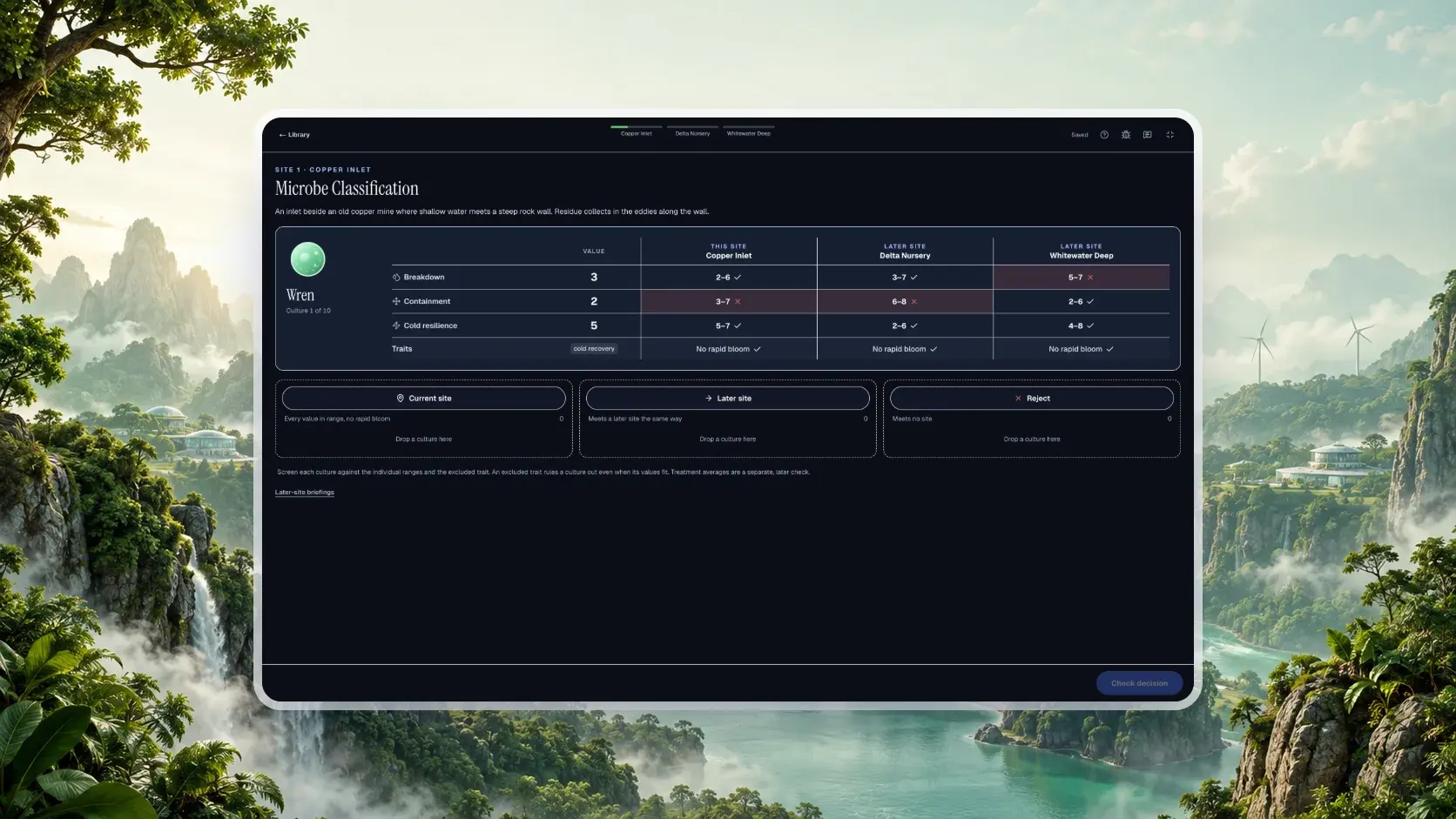
Sea Wolf is the closest current McKinsey Solve game to Ecosystem Building. Ecosystem asked you to pick a set of species that met habitat ranges and calorie rules together; Sea Wolf, as candidates describe it, asks you to pick microbes for three ocean sites so that the treatment's attribute averages fall inside each site's ranges, desirable traits are present and forbidden traits are absent. In both games:
- A single impressive member can break the whole set (the Spiny Crab above, or a microbe with a forbidden trait).
- Fast elimination with hard rules (habitat, traits) beats calculating everything.
- You must check the complete combination against every rule before committing.
The skills split differently for Red Rock, which is a data-analysis and reporting task, and the Sustainable Futures Lab, which tests prioritization over linked decisions. Our Solve prep plan schedules all three.
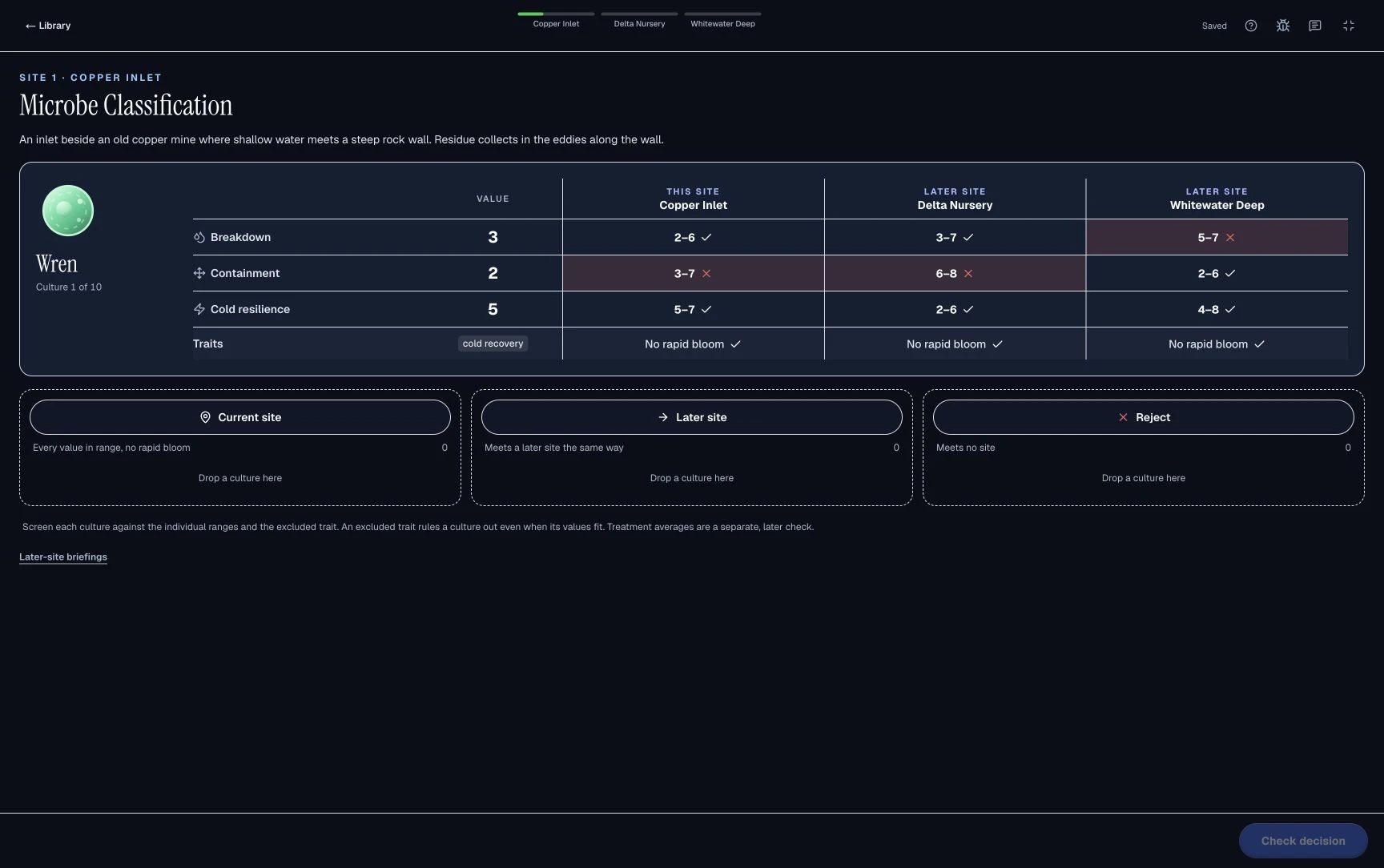
Road to Offer, our practice platform, simulates Red Rock, Sea Wolf and the standard Sustainable Futures Lab with one free run per game. The Sea Wolf practice method walks through original microbe puzzles with the same check-every-constraint discipline as the worked food chain here, and the practice hub links each simulation.
Are old Ecosystem guides and videos still useful?
Yes, but only as practice. Older Ecosystem material is still useful as a constraint-reasoning exercise, but it can mislead you about the test you will sit. Use it like this:
- Check the date and the game list. Material that describes Ecosystem plus Plant Defense, or Ecosystem plus Red Rock, predates the lineup 2026 candidates report.
- Keep the method, drop the specifics. "Filter by habitat, then check calories in feeding order" transfers. Species counts, catalogs and timings do not.
- Do not buy templates for a live sitting. See the integrity section above.
- Move your practice hours to current games. If you are unsure how hard they are, read is McKinsey Solve hard, then see the Solve tips before practising.
If you are comparing firms, the Solve, Casey and SOVA comparison covers how McKinsey's game-based format differs from BCG's and Bain's online assessments. This guide is written and reviewed by Esteban Ronsin.
Sources and evidence boundaries
- Official: McKinsey's blog post "Build a reef? Save a species?" (January 16, 2018). The live page did not respond to our automated check on October 3, 2026; we read its text from an Internet Archive capture dated April 20, 2026. It confirms the Imbellus collaboration, the November 2017 London pilot with 520 candidates and the reef and forest scenarios, and gives no rules. Also McKinsey's digital assessment page and the Solve FAQ (PDF, August 2025), checked October 3, 2026, for the no-outside-tools rule. Neither names individual games.
- Candidate forum: the PrepLounge Ecosystem and Red Rock thread (July 21, 2024), checked October 3, 2026.
- Candidate forum, strategy: the PrepLounge Ecosystem strategy thread (August 9 to 11, 2025) and the PrepLounge Sea Wolf thread (answers July 31 to August 27, 2026), both checked October 3, 2026.
- Prep-site reports, treated as unverified: catalog size, groups, location conditions, clock and heuristics from MConsultingPrep's Ecosystem deep dive and PSG Secrets' Solve guide; game rules and feeding order from PSG Cracked's Ecosystem guide; removal dates from Hacking the Case Interview, MConsultingPrep, PSG Secrets (mid-2025) and SolvePrep's Ecosystem page (early 2026). All reviewed October 3, 2026.
- Not established anywhere public: an official end date, official Ecosystem rules or scoring, and whether any 2026 invitation still includes the game.