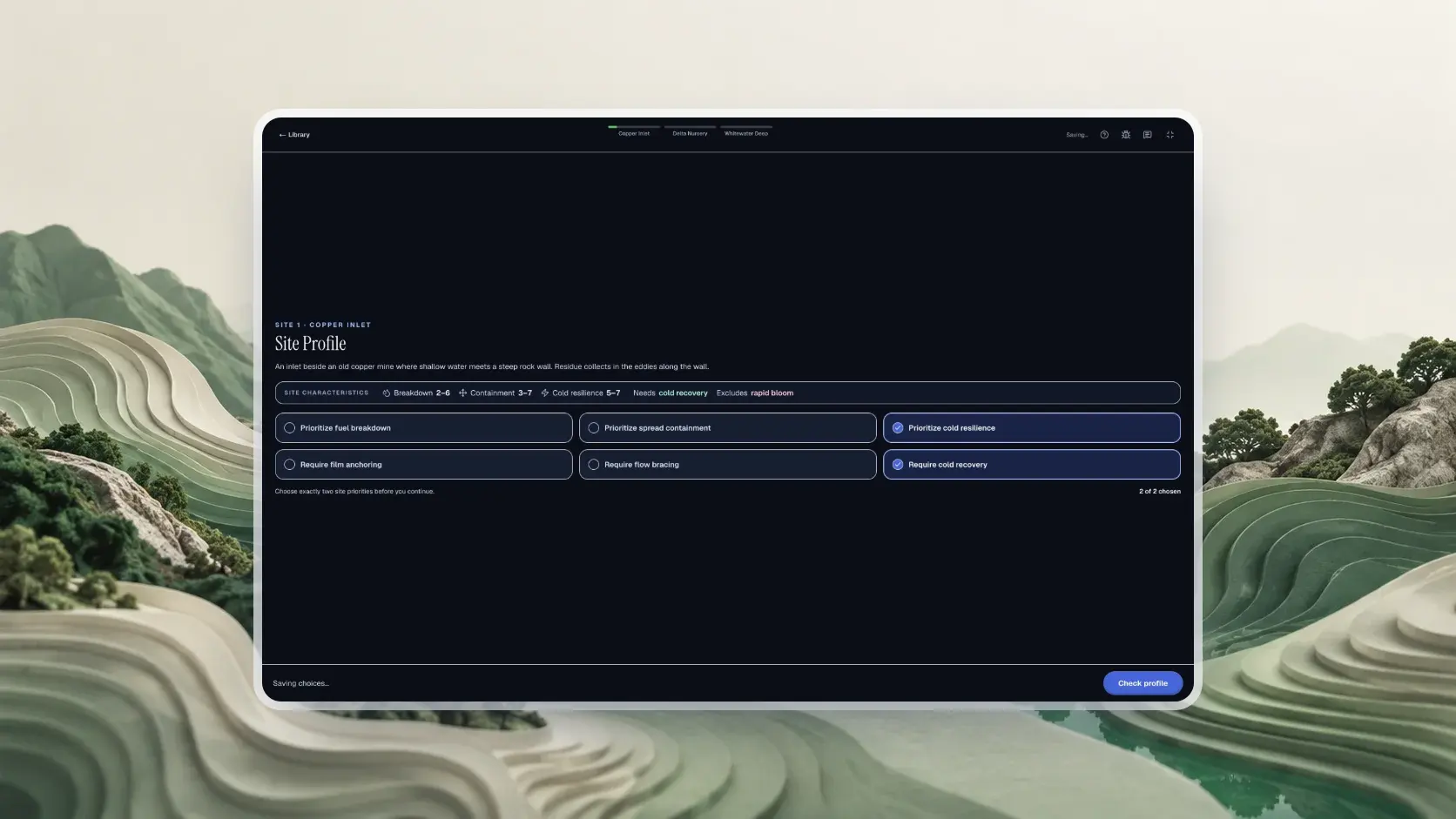
The McKinsey PSG (Problem Solving Game), the Imbellus test, the McKinsey digital assessment and McKinsey Solve are one assessment: McKinsey's online, game-based problem-solving test, built with the start-up Imbellus, piloted with 520 candidates in London in November 2017 and now called Solve. It replaced the paper Problem Solving Test (PST), and McKinsey's July 2025 blog says it is given to around 300,000 early-career candidates a year. What changed is the games inside it: early versions had Ecosystem Building and Plant Defense, while 2026 candidates report Red Rock, Sea Wolf and, on longer invitations, a Sustainable Futures Lab.
| Fact | Detail | Evidence |
|---|---|---|
| Current name | Solve; PSG, Imbellus test and digital assessment are older or generic names for it | Official (McKinsey Solve page) |
| First pilot | 520 candidates, London, November 2017, built with Imbellus and UCLA CRESST | Official (McKinsey blog, January 16, 2018) |
| Replaced | The multiple-choice Problem Solving Test (PST), around 2019 to 2020 | Official that the PST was replaced; dates candidate-reported |
| Imbellus ownership | McKinsey says it acquired Imbellus; Roblox lists Imbellus, Inc. as a subsidiary | Official (McKinsey blog, July 9, 2025); Roblox corporate profile |
| Takers per year | Around 300,000 early-career candidates | Official (McKinsey blog, July 9, 2025) |
| Games in 2026 | Red Rock, Sea Wolf, Sustainable Futures Lab; not Ecosystem Building or Plant Defense | Candidate-reported |
So a guide that says "PSG" is not automatically wrong, but a guide that describes Plant Defense is describing an older version. Our complete McKinsey Solve guide covers the current test end to end.
What do PST, PSG, Imbellus and Solve each mean?
PST is McKinsey's old paper test; Imbellus test, PSG and digital assessment are older or generic names for the game-based assessment McKinsey now calls Solve. Use this table to translate whatever name a recruiter, forum or video uses. "Current?" means whether the name is still a good description of what you will sit in 2026, not whether people still say it.
On small screens, scroll the table horizontally to see every column.
| Name | When it was common | What it refers to | Current? |
|---|---|---|---|
| PST (Problem Solving Test) | Before the digital rollout, roughly until 2019 to 2020 | McKinsey's earlier multiple-choice, case-based quantitative test | No. Replaced by the game-based assessment |
| Imbellus test / Imbellus game | 2017 pilot through the early 2020s | The game-based assessment, named after the start-up that built it | Name outdated; the assessment continues as Solve |
| PSG (Problem Solving Game) | Early 2020s, still widely searched | The same game-based assessment, informal candidate and prep-site name | Same test, older label. Check which games the source describes |
| Digital assessment | Throughout, and in McKinsey's own page URL | Generic name for the online assessment step | Yes, as a generic term |
| Solve | Current official name | McKinsey's game-based assessment as it exists today | Yes. The name McKinsey uses on its official Solve page |
Two near-misses cause confusion. "McKinsey Problem Solving Test" (PST) is the old paper test, not the game. And individual game names, such as Red Rock (sometimes written Redrock) or Ecosystem Building, are modules inside the assessment, not separate assessments. If you only have one name from a recruiter, the invitation guide shows where your email states the length and the next steps.
How did McKinsey's test change from the PST to Solve?
McKinsey moved from the multiple-choice PST to a game-based assessment built with Imbellus, piloted in November 2017 and now called Solve; McKinsey has described the origin in its own words twice. A January 2018 blog post says the standard process used a multiple-choice test and that, with the start-up Imbellus and UCLA's CRESST research center, the firm piloted a scenario-based assessment with 520 candidates in London in November 2017. A July 2025 post says McKinsey acquired Imbellus, that its game-based innovation lab has existed since late 2020, that candidates now play Sea Wolf as part of "our assessment called Solve", that Solve "measures analytical thinking and problem-solving", and that it is given to around 300,000 early-career consultant candidates a year. Everything else on the timeline below comes from candidate and prep-site reports, and the dates for the middle steps genuinely disagree.
- Before 2017 to about 2020Official descriptionPST era.
A multiple-choice problem-solving test. McKinsey's 2018 post names its limitation: it showed whether an answer was right, not how the candidate got there.
- November 2017OfficialImbellus pilot.
520 candidates sit a scenario-based assessment in London, including a "Build a reef" scenario.
- About 2019 to 2022Candidate reportsImbellus-built PSG.
The assessment moves online and spreads across offices. Candidates report Ecosystem Building (build a sustainable food chain) and Plant Defense (protect a plant from invading species on a map).
- About 2023 to 2025Disputed datesRed Rock, then Sea Wolf.
Red Rock (a data study plus short cases) is reported to replace Plant Defense around 2023. Sea Wolf (microbe treatments) is reported in pilot from 2024 and to displace Ecosystem Building, which most prep sites say was removed around mid-2025; SolvePrep says early 2026. McKinsey announced neither change.
- Mid-2025 to 2026 (dates disputed)Disputed datesThird game.
The Sustainable Futures Lab appears on longer, about 85-minute invitations: one ranking task, then about 12 linked decisions. Prep sites date its arrival anywhere from mid-2025 to March 2026.
- From August 24, 2026Pilot, not announced by McKinsey95-minute pilot.
95-minute invitations are reported from August 24, 2026, and on September 11 a candidate described their new, roughly 30-minute SFL, in which you lead four researchers over three simulated days. 85-minute invitations kept arriving afterwards.
Filled dots are eras McKinsey itself has described. Everything else comes from candidate reports, and sources disagree on dates.
A few details are worth knowing for interpreting old sources:
- The Imbellus ownership story is two-sided. McKinsey's 2025 post says it acquired Imbellus and the assessment team. Roblox also lists Imbellus, Inc. among its subsidiaries, and trade press describes a 2020 Roblox deal. For candidates this changes nothing: McKinsey runs the assessment and calls it Solve.
- Versions change without announcements. McKinsey's July 2025 post says it "started piloting a new version in January" (2025, going by the post's date) and that over 60,000 people had used it, without saying what changed. It has not published when or where it tests new versions, so a new format such as the 95-minute invitation can appear in candidate reports before any official word.
- The old games were not "harder" or "easier" versions of today's. They were different tasks. Our Ecosystem Building guide explains how that game worked, with an original worked food chain, and why Sea Wolf trains the closest skill today.
Which games were in the old McKinsey PSG?
The old McKinsey PSG featured Ecosystem Building and Plant Defense, both shown in candidate footage from 2021, and McKinsey's own 2018 post describes reef and forest-illness pilot scenarios. Prep sites name up to five games from the Imbellus and PSG years, and McKinsey's own 2018 post describes two pilot scenarios. The evidence behind each is uneven, so the last column says how far to trust it. None of these is reported by 2026 candidates.
On small screens, scroll the table horizontally to see every column.
| Game | What it reportedly asked | Sources | Confidence |
|---|---|---|---|
| "Build a reef" (2017 pilot) | A reef scenario shown in a screenshot; no rules described | McKinsey's January 2018 post | Official Pilot only |
| Forest illness scenario (2017 pilot) | Forest animals fall ill from an unknown illness; decide what to do and protect what you can | McKinsey's January 2018 post, which gives it no game name | Official Pilot only |
| Ecosystem Building | Build a food chain of species that survives in a chosen location | PrepLounge thread (July 21, 2024); MConsultingPrep video with game footage (August 2, 2021); most prep sites | Candidate-reported High |
| Plant Defense | Protect a plant from invading species on a map | MConsultingPrep video (August 2, 2021); JobTestPrep (December 9, 2025); CaseBasix (August 23, 2026) | Candidate-reported High |
| Disease Management | Predict which species a contagious disease reaches next from earlier spread data | JobTestPrep; CaseBasix, which calls it a beta-testing game. Resembles McKinsey's 2017 forest scenario | Prep-site claim Medium |
| Disaster Management | Identify which natural disaster hit an ecosystem, then relocate it so it survives | JobTestPrep; CaseBasix (beta testing) | Prep-site claim Low |
| Migration Management | Move an animal population safely from one environment to another | JobTestPrep; CaseBasix (beta testing) | Prep-site claim Low |
"Low" means two prep sites name the game and we found no candidate post or footage describing it; the names may come from early pilots seen by few people. Old Ecosystem and Plant Defense videos are still useful history, but they show a different test. The Ecosystem Building guide covers how that game worked.
What skills does the McKinsey PSG (now Solve) test?
McKinsey says the PSG, now Solve, tests problem-solving and analytical thinking; the popular five-skill list comes from prep sites, not McKinsey. Its Solve page calls the test an assessment "created to showcase your problem-solving abilities", and its July 2025 post says Solve "measures analytical thinking and problem-solving". Prep sites such as JobTestPrep and CaseBasix add a five-skill list: critical thinking, decision making, metacognition, situational awareness and systems thinking. We could not find that list on McKinsey's current Solve page, its August 2025 FAQ or either McKinsey blog post, so treat it as a prep-site description. The complete Solve guide explains each skill and where it shows up in the current games.
Practise the games 2026 candidates report, free
Which games are in McKinsey Solve now?
As of late September 2026, candidate reports describe three McKinsey Solve games: Red Rock (about 35 minutes), Sea Wolf (about 30 minutes) and, on longer invitations, the Sustainable Futures Lab (20 or 30 minutes). Your invitation length tells you which you get: about 65 minutes means Red Rock and Sea Wolf, about 85 adds the standard SFL, and about 95 adds the new SFL instead (65, 85 and 95 minute guide).
- Red Rock, about 35 min
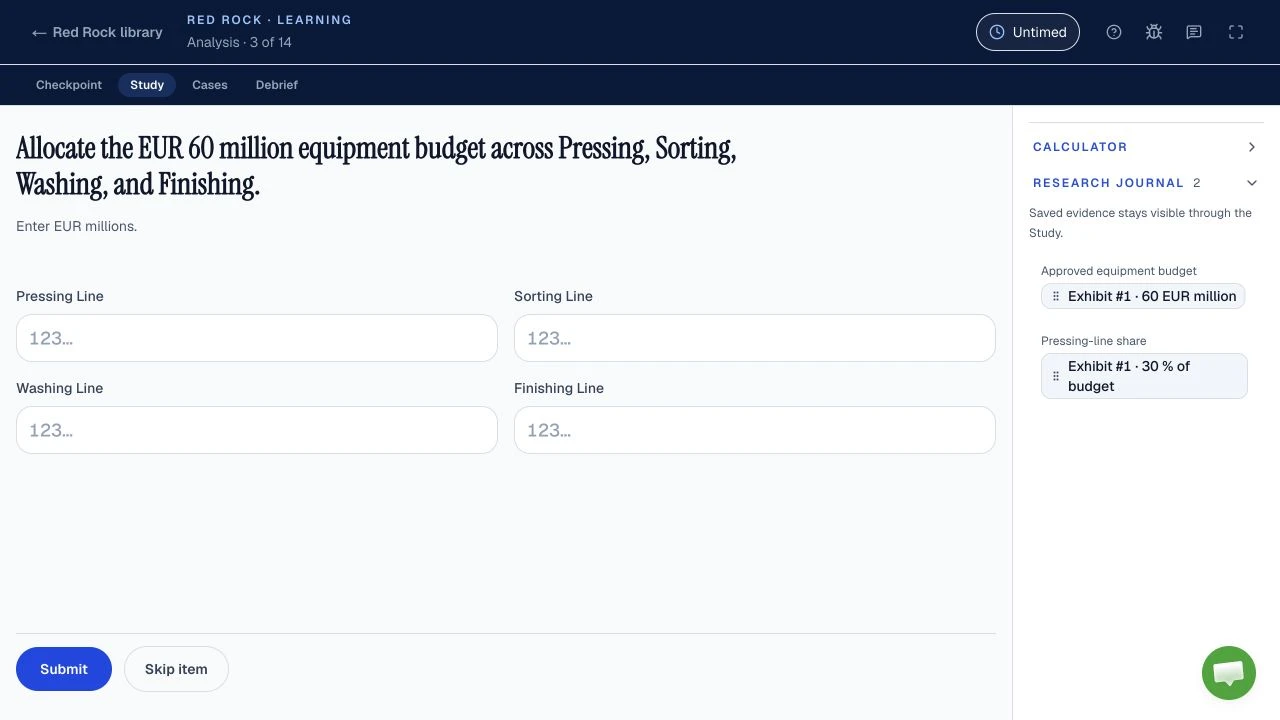
- A research study (save evidence, calculate, report a conclusion), then six short cases. Took Plant Defense's place, according to prep sites. Red Rock practice questions
- Sea Wolf, about 30 min
- Choose microbes whose attribute averages fit each of three sites' ranges while meeting trait rules. The closest heir to Ecosystem Building's constraint logic. Sea Wolf rules and puzzles
- SFL, 20 or 30 min
- Sustainability-project judgment: a ranking then about 12 linked decisions (20 minutes), or leading four researchers over three simulated days (30 minutes, reported pilot). SFL guide
Times are candidate-reported game clocks; each game also starts with an untimed tutorial. The 2026 update log dates every reported change.
Officially, McKinsey says less: your assessment length is in your invitation email, each task starts with an untimed tutorial, no business or gaming knowledge is needed, and you must work alone without applications, websites, AI tools or pre-prepared notes. Its August 2025 Solve FAQ lists English, Spanish, Portuguese and Japanese as available languages.
Pass rate. McKinsey publishes no pass mark, pass rate or scoring weights. Prep sites quote about 20% passing (CaseBasix, August 2026), 20% to 30% (Case Prep, August 2026) or about 70% failing (SolvePrep, September 2026); none shows data, so treat them as unverified estimates. Our pass rate guide traces where each number comes from.
How can you tell if a McKinsey PSG guide or video is outdated?
A McKinsey PSG or Solve guide is outdated if it presents Plant Defense or Ecosystem Building as current games, never mentions the Sustainable Futures Lab, or treats 85 minutes as the only long version, since 95-minute invitations have been reported since August 24, 2026. Most of the confusion around PSG and Imbellus comes from material written for an earlier version still ranking in search results and on video platforms. Run any source through this checklist before you spend time on it.
- It names Plant Defense as a current game. Outdated. No 2026 candidate report we reviewed includes it.
- It names Ecosystem Building as a current game. Outdated for 2026 invitations. Useful only as constraint-reasoning practice.
- It says the test is two games and never mentions the Sustainable Futures Lab. Probably written before the SFL arrived, or only covers 65-minute invitations.
- It treats 85 minutes as the only long version. Written before late August 2026; it misses the 95-minute pilot.
- It claims the original 20-minute SFL is gone for everyone. Contradicted by later reports: both SFL versions were still being reported in late September 2026.
- It gives a precise pass mark, pass rate or score cutoff as fact. McKinsey publishes none, so treat that number as an estimate, whatever the date.
- It sells a solver or template to run during the test. Conflicts with McKinsey's rule to work alone without outside tools, whatever the game.
- It has no visible date or "last reviewed" line. Check the game list it describes; that dates it better than the publish date does.
Prep sites are not immune: SolvePrep, for example, keeps a current change log while some of its older hub pages still describe only 65 and 85 minute invitations, and different prep sites date the arrival of the SFL anywhere from mid-2025 to March 2026. When two sources disagree, trust the one that names its evidence and date, and prefer dated forum posts such as the PrepLounge timing thread over undated summaries.
How should you prepare if your sources say PSG or Imbellus?
If your sources say PSG or Imbellus, prepare for the McKinsey Solve games your invitation length implies, not the games those older guides describe.
- Search with the current name. "McKinsey Solve" plus a game name returns more current material than "McKinsey PSG" or "Imbellus".
- Prepare for what your invitation states. Its length tells you which reported version to expect.
- Train the current games. Start with a structured Solve prep plan, then use the Solve tips and test-day checklist in the last days.
- Keep perspective. McKinsey says results are considered alongside the rest of your application. If you are also applying to BCG or Bain, the Solve, Casey and SOVA comparison covers their formats.
All three current games are available in the practice hub. This guide is written and reviewed by Esteban Ronsin.
Sources and evidence boundaries
- Official: McKinsey's digital assessment page and Solve FAQ (PDF, August 2025), checked October 3, 2026. McKinsey blog posts "Build a reef? Save a species?" (January 16, 2018) and "From apprenticeship in space to selecting microbes" (July 9, 2025). The live blog pages did not respond to our automated check on October 3, 2026; we read their text from Internet Archive captures dated April 20 and June 17, 2026.
- Ownership note: Roblox lists Imbellus, Inc. among its subsidiaries on its public corporate profile; trade press reports a 2020 Roblox deal. Checked October 3, 2026.
- Candidate forums: PrepLounge timing thread (posts dated August 24, August 25 and September 11, 2026) and the PrepLounge Ecosystem and Red Rock thread (July 21, 2024), both checked October 3, 2026.
- Prep-site reports, treated as unverified: game transition dates from SolvePrep's change log, PSG Secrets and other general Solve guides, reviewed October 2 to 3, 2026.
- Not established anywhere public: official dates for dropping Ecosystem Building or Plant Defense, the date the name "Solve" was adopted, and official confirmation of the 95-minute pilot.