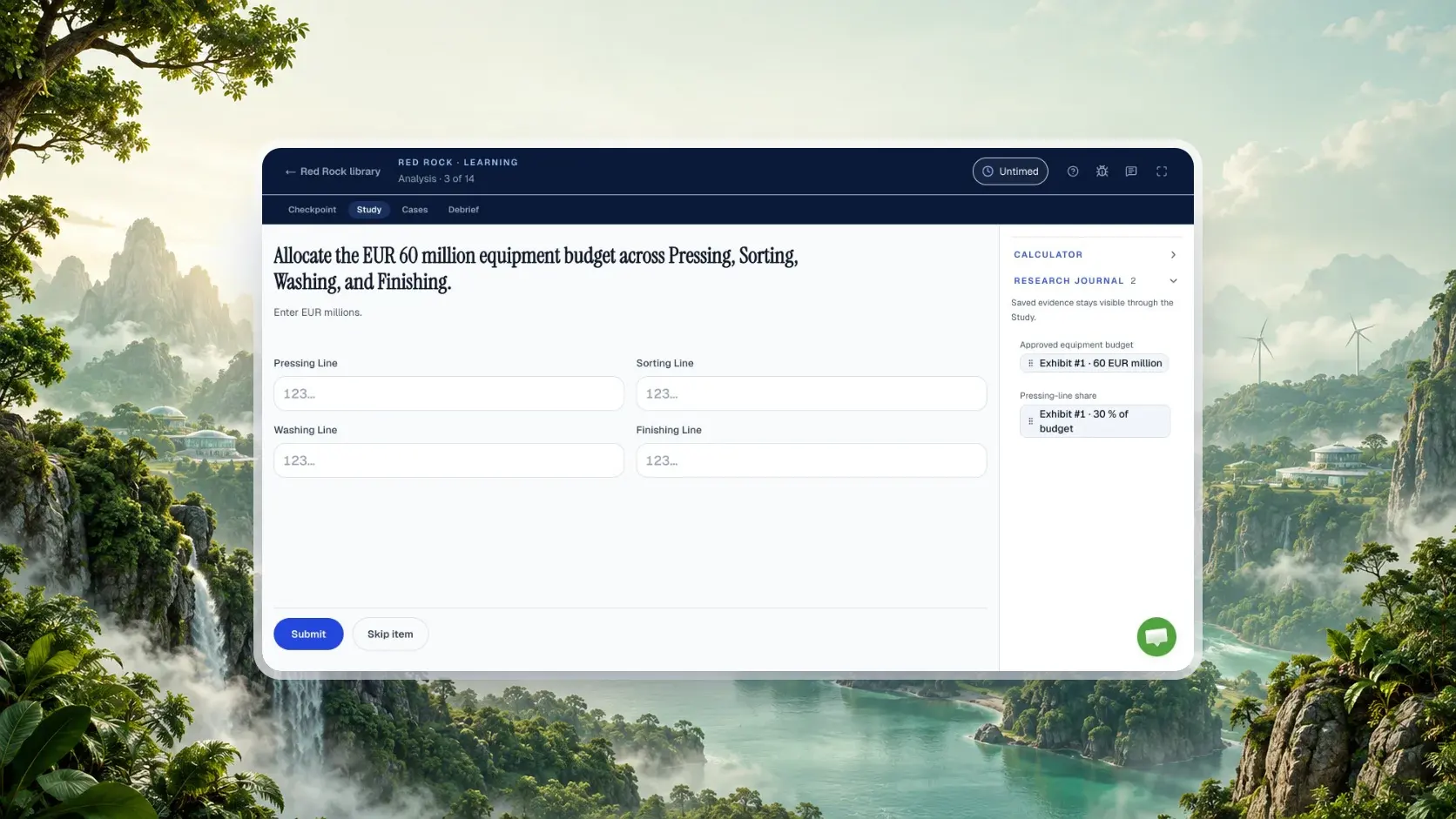
Short answer: McKinsey Solve is hard, but not in the way most candidates fear. McKinsey's Solve page and August 2025 FAQ say it needs no business knowledge or gaming experience, and it does not test advanced maths. It is hard because a tight clock (about 35 minutes for Red Rock and 30 for Sea Wolf, as candidates report), an unfamiliar interface and a few small reasoning traps (units, denominators, averages and inconsistent decisions) cost points even for strong analytical candidates. Those traps are trainable. McKinsey publishes no pass rate or cutoff; prep sites claim roughly 20% to 30% pass (unverified, compared below).
| Question | Answer | Source |
|---|---|---|
| Knowledge needed? | No business or gaming knowledge; Red Rock uses arithmetic with an in-game calculator | Official (knowledge); reported (calculator) |
| Time pressure | Red Rock about 35 min, Sea Wolf about 30, SFL about 20 or 30, each after an untimed tutorial | Reported clocks, 2026; official untimed tutorials |
| Pass rate | Not published by McKinsey; prep sites claim about 20% to 30% pass | Unverified prep-site claims, 2025 to 2026 |
| Where points go | Units, denominators, averaged rates, out-of-range microbes, inconsistent decisions | Our coaching, from practice runs |
What pass rates are claimed for McKinsey Solve?
The number most searchers want is the pass rate. McKinsey does not publish one. Prep sites do, and converted to the same terms they mostly say 20% to 30% pass, which is the same claim as 70% to 80% failing. McKinsey's own July 2025 blog says Solve is given to around 300,000 early-career candidates a year, but it gives no pass rate. Here is every figure we found, who says it and what it rests on.
| Claim | Who says it | Source cited | Status |
|---|---|---|---|
| About 20% pass (80% fail) | CaseBasix pass-rate page, updated August 17, 2026 | None | Unverified |
| About 70% fail; decile 8 or above to advance | PSG Secrets assessment guide, April 17, 2026 | None | Unverified |
| 20% to 30% pass | PSG Secrets test guide, April 21, 2026, and Case Prep, August 17, 2026 | Case Prep calls it an inference from candidate reports and coaching data | Unverified |
| About 70% fail | SolvePrep score guide, September 14, 2026 | "Most estimates" | Unverified |
| 7 in 10 fail | JobTestPrep, December 9, 2025 | None | Unverified |
| 60% to 70% pass if prepared | WallStreetGuide, May 29, 2026 | None; the page also describes an older two-game format | Unverified |
| About 20% to 30% move on | A coach on a PrepLounge thread, June 2026 | No basis stated | Coach opinion |
| Pass rate, cutoff or score scale | McKinsey | Not published | Official: none |
Two things follow. First, several of these pages sell Solve preparation, and agreement between unsourced pages is not independent evidence. Second, even if one of them were right, a pass rate tells you about everyone else, not about you. The rest of this page is about the part you control: where points are lost and how to stop losing them. The pass rate guide examines each figure in more depth.
How hard is McKinsey Solve, really?
McKinsey Solve is hard mainly because of time pressure, unfamiliar game interfaces and small reasoning traps, not because of advanced maths or business content. Solve is McKinsey's game-based assessment, described on the official McKinsey Solve page. McKinsey states that you need no business or gaming knowledge, that each task begins with an untimed tutorial, and that your total length appears in your invitation email. That framing matters: the assessment is designed so that preparation is not required to understand it. It is not designed to be easy to score well on.
Most of the difficulty is concentrated in three places:
- Time pressure. Candidates report roughly 35 minutes for Red Rock and 30 minutes for Sea Wolf, plus about 20 or 30 minutes for the Sustainable Futures Lab depending on your invitation. Each game asks for many linked decisions in that window. The 95-minute invitation guide explains which games each length is reported to contain.
- Novelty. The interfaces look like games, not tests. The first few minutes go to understanding the screen, and candidates who see it cold often spend the tutorial reading instead of planning.
- Small, repeatable traps. Most lost points in practice come from a handful of errors: a number saved without its unit, a rate averaged instead of pooled, a microbe rejected for the wrong reason, or a decision that contradicts an earlier priority.
So the honest answer to "is McKinsey Solve hard" is: hard enough that unprepared strong candidates lose points, but predictable enough that a week or two of targeted practice changes the result. The rest of this page shows exactly where those points go.
Which McKinsey Solve game is the hardest?
No single McKinsey Solve game is hardest for everyone: Red Rock is hardest for candidates who rush numbers, Sea Wolf for those who check each microbe instead of the treatment's average, and the Sustainable Futures Lab for those who decide case by case. Each game rewards a different habit. The table below summarises what makes each one hard, the mistake we see most in practice runs, and the fix. Game formats are candidate-reported; McKinsey does not publish module specifications.
| Game | What makes it hard | Typical mistake | Fix |
|---|---|---|---|
| Red Rock (about 35 min, reported) | One Study with Investigation, Analysis and Report, then six standalone Cases on one shared clock; lots of irrelevant data | Mixing units or using the wrong denominator; averaging rates instead of pooling counts | Save every number with its label, unit and denominator; write the formula before using the calculator |
| Sea Wolf (about 30 min, reported) | Three sites; treatment averages must fall inside site ranges while trait rules hold | Rejecting a useful microbe because one value sits outside the range, when only the average must fit | Separate individual rules from average rules; convert average ranges to sum ranges |
| Sustainable Futures Lab (about 20 or 30 min, reported) | Linked scenario decisions with no single obviously right answer; a new 30-minute version is in pilot | Choosing each option on its own merits and drifting away from the priorities you set earlier | Write your objective and ranking down, then test every later choice against it |
Notice what is absent from the "what makes it hard" column: difficult maths, specialist vocabulary and reaction speed. The same three habits (labelling, separating rule types, and staying consistent) cover most of the gap between a careless and a careful run.
Find your weakest Solve game with a free run
Where do candidates lose points in McKinsey Red Rock?
In McKinsey Red Rock, candidates lose the most avoidable points by mixing units and by averaging rates instead of pooling counts. Red Rock is where numerically confident candidates lose the most avoidable points, because the calculator makes arithmetic feel safe. The calculator is reliable; the inputs are not. Here is a fictional mini-example written for this guide, not taken from any assessment.
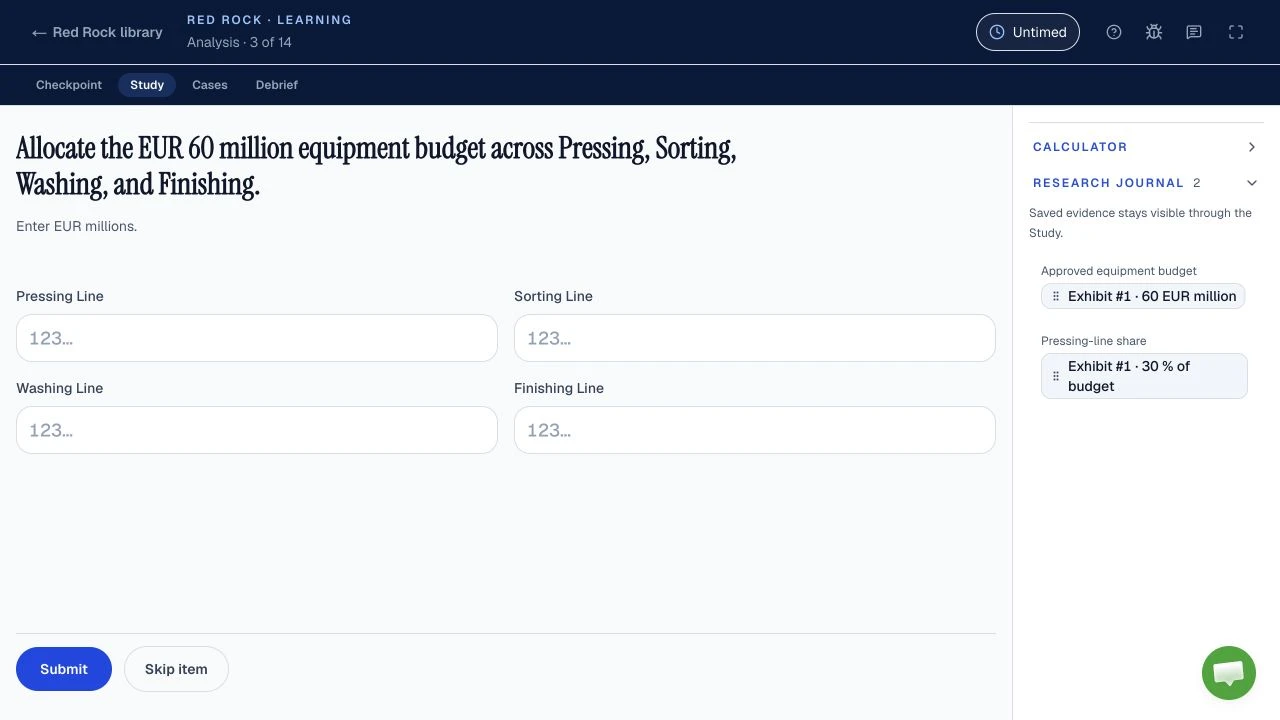
- Data
- A reef survey covers two regions. Region A has 0.6 km² of reef, of which 0.15 km² is bleached. Region B has 240 hectares of reef, of which 30 hectares are bleached.
- Question
- What share of the combined reef area is bleached?
- Lost point 1, mixed units
- (0.15 + 30) / (0.6 + 240) = 30.15 / 240.6 = about 12.5%. The numbers were added as if km² and hectares were the same unit.
- Lost point 2, averaged rates
- Region A is 0.15 / 0.6 = 25% bleached, Region B is 30 / 240 = 12.5%. Averaging gives (25% + 12.5%) / 2 = 18.75%, which gives the small region the same weight as the large one.
- Correct
- 1 km² = 100 hectares, so Region A is 60 ha of reef with 15 ha bleached. Combined: (15 + 30) / (60 + 240) = 45 / 300 = 15%.
Two of the three answers look plausible, and both would come out of a calculator without complaint. The fix is procedural: convert to one unit before you save the number, and pool counts before you divide whenever the question says "combined", "overall" or "total". Our Red Rock practice questions drill the same two errors on a different dataset.
Where do candidates lose points in Sea Wolf?
In Sea Wolf, candidates lose points by rejecting a microbe whose own value is out of range when only the treatment's average has to fit. Sea Wolf asks you to pick microbes so that the treatment's attribute averages fall inside a site's ranges, while trait rules hold. The trap is treating an average rule as if every member had to satisfy it. Again, this is a fictional example, not assessment content.
- Rule
- Choose three microbes. The average salinity tolerance must be from 5 to 7 inclusive, and at least one microbe must have the "filter" trait.
- Pool
- P = 9 (filter), Q = 4, R = 6, S = 3 (filter).
- Lost point
- A candidate rejects P because 9 is above 7. The only remaining trio that includes a filter is Q + R + S, with an average of (4 + 6 + 3) / 3 = 13 / 3 = about 4.33. That is below 5, so the candidate concludes no valid treatment exists, or submits an invalid one.
- Correct
- Convert the average range to a sum range: 5 × 3 = 15 to 7 × 3 = 21. Now test trios with P: P + Q + R = 19, P + Q + S = 16, P + R + S = 18. All three are valid, and each includes a filter.
The high-value microbe that looks out of range is often the one that balances the others. Reject a microbe only for a rule that applies to each member, such as a forbidden trait. The Sea Wolf practice guide has a fuller pool to work through.
Where do candidates lose points in the Sustainable Futures Lab?
In the Sustainable Futures Lab, the likely point loss is a later decision that contradicts the priorities you ranked earlier. The standard Sustainable Futures Lab, reported at about 20 minutes, opens with a ranking task and then asks roughly a dozen linked scenario decisions. McKinsey does not publish how SFL is scored, so the trap below is a coaching hypothesis rather than a known rule: decisions that contradict your own stated priorities are hard to defend under any reasonable scoring. This example is fictional.
- Your ranking
- 1. reliable water supply, 2. cost, 3. habitat protection. The budget cap is 100 units.
- Later decision
- Option X costs 80 units and drops reliable supply from 95% to 88% of days. Option Y costs 96 units and keeps supply at 95%.
- Lost point
- A candidate picks X because it is cheaper. But Y costs only 16 units more, which is 16 / 80 = 20% more, and both options fit under the 100-unit cap. Cost is not binding, so it should not override the top priority.
- Consistent choice
- Y protects the priority you ranked first while staying inside the budget. If Y had cost 104 units, the cap would bind and X would be the defensible choice.
The fix is to fix your objective and ranking in mind before the decisions start (check your tutorial for which note-taking, if any, is allowed) and ask of every decision: does this option serve the priority I ranked higher, and does a constraint actually force me off it? The SFL guide covers both the 20-minute version and the new 30-minute version that some 95-minute invitations include.
Can you fail McKinsey Solve?
Yes, you can fail McKinsey Solve in the sense that matters. McKinsey says Solve results are considered together with the rest of your application, so it can affect whether you advance; how much it weighs against your CV is not published. What does not exist publicly is a pass mark. McKinsey publishes no pass rate, no cutoff, no score scale shown to candidates and no scoring weights.
The confident numbers in the claims table above, such as 70% or 80% failing, circulate on prep sites without a McKinsey source, so treat them as unverified. Our pass rate guide traces where these figures come from, and the scores and results guide explains what your result can and cannot tell you. For when results usually arrive, see the Solve timeline.
Can you retake McKinsey Solve if you fail?
McKinsey publishes no retake or reapplication period for Solve; most coaches on a February 2026 PrepLounge thread say to wait about 12 months before reapplying. Official: neither the Solve page nor the August 2025 FAQ gives a period. Unverified reports: the figures below come from coaches and prep sites, not McKinsey, and they disagree.
| Claim | Who says it | Status |
|---|---|---|
| About 12 months before reapplying, some offices longer | Most coaches on a February 2026 PrepLounge thread | Coach opinion |
| At least 12 months | PSG Secrets, April 21, 2026 | Unverified |
| 6 to 12 months | CaseBasix full guide, August 23, 2026 | Unverified |
| No retakes; 12 to 24 months before reapplying | WallStreetGuide, May 29, 2026 | Unverified |
The practical answer: no public source describes a resit within the same application, and the wait before a new application is something to confirm with your recruiter rather than read off a prep site. The Solve timeline covers the reapplication wait in more detail.
Who finds McKinsey Solve hardest?
Four groups find McKinsey Solve hardest: strong quants who rush, careful readers who run out of time, candidates working in a second language, and candidates relying on old guides.
- Strong quants who rush. Speed with numbers tempts candidates to skip labelling. Red Rock punishes that more than slow arithmetic.
- Careful readers who run out of time. Reading every fact before acting can leave the six Red Rock Cases or the final Sea Wolf site under-timed. A rough time budget per section helps.
- Candidates working in a second language. Dense instructions take longer to parse. McKinsey's FAQ lists English, Spanish, Portuguese and Japanese as available languages; check your invitation for options.
- Candidates relying on old guides. Solve replaced the paper Problem Solving Test around 2019 to 2020, and early versions included Ecosystem Building and Plant Defense. 2026 candidate reports no longer include those games. Practising the wrong game is a quiet way to make Solve harder. See PSG, Imbellus and Solve and the Ecosystem game history.
Is McKinsey Solve harder than the old PST or a case interview?
McKinsey Solve is different from the old Problem Solving Test and from a case interview, rather than strictly harder. The paper PST was a multiple-choice business reasoning test; Solve uses game-like scenarios with no business content. A case interview tests structured conversation with an interviewer; Solve tests the same underlying habits (structure, evidence, consistent judgement) without anyone to ask for clarification. In our coaching view, case prep transfers most directly to Red Rock and the SFL, and least to Sea Wolf, which is closer to a constraint puzzle. If you are also applying to BCG or Bain, the MBB assessments comparison shows how their screens differ.
How can you make McKinsey Solve easier in one to two weeks?
To make McKinsey Solve easier, learn each current format once, do one timed run per game, drill the specific mistake that run exposes, and rehearse test day; in our coaching view one to two weeks is enough.
- Learn each format once. Read the McKinsey Solve overview and the 2026 changes log so you prepare for the current games.
- Do one timed run per game. Note where the clock went and which trap cost you. One free run per game is available on our practice page.
- Drill the specific mistake. Units and denominators for Red Rock, sum ranges for Sea Wolf, written priorities for the SFL.
- Rehearse test day. Use the test-day checklist and read your invitation for your exact length.
The Solve prep plan turns this into a day-by-day schedule, and the Solve tips collect the in-game habits that save the most time.
Run a timed Red Rock, Sea Wolf or SFL simulation
Sources and evidence boundaries
- McKinsey Solve official page and the August 2025 Solve FAQ, checked October 3, 2026: no business or gaming knowledge needed, untimed tutorials, length stated in your invitation, results considered with the rest of the application, listed languages. McKinsey's July 2025 blog gives the figure of around 300,000 early-career candidates taking Solve each year.
- Game timings and structures (Red Rock about 35 minutes, Sea Wolf about 30, SFL about 20 or 30) are candidate-reported, including the PrepLounge timing thread (August to September 2026). McKinsey has not published module specifications.
- Competitor coverage reviewed October 3, 2026 for gaps, including SolvePrep's difficulty page. Failure percentages and retake periods quoted on prep sites are unsourced estimates; they appear in the claims tables above, attributed and dated, and are not stated here as fact.
- All worked examples on this page are original and fictional. They illustrate reasoning errors; they are not McKinsey questions and do not reflect official scoring.