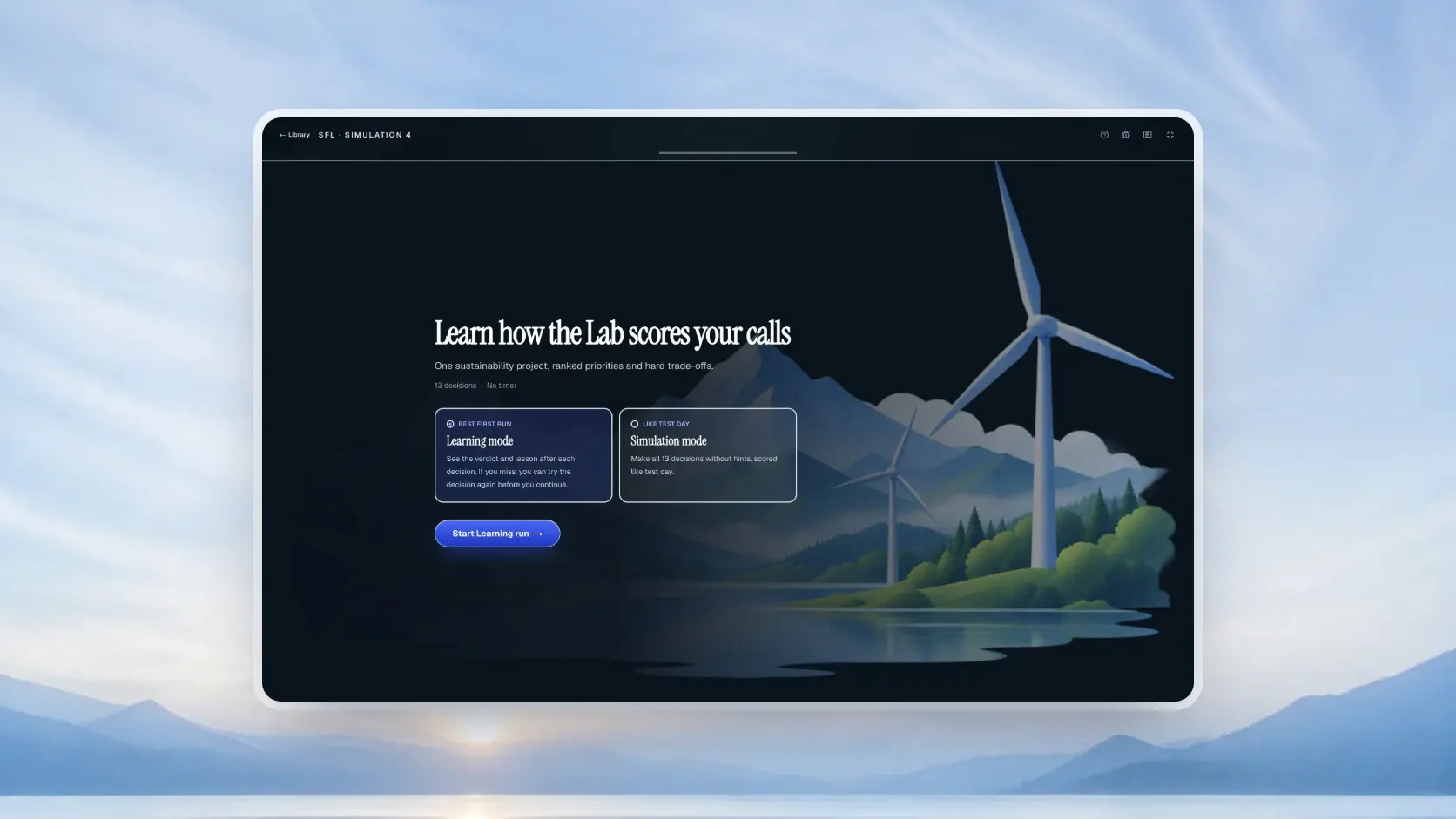
The short answer. In 2026 McKinsey Solve invitations state one of three lengths: about 65 minutes (Red Rock about 35, Sea Wolf about 30), about 85 minutes (those two plus the standard 20-minute Sustainable Futures Lab), or about 95 minutes (Red Rock, Sea Wolf and a newer 30-minute SFL in which you lead four researchers over three simulated days). These maps come from candidate reports, not McKinsey: 95-minute invitations were first reported on PrepLounge on August 24, 2026, the new 30-minute SFL was first described there on September 11, 2026, and 85-minute invitations were still reported in late September, so treat 95 minutes as a pilot. McKinsey's August 2025 Solve FAQ says only that your length is stated in your invitation and that each task starts with an untimed tutorial, which runs outside the game timers, so your sitting lasts longer than the number.
| Invitation | Games and minutes | Since | Evidence |
|---|---|---|---|
| About 65 min | Red Rock 35, Sea Wolf 30 | Reported through 2026 | Candidate-reported |
| About 85 min | Red Rock 35, Sea Wolf 30, standard SFL 20 | Prep-site dates from mid-2025; still sent in late September 2026 | Candidate-reported |
| About 95 min | Red Rock 35, Sea Wolf 30, new SFL 30 | Invitation first reported August 24, 2026; new SFL first described September 11, 2026 | Candidate-reported pilot |
| Tutorials | Untimed, one before each game | McKinsey Solve FAQ, August 2025 | Official |
Which games come with 65, 85 and 95 minutes?
A 65-minute McKinsey Solve has Red Rock and Sea Wolf, an 85-minute one adds the standard 20-minute Sustainable Futures Lab, and a 95-minute one has a newer 30-minute SFL in its place, according to candidate reports checked October 3, 2026. Minutes per game are approximate: candidates quote them from in-game timers and invitation emails, and McKinsey publishes no per-game split.
Two things are official, from McKinsey's digital assessment page and its August 2025 FAQ: the length of your assessment appears in your invitation, and each task opens with an untimed tutorial. Everything about which games come with which length comes from candidates.
How many minutes does each McKinsey Solve game take?
In every reported McKinsey Solve version, Red Rock takes about 35 minutes and Sea Wolf about 30; the Sustainable Futures Lab takes about 20 minutes in 85-minute invitations and about 30 in 95-minute ones (candidate reports, 2026). McKinsey publishes no per-game split. Each bar below is drawn to scale against 95 minutes. Use it to see where your time goes and how much of your sitting depends on each game.
- Red Rock
- Sea Wolf
- SFL
- New SFL
Reported minutes per game. Untimed tutorials sit outside these bars, so your session will run longer than the invitation number. The bars show composition, not the order you play the games in.
Two practical readings of the bars. First, Red Rock is the single largest block in every version, so it deserves the largest share of your preparation whatever your length. Second, moving from 85 to 95 minutes does not add a fourth game; it swaps a 20-minute SFL for a 30-minute one with a different interface and a different kind of decision.
What should you practise for a 65, 85 or 95 minute McKinsey Solve?
For any McKinsey Solve length, Red Rock deserves the most practice, then Sea Wolf; add the standard SFL for 85 minutes, and for 95 minutes train the habits the new SFL reportedly rewards instead of memorising standard SFL patterns. Knowing your length stops you practising for a game you will not see. Pick your row.
| Your length | Spend most time on | Also cover | Skip |
|---|---|---|---|
| 65 minutes | Red Rock: units, denominators, and finishing the six Cases on one shared clock | Sea Wolf: attribute averages inside each site's range | SFL practice |
| 85 minutes | Red Rock, then the standard SFL ranking task and consistency across about 12 decisions | Sea Wolf constraint checks | Nothing; all three games apply |
| 95 minutes | Red Rock, then the habits the new SFL rewards: targeted questions, staffing to constraints, steady judgment across days | Sea Wolf; the standard SFL as a warm-up for consistent decisions | Memorising standard SFL answer patterns |
If you have 65 minutes
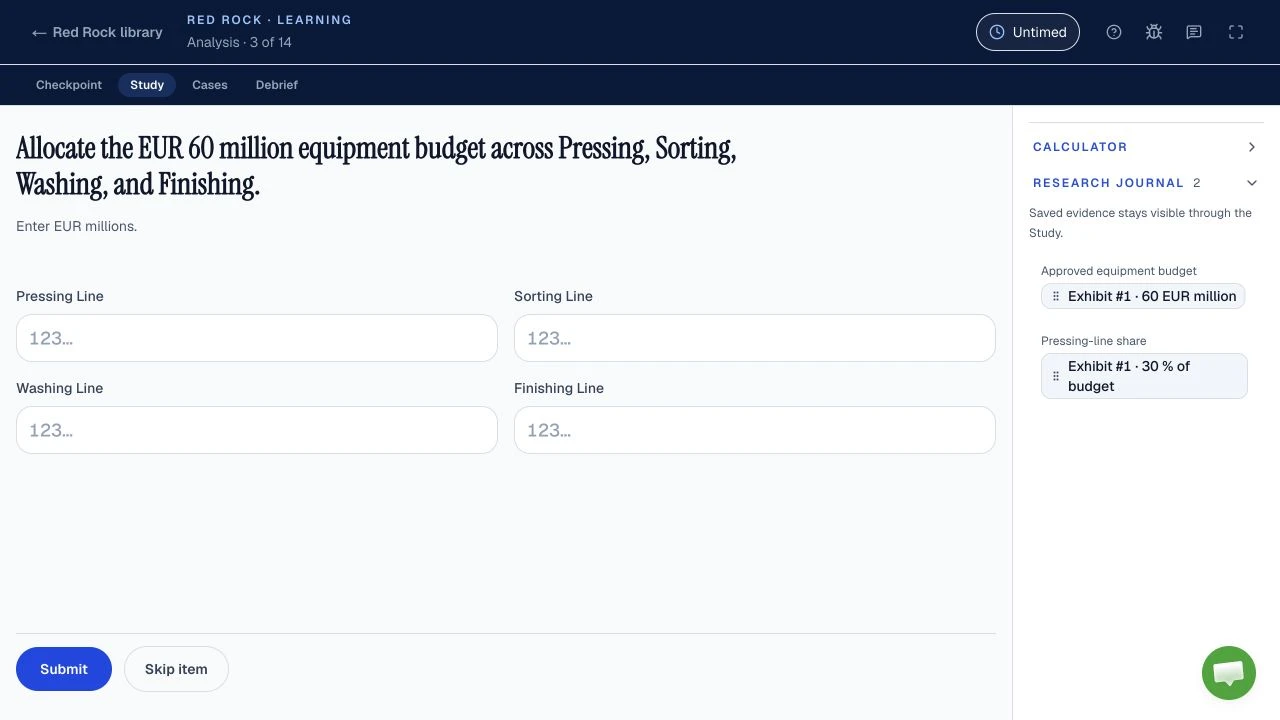
Red Rock is one Study (Investigation, Analysis, Report) followed by six standalone Cases on a shared clock of about 35 minutes, with an in-game calculator. Points are usually lost to unit slips, the wrong denominator and irrelevant facts dressed up as data, not to hard maths. The Red Rock practice method has a worked dataset built around exactly those traps. Sea Wolf asks you to pick microbes for three sites so that the treatment's attribute averages land inside each site's range while trait rules hold; the Sea Wolf practice method drills the range check that most errors come from.
If you have 85 minutes
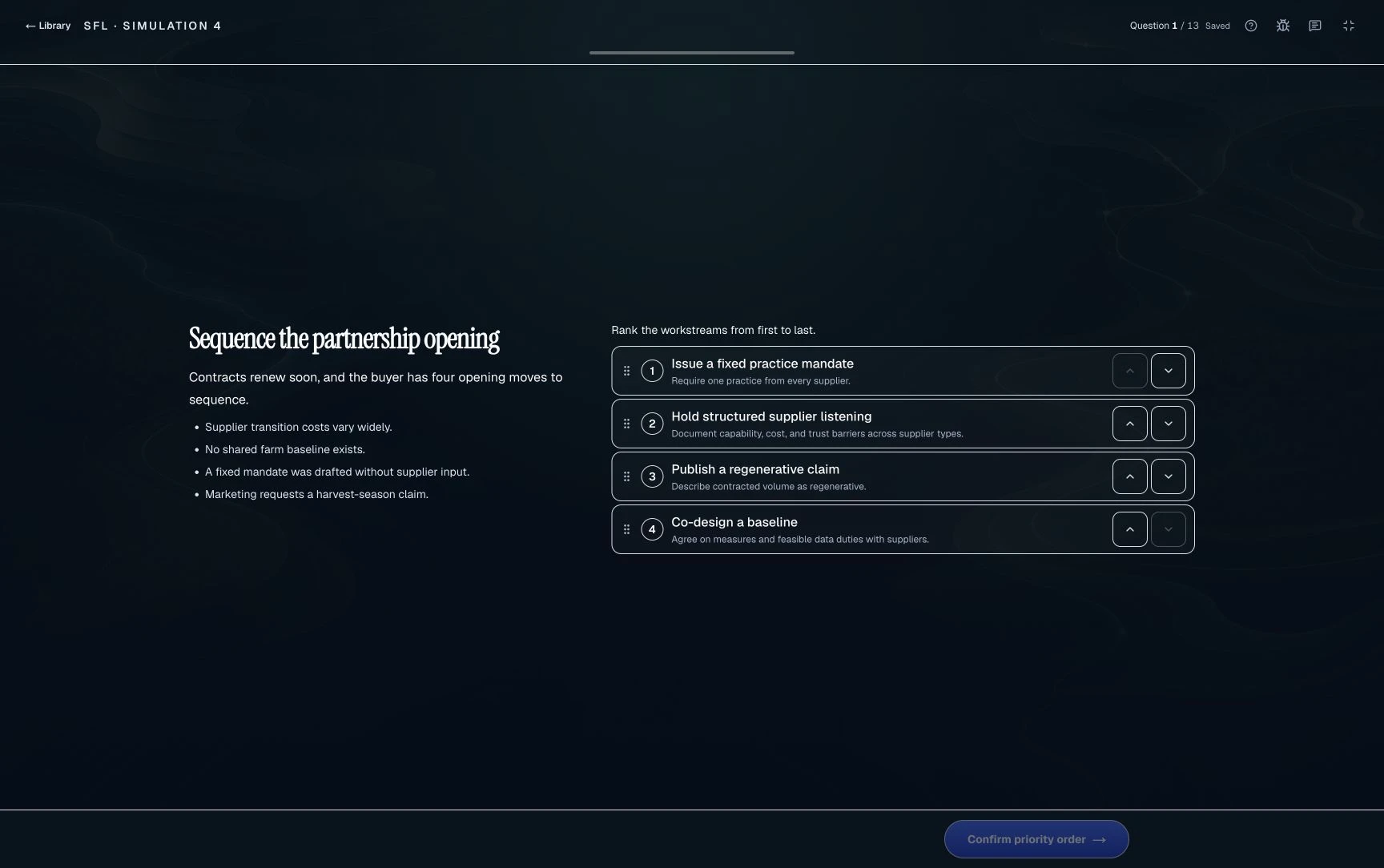
Everything above, plus the standard SFL: one ranking task, then about 12 linked scenario decisions in roughly 20 minutes. The skill is consistency. A decision on question 7 should still respect the priorities you set on question 1, unless new evidence gives you a reason to change. Practise stating a one-line rule for each decision before you click. The Sustainable Futures Lab guide has an original scenario that shows how new evidence should, and should not, move a ranking.
Run a free standard SFL simulation
If you have 95 minutes
Red Rock and Sea Wolf preparation does not change. The difference is the new SFL, and the honest position is that any practice version, including the ones some prep sites now sell, is a reconstruction of a format first described by a candidate on September 11, 2026. Road to Offer's version is coming soon. What you can train are the habits every report says it rewards: asking only for the information the day's goal needs, staffing people against hard limits, handling interruptions without abandoning your plan, and keeping your judgment consistent from day to day. Standard SFL practice still helps with the last of those. Until it ships, read the day-by-day walkthrough below twice and practise talking through each stage aloud.
How does the new 30-minute Sustainable Futures Lab work?
In the new 30-minute Sustainable Futures Lab, candidates report leading four researchers across four workstations over three simulated days, with each day repeating four stages: explore, assign, support and reflect. The only first-hand description is a September 11, 2026 PrepLounge post, and McKinsey has published nothing about the format.
Everything in this section comes from one first-hand candidate post and several prep sites that describe the format consistently, possibly from shared sources. McKinsey has published nothing about it. Treat the details as a working map and let the live tutorial overrule any of it.
The setup. You run a field research lab. You lead four researchers with different specialisms (reported as an ecologist, a biologist, a habitat planner and an engineer) and four workstations to staff (reported as water, plants, communications and animals), with no more than two researchers at one workstation. After a tutorial and onboarding, three simulated days follow. Instructions are reported to be text-heavy, with no calculator and no data exhibits, and with a notes panel that keeps your history.
The daily loop. Each day repeats four stages:
- Explore. Spend a small number of information requests on researchers or workstations. One prep site reports three requests per day and two on Day 3; treat the exact budget as unconfirmed. The skill is choosing the question that actually changes your next decision.
- Assign. Place researchers at workstations within the limits. A good assignment matches each person's strengths to what each station needs that day, not to what it needed yesterday.
- Support. Respond to dilemmas your researchers raise. The answer options are reported as dense paragraphs; read for the trade-off, not the tone.
- Reflect. Rate the state of your researchers. One prep site reports three rating states, neutral, balanced or unbalanced, and says their exact meaning is unclear; treat that as single-source. This is where consistency is tested: your ratings should follow from what you learned and decided, not from a fresh impression.
| Day | Reported focus | What to do well |
|---|---|---|
| Day 1 | The researchers' needs | Learn who is good at what, and spend requests on people, not stations |
| Day 2 | The workstations' needs | Staff the stations with the most pressing needs without breaking the two-per-station limit |
| Day 3 | Balancing both | Use what you learned on Days 1 and 2; with fewer requests, rely on your notes |
Why it is longer. The standard SFL asks for a ranking and then a run of separate decisions. The new version asks you to manage people over time, so each day's choices carry into the next. Ten extra minutes for three rounds of four stages is not generous. The candidate who reported it on September 11 described a much more complex interface. Pace yourself by day: roughly a third of the clock each, with a little held back for Day 3.
60.7%of available consistency points lost by candidates on SolvePrep's SFL simulator (95% interval 59.4% to 62.0%), its worst-performed component. Across 8,317 runs, SolvePrep's SFL guide reports 33.5% of situational-judgment points lost.
SolvePrep's own figures from its standard-SFL simulator, last reviewed by SolvePrep September 25, 2026 and read by us October 3, 2026. They measure that site's scoring, not McKinsey's. We have no comparable data of our own yet. The useful signal is the direction: consistency, the habit the new three-day format stretches further, is where practice runs lose most.
For the full side-by-side comparison of the two SFL versions, including an original practice scenario, read the Sustainable Futures Lab practice guide.
What if my invitation says something else?
If your McKinsey Solve invitation states a length other than 65, 85 or 95 minutes, prepare for the nearest reported version and ask your recruiter before starting if the number matches nothing. Those three lengths are only what candidates report most often; your invitation is the authority for your sitting. A few situations come up:
- A number close to one of the three, such as 60 or 90 minutes. Some invitations quote preparation or setup time separately. One candidate's email on August 25 described 85 minutes plus 20 minutes of preparation. Map your number to the nearest version, then prepare for every game that version could include.
- Your invitation or portal names the games. Those names beat any map, including this one.
- A length that matches nothing reported, or no length at all. Ask your recruiter before you start. Do not guess on the day.
- You are told the extra 10 minutes is only setup time. Several forum coaches said this in late August 2026, before a candidate described the new 30-minute SFL on September 11. Prepare for the longer game rather than relying on that reading.
Why do some sites give a different McKinsey Solve length?
Some sites still quote McKinsey Solve lengths that 2026 candidate reports contradict, such as 60 to 70 minutes (Leon Staff, May 31, 2026) or a 35-minute Sea Wolf (CaseBasix, August 23, 2026), while others predate the 95-minute reports. Here is who says what, and how each claim fits the dated candidate evidence above.
| Claim | Who says it, and when | How it fits the evidence |
|---|---|---|
| Solve takes 60 to 70 minutes | Recruiter blog Leon Staff, updated May 31, 2026 | Conflicts No candidate report in 2026 describes this length; invitations say 65, 85 or 95. |
| Sea Wolf lasts 35 minutes | CaseBasix full Solve guide, August 23, 2026 | Conflicts Its own SFL page and candidate reports give about 30 minutes; 35 is Red Rock. |
| The 13-question SFL has been replaced by the team version | PrepMatter, July 15, 2026 page, updated after the redesign | Conflicts An 85-minute invitation with the standard SFL was reported on August 25, and prep sites described both as live in late September. |
| The extra 10 minutes is setup buffer, or 95 is simply standard | Coaches on the PrepLounge timing thread, August 24 to 29, 2026 | Later contradicted On September 11 a candidate described a new, roughly 30-minute SFL. |
| No single length applies to everyone | Game Assessment Prep, updated September 11, 2026 | Consistent Matches McKinsey's FAQ: your invitation states your length. |
The invitation guide covers deadlines, time zones and who to contact when something looks wrong.
Do the untimed tutorials count toward the 95 minutes?
McKinsey's August 2025 Solve FAQ says each task starts with an untimed tutorial but does not say whether the invitation number includes them, so plan for a McKinsey Solve sitting longer than the stated 65, 85 or 95 minutes. That has two consequences. First, block more time than the invitation number: a 95-minute invitation is not a 95-minute afternoon. Add setup, a technical check and time to read each tutorial properly. Second, use the tutorials. They are the only official description of the interface you will meet, and for the new SFL in particular they are better evidence than any guide, this one included. The test day checklist sets out a realistic block to reserve.
When did the 95-minute McKinsey Solve first appear?
The 95-minute McKinsey Solve invitation was first reported on a PrepLounge thread on August 24, 2026, and the new 30-minute SFL inside it was first described on the same thread on September 11, 2026. McKinsey has announced neither, and 85-minute invitations kept arriving in between.
- August 24, 2026Candidate-reported
A candidate in the Middle East asks on a public PrepLounge thread why their invitation says 95 minutes. The earliest first-hand report we could verify.
- August 24 to 29CoachesLater contradicted
Several coaches on the same thread suggest the extra time is setup or transition time rather than new content.
- August 25Candidate-reported
Another candidate reports an 85-minute invitation: the older version was still being sent.
- September 11Candidate-reported
A candidate warns of a new, roughly 30-minute SFL with a much more complex interface. The only first-hand description of the new game we found.
- Late SeptemberPrep-site claim
Prep sites describe both versions as live. No region, role or office pattern has been identified, and McKinsey has made no announcement.
Filled dots mark the two first-hand reports that define the 95-minute version. All dates 2026.
The running record of these and other changes lives in our dated McKinsey Solve update log.
How should you plan the week before a 95-minute McKinsey Solve?
Before a 95-minute McKinsey Solve, give Red Rock two timed sessions and Sea Wolf and the standard SFL one each, prepare for the new SFL by rereading the day-by-day walkthrough, and sit with at least two hours blocked. Worked example: suppose your invitation arrives on a Monday, states 95 minutes and gives a Friday evening deadline. A proportionate plan, with dates that are illustrative rather than a McKinsey schedule:
- Monday: read the invitation for any named modules, run the technical check, and save the support contact.
- Tuesday: one timed Red Rock session; review every error by type (unit, denominator, irrelevant fact).
- Wednesday: one Sea Wolf session, then one standard SFL session focused on keeping each decision consistent with your opening ranking.
- Thursday: reread the day-by-day SFL walkthrough above, write your own one-line rule for each of the four stages, and a second Red Rock session.
- Friday morning: sit the assessment with at least two hours blocked, so untimed tutorials and setup never squeeze the games.
The same plan works for 85 minutes; drop Thursday's new SFL step. For 65 minutes, give Wednesday's SFL slot to a second Sea Wolf run.
Does a 95-minute McKinsey Solve change your odds of passing?
No public evidence says a 95-minute McKinsey Solve is easier or harder to pass than an 85 or 65-minute one; McKinsey publishes no pass mark, pass rate or scoring weights (see McKinsey Solve pass rate and scores and results). The length also does not tell you:
- Your stage or office. No pattern links length to region or role in public reports.
- The game order. Reports differ on order, so prepare each game as a standalone block.
- That the new version is permanent. Both versions coexist. It may spread, be revised or disappear.
Plan your preparation from here
If your deadline is close, the 7, 3 or 2 day prep plan allocates time by game; the McKinsey Solve tips list the habits that protect your score in each. If you are new to Solve, start with the complete McKinsey Solve guide, and if you saw older names like the PSG or the Imbellus test, the PSG and Imbellus explainer confirms they refer to the same screen. One free run each of Red Rock, Sea Wolf and the standard SFL is on the practice page.
Sources and evidence boundaries
- Official: McKinsey's digital assessment page and the Solve FAQ (PDF, August 2025), both checked October 3, 2026. They state that the length is in your invitation and that tutorials are untimed. They name no games per length and say nothing about a 95-minute version.
- First-hand candidate reports: the PrepLounge timing thread (posts dated August 24, August 25 and September 11, 2026), checked October 3, 2026.
- Prep-site reports, treated as unverified and cited for the new SFL's structure: Solve Games Guide (including the daily request budget and the neutral, balanced or unbalanced rating states, single-source claims), SolvePrep (85 vs 95 page, reviewed September 25, 2026, for the 60.7% figure and its interval; SFL guide for the 8,317-run count and 33.5%) and PrepMatter (day goals, a single-source claim), all reviewed October 2 to 3, 2026.
- Conflicting published claims, listed in the table above and reviewed October 3, 2026: Leon Staff (May 31, 2026), CaseBasix's full Solve guide (August 23, 2026), PrepMatter's SFL page (July 15, 2026) and Game Assessment Prep (September 11, 2026).
- Not established anywhere public: official confirmation of the pilot, a region pattern, scoring for either SFL version, or whether the 95-minute version will replace the 85-minute one.