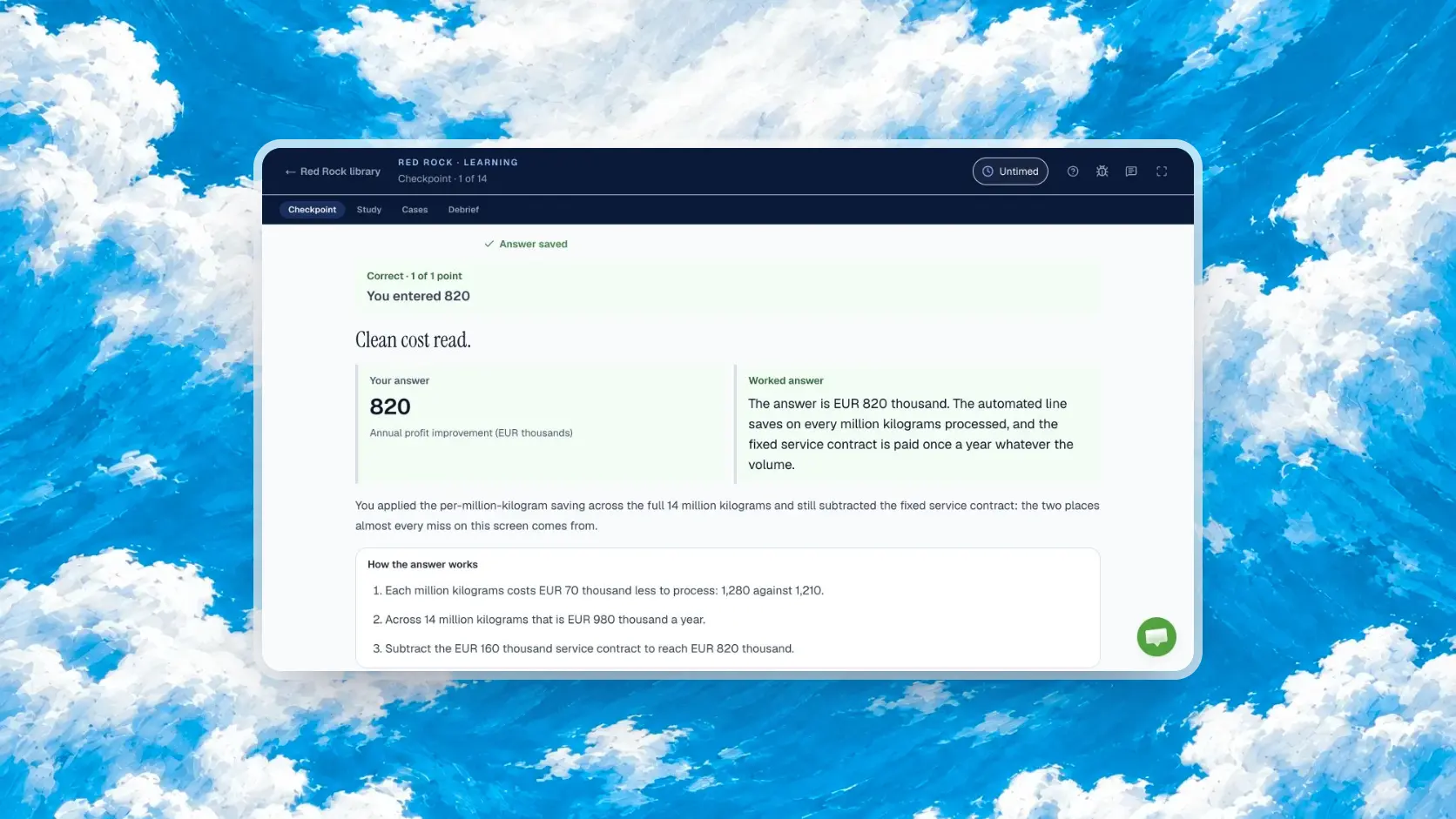
McKinsey, BCG and Bain each screen with a different online assessment. McKinsey Solve is a game-based test with no business content (candidates report 65, 85 or 95 minutes), BCG's online case is a chatbot-led business case called Casey (about 35 minutes on BCG's US page), and Bain's digital assessment is an aptitude test on Sova or TestGorilla that Bain says takes approximately 30 to 40 minutes. None of the three firms publishes a pass mark. Official facts were checked on each firm's careers pages on October 3, 2026; everything else is labelled as reported by candidates and prep providers.
| Assessment | Format | Length |
|---|---|---|
| McKinsey Solve | Game-based scenarios: Red Rock, Sea Wolf, and in longer invitations the Sustainable Futures Lab (games reported) | Stated in your invitation (official); candidates report about 65, 85 or 95 minutes |
| BCG online case (Casey) | Chatbot-led business case with structured questions, free-text answers and a video summary | About 35 minutes (BCG US page); 25 to 35 minutes reported elsewhere |
| Bain digital assessment (Sova or TestGorilla) | Online aptitude assessment; Sova or TestGorilla depending on role and region | Approximately 30 to 40 minutes (Bain's page); 45 to 60 minutes reported by some prep sites |
How do McKinsey Solve, BCG Casey and Bain SOVA compare?
McKinsey Solve is the longest and least familiar of the three MBB screens, BCG Casey is the closest to a real case interview, and Bain's Sova or TestGorilla test is a standard graduate aptitude test. Beyond the format and length above, they differ in the skills tested, when they arrive and whether you sit them again, per each firm's pages checked October 3, 2026.
| Aspect | McKinsey Solve | BCG online case (Casey) | Bain digital assessment (Sova or TestGorilla) |
|---|---|---|---|
| Skills | Data reasoning, constraint checking, consistent decisions; no business or gaming knowledge needed | Case structuring, business math, chart reading, synthesis | Problem solving, communication and analytical skills; reported numerical, logical, verbal and situational or behavioural sections |
| When in process | After you apply; results considered with the rest of your application | Select candidates, about 2 weeks after the application deadline (US page) | If required; in some markets the link arrives within one week of applying |
| Retake | No published retake or reapplication period; about 12 months reported by coaches | Online case not repeated if you have taken it before (US page) | No retake needed once completed, unless directed otherwise |
| What to practise | Timed runs of each game; units, denominators, average rules | Mini-cases with a written answer and a short spoken summary | Timed aptitude sets and the Sova sample questions |
Familiarity is the biggest practical difference: case preparation transfers directly to Casey, Bain's test resembles other graduate aptitude tests, and McKinsey Solve looks like neither, which is why it attracts the most preparation questions and why most of this site focuses on it.
When does each MBB firm send its online assessment?
All three MBB online assessments come after you apply and before interviews. BCG's US page says the CCA arrives 30 to 90 minutes after you apply and the online case about two weeks after the application deadline, Bain says its link arrives within one week in some markets, and McKinsey publishes no standard timing for Solve invitations (checked October 3, 2026).
- Apply
- Solve (game-based)
- Interviews
- Apply
- CCA, 30 to 35 min
- Online case (Casey), select candidates
- Interviews
- Apply
- Sova or TestGorilla, if required
- Interviews
Simplified from each firm's careers pages, checked October 3, 2026. Steps and timing vary by office, role and year; your invitation email is authoritative.
What is McKinsey Solve?
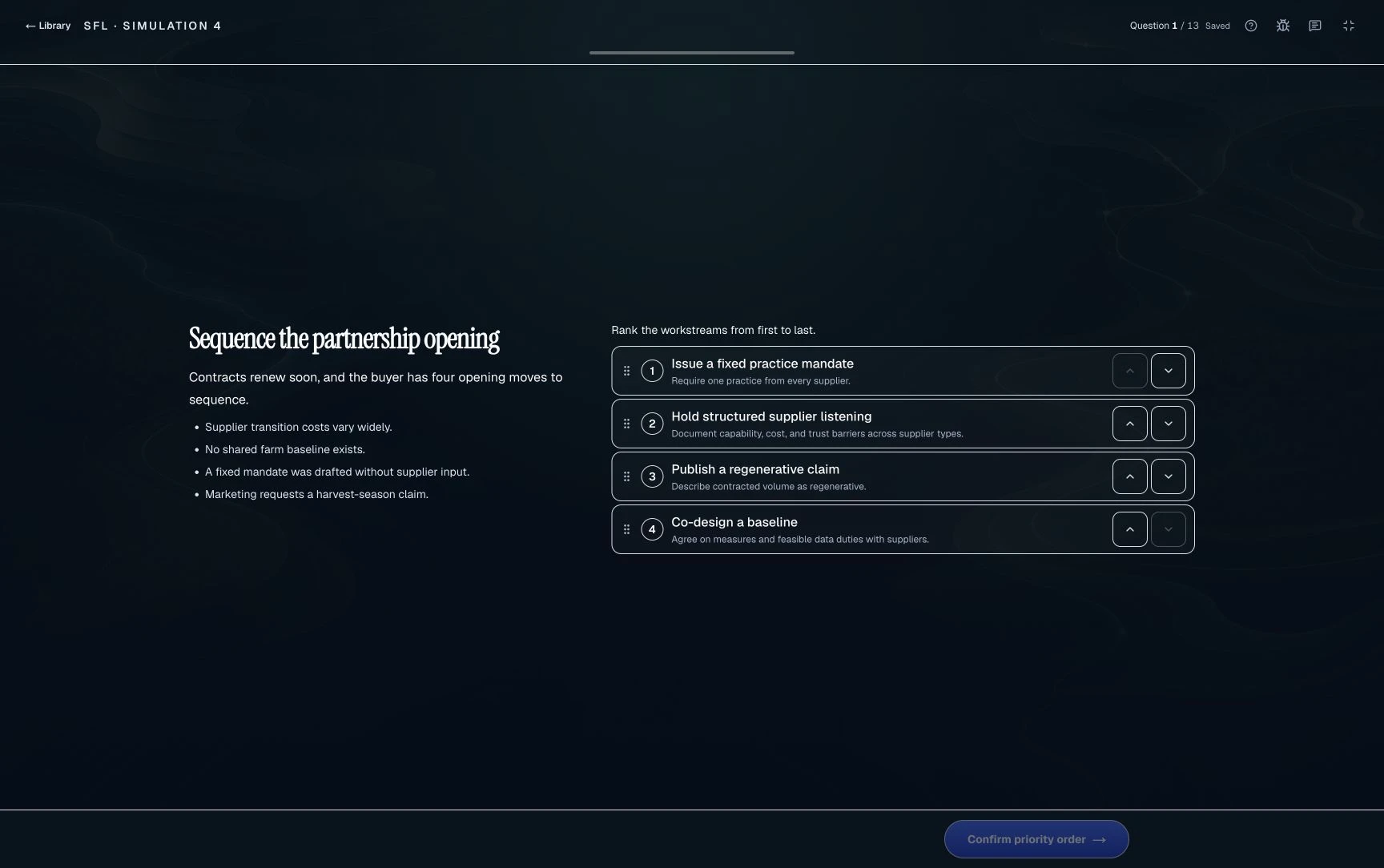
McKinsey Solve is McKinsey's game-based online assessment, built around ecology scenarios with no business content; 2026 candidates report Red Rock, Sea Wolf and, in longer invitations, the Sustainable Futures Lab. McKinsey's July 2025 blog post says Solve is given to around 300,000 early-career candidates a year.
Official: the McKinsey Solve page and the August 2025 FAQ describe Solve as a game-based assessment. Your total length is in your invitation email. Each task starts with an untimed tutorial. No business or gaming knowledge is needed. You take it on a PC or Mac, alone, without outside tools or recording, and results are considered together with the rest of your application. The FAQ lists English, Spanish, Portuguese and Japanese as languages.
Reported: candidates describe three invitation lengths. About 65 minutes covers Red Rock (about 35 minutes) and Sea Wolf (about 30). About 85 minutes adds the standard Sustainable Futures Lab (about 20 minutes: one ranking task, then about 12 linked scenario decisions). About 95 minutes adds a new 30-minute SFL instead, best treated as a pilot: 95-minute invitations were first reported on PrepLounge on August 24, 2026, and the new SFL was first described there on September 11. The 95-minute guide and 2026 changes log track this.
- Red Rock: one Study (Investigation, Analysis, Report) then six standalone Cases, with an in-game calculator. Traps are units, denominators and irrelevant facts. Practise with the Red Rock method.
- Sea Wolf: three sites; choose microbes so treatment averages fall inside site ranges while trait rules hold. See the Sea Wolf method.
- Sustainable Futures Lab: linked decisions where consistency with your own priorities matters. See the SFL guide.
Solve is the hardest of the three to prepare for cold, simply because nothing else looks like it. Our page on whether Solve is hard walks through where candidates lose points in each game.
Try a free McKinsey Solve game simulation
What is BCG Casey?
BCG Casey is BCG's chatbot-led online case: a case interview chatbot presents a business scenario and works through structured questions, free-text answers and a short video summary. BCG's US associate page lists the online case at about 35 minutes for select candidates, checked October 3, 2026.
Official: BCG's US associate recruiting page lists two online steps. First, the Consulting Career Assessment (CCA), sent 30 to 90 minutes after you apply, taking about 30 to 35 minutes, with 48 hours to complete. Second, for select candidates, an online case of about 35 minutes, sent about two weeks after the application deadline; candidates who have already taken it are not asked again. A BCG alumni interview describes the origin of "Casey", a case interview chatbot that presents a scenario and asks how you would diagnose the problem and propose solutions, through structured questions, free-text answers and a video summary.
Reported: candidates and prep providers describe Casey as roughly 25 to 35 minutes with about 6 to 10 questions: a mix of multiple-choice structuring, calculations from exhibits, and a short written or recorded recommendation. Steps vary by country. MyConsultingCoach's online case guide is one of several third-party descriptions; none is an official specification.
What about BCG's Pymetrics games?
Several prep sites say some BCG offices have used Pymetrics, a set of short behavioural games, instead of or alongside the online case. CaseBasix (August 2026) presents Pymetrics as BCG's screen, while MBB Prep (June 2026) describes BCG's assessment as case-style with pymetrics-style game exercises in some processes. BCG's US recruiting page, checked October 3, 2026, mentions only the CCA and the online case, with no game-based assessment. Treat Pymetrics as office-specific and reported: if your BCG invitation names it, prepare for it; otherwise prepare for Casey.
What makes it hard: unlike a live case, there is no interviewer to clarify a question or steer you back. The clock runs per question, and the video summary asks you to synthesise in a minute or so without notes from a human. The core skills are the ones a case interview tests: structure the problem, do clean math from an exhibit, and lead with an answer.
- Exhibit
- a regional bakery chain has revenue of 120 million and costs of 108 million, a 10% margin. Question: how much must costs fall, with revenue flat, to reach a 15% margin?
- Common slip
- cutting costs by 5% of 108 million (5.4 million) because the margin gap is 5 points. That gives costs of 102.6 million and a margin of 17.4 / 120 = 14.5%, short of the target.
- Correct
- a 15% margin on 120 million is 18 million of profit, so costs must be 120 minus 18 = 102 million. The cut is 108 minus 102 = 6 million, about 5.6% of costs. Same unit and denominator discipline as Red Rock, in business clothing.
This example was written for this guide and is not taken from any BCG assessment. Its point is that Casey's numbers are simple, but the question wording decides which base you divide by, exactly the habit Solve rewards.
How to practise: do short written mini-cases under a timer, then record a 60-second spoken recommendation and play it back. Road to Offer has a Casey-style chatbot simulation at roadtooffer.com/bcg-casey-chatbot.
What is the Bain SOVA test?
The Bain SOVA test is Bain's online aptitude assessment, delivered on Sova or TestGorilla depending on role and region. Bain's page says it takes approximately 30 to 40 minutes and allows pen, paper and a calculator on both platforms, checked October 3, 2026.
Official: Bain's digital assessment page says candidates for intern and full-time consulting roles may be required to complete a digital assessment. After you apply, an email tells you whether it is Sova or TestGorilla, which depends on role and region, and in some markets the link arrives within one week. The assessment takes approximately 30 to 40 minutes and reflects problem solving, communication and analytical skills. Pen, paper and a calculator are allowed for both TestGorilla and Sova, but Bain says calculators are not allowed in later interviews. If you have already completed the assessment, Bain says you will not need to retake it unless directed otherwise. TestGorilla should be completed in one sitting, while Sova sections can be spread across sittings before the deadline. AI tools, recording, screenshots and transcription software are prohibited, and applications are not considered if the assessment is missed. Bain also points candidates to Sova's own candidate preparation area for sample questions.
Reported: candidates describe Sova sections covering numerical reasoning, logical or abstract reasoning, verbal reasoning and a situational-judgement or work-preference questionnaire. The mix varies by office and year, so treat any fixed section list as a report.
How long, really? Sources disagree. Bain's page says approximately 30 to 40 minutes. SolvePrep's MBB comparison (undated, checked October 3, 2026) says candidates report 45 to 60 minutes in total. We could not find the basis for the longer figure; one possibility is that it counts instructions or the questionnaire, but that is a guess. Plan on Bain's figure, and treat the time in your own invitation as final.
What makes it hard: per-question time is short and the items are generic aptitude questions rather than consulting scenarios, so case preparation alone does not cover it. Numerical items reward the same habits as Red Rock: read the table header, check the unit, and estimate before calculating.
How to practise: work timed numerical and logical sets, then the Sova sample questions Bain links to. Road to Offer has Bain-style practice at roadtooffer.com/bain-online-assessments.
How much do the skills overlap?
The skills behind McKinsey Solve, BCG Casey and Bain's aptitude test overlap more than the formats suggest. All three reward reading a question precisely, separating relevant from irrelevant information, doing simple arithmetic accurately under time, and committing to a conclusion. Where they diverge:
- Only Solve tests constraint puzzles (Sea Wolf) and long linked decision chains (SFL) with no business framing.
- Only Casey asks you to structure a business problem and summarise it aloud.
- Only Bain's test includes generic verbal and logical aptitude items and, reportedly, a work-style questionnaire.
In practice, Red Rock preparation is the most transferable single block: unit and denominator discipline helps in Casey's exhibits and Bain's numerical items. The Solve tips list the habits that carry over.
If you only have one invite, what should you prepare?
Spend nearly all your preparation on the one format you face: timed game runs for McKinsey Solve, timed mini-cases with a spoken summary for BCG Casey, or timed aptitude sets for Bain's Sova or TestGorilla test.
- McKinsey only
- All of it on Solve. Check your invitation length to see whether you face the SFL, then do one timed run of each game and review errors by type. Start with the Solve prep plan.
- BCG only
- Case practice first: timed written mini-cases with exhibit math and a 60-second spoken summary. In the US, also keep a 35-minute slot free within 48 hours of applying for the CCA. Add Pymetrics-style practice only if your invitation names it.
- Bain only
- Timed numerical, logical and verbal aptitude sets, then the Sova sample questions Bain links to. Sit it early in the window, because a missed assessment means the application is not considered.
- Two or three
- Learn every format before you apply, then follow the sequencing plan below. Red Rock style data work is the block that transfers most.
- Reapplying
- Check with the recruiter whether you must sit the assessment again: Bain and BCG say a completed assessment is not normally repeated, and McKinsey publishes no rule. Then put the time into whatever your last attempt exposed.
Our recommendation, based on each firm's page as checked October 3, 2026. Steps vary by office; your invitation is authoritative.
How should you prepare if you apply to McKinsey, BCG and Bain?
If you apply to McKinsey, BCG and Bain, learn all three formats before you submit any application, sit the shorter Bain and BCG tests early in their windows, and give McKinsey Solve its own unhurried block. Invitations arrive on different clocks. Bain says its link arrives within a week in some markets, BCG's US CCA arrives within hours with a 48-hour window, and Solve deadlines are set in your McKinsey invitation. That makes order matter. A plan that works for most candidates:
- Before you submit any application: do one timed run of each Solve game and one Casey-style mini-case. You cannot control when invitations arrive, so learn the formats first. The Solve prep plan sets out a one to two week schedule.
- If you apply to BCG in the US: keep a free 35-minute slot within 48 hours of submitting, because the CCA follows quickly.
- When the Bain link arrives: do two short timed aptitude sets the day before, then sit the assessment early in its window rather than at the deadline.
- When the Solve invitation arrives: check your length to see which SFL version you face, using the invitation guide, then follow the test-day checklist.
- Between assessments: keep case practice going. Interviews follow all three screens, and BCG's online case draws on the same skills.
If two deadlines collide, sit the shorter assessment first (Bain or BCG) and give Solve a separate, unhurried block, since it is the longest and the most tiring. Use the Solve timeline to plan around when results typically arrive.
- Preparing for one test and assuming it covers the others. Casey needs case structuring and Bain needs aptitude pacing; Solve practice alone covers neither fully.
- Missing a short window. BCG's US CCA gives 48 hours, and Bain says applications are not considered if the assessment is missed.
- Ignoring the time in your invitation. Solve length tells you which games you face; Bain's and BCG's stated times tell you how long to protect.
- Trusting an old comparison. Articles that list Ecosystem Building or Plant Defense as current describe an earlier Solve.
Start with a timed Red Rock, Sea Wolf or SFL run
Do McKinsey, BCG or Bain publish a pass mark?
No. McKinsey publishes no pass rate, cutoff, candidate-facing score scale or scoring weights for Solve, and neither BCG nor Bain publishes a threshold on the pages reviewed for this guide. Percentages quoted on prep sites are estimates. See the Solve pass rate guide and the scores and results guide for what is known.
Are the PSG, the Imbellus test and McKinsey Solve the same?
Yes. The PSG, the Imbellus test and the digital assessment are older names for McKinsey Solve, the same screen, which replaced the paper Problem Solving Test around 2019 to 2020. Some also describe Ecosystem Building or Plant Defense, which 2026 candidate reports no longer include. If a comparison article lists those as current, check its date. See PSG, Imbellus and Solve and the Ecosystem game history. For the full overview, start at the McKinsey Solve guide.
Sources and evidence boundaries
- McKinsey Solve official page and August 2025 Solve FAQ, checked October 3, 2026.
- BCG US associate job opportunities page (CCA and online case timing) and BCG alumni interview on Casey, checked October 3, 2026. BCG's general interview process page does not describe the online assessments. Other offices may differ.
- Bain digital assessment page, checked October 3, 2026 (duration, one-week link in some markets, calculators allowed for both TestGorilla and Sova but not in later interviews, no retake once completed). Bain's page does not list Sova's section types; the section list above is reported.
- McKinsey game timings are candidate-reported, including the PrepLounge timing thread (August to September 2026). Casey question counts and Sova sections are reported by candidates and prep providers, including MyConsultingCoach and SolvePrep, reviewed October 3, 2026. Pymetrics references come from CaseBasix and MBB Prep. The McKinsey reapplication report is from a February 2026 PrepLounge thread.