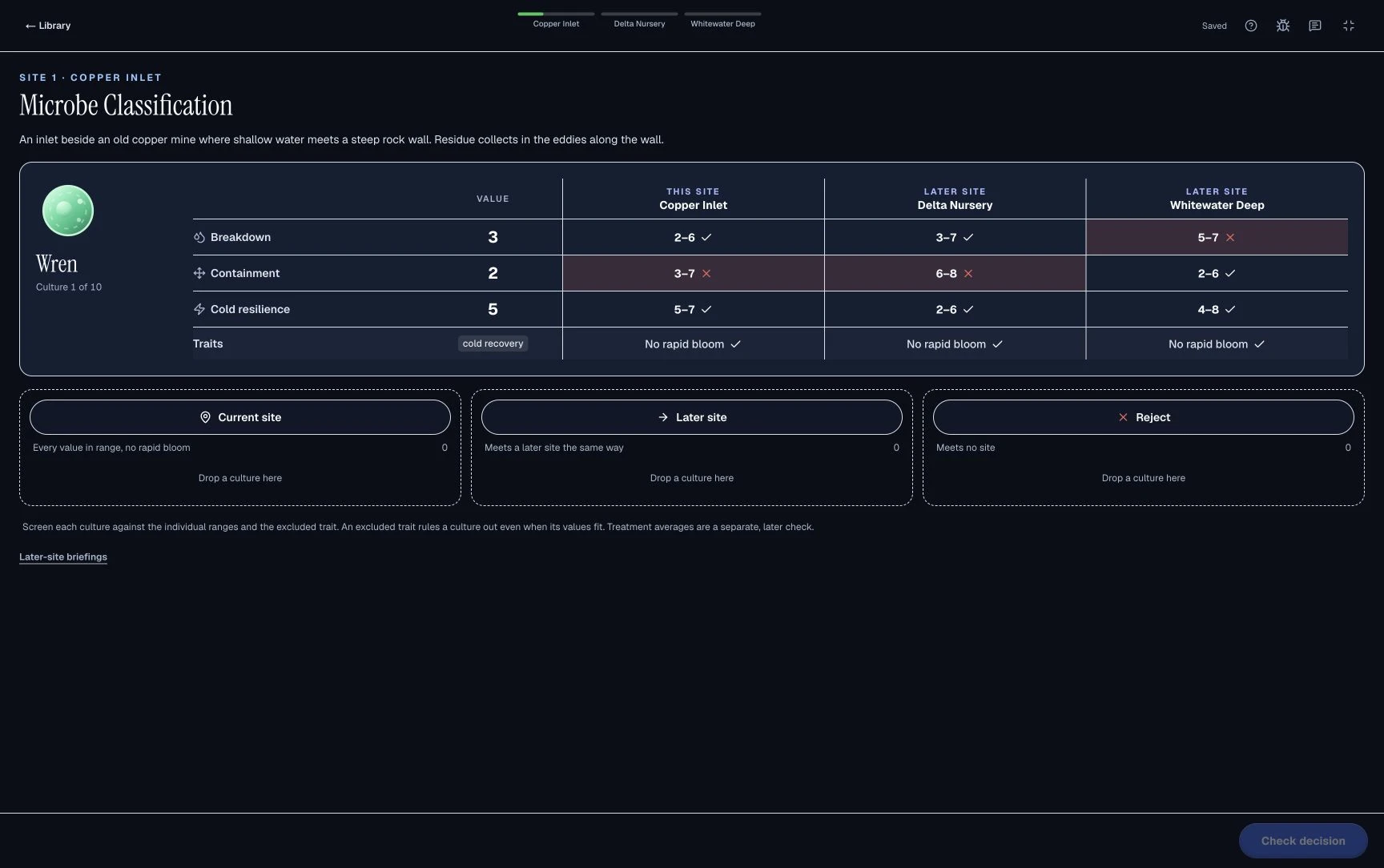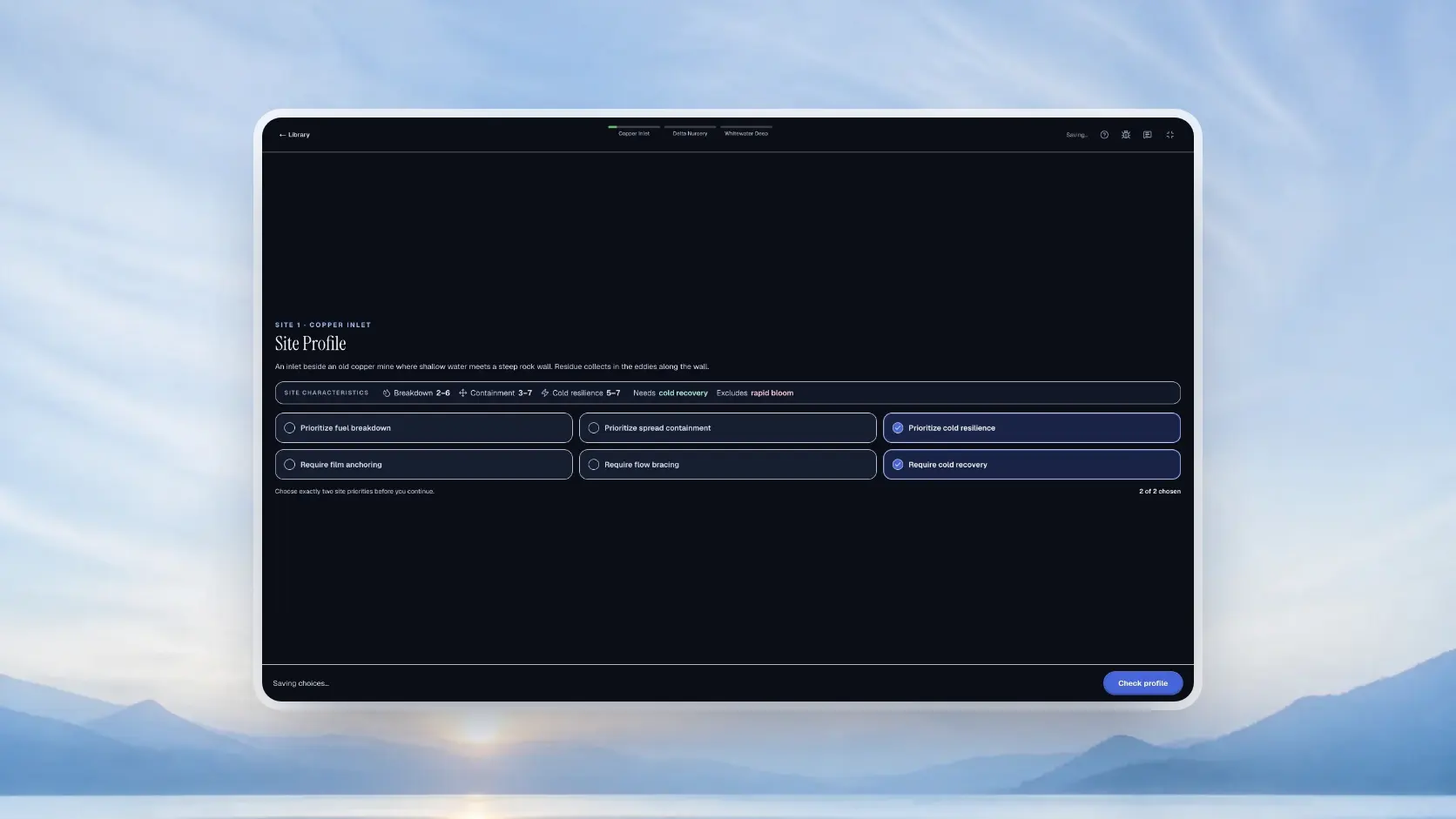
Use this Sea Wolf cheat sheet before your assessment: read the site rules, keep useful options for the current or next site, build a pool that can form a valid trio, then check every average and trait. These phase details are reported, not published by McKinsey. Your live tutorial and site instructions decide the actual rules.
| Point | Short answer | Status |
|---|---|---|
| Sea Wolf | McKinsey names a microbe-selection task for contaminated sites. | Official, July 2025 blog |
| Tutorial | Each Solve task begins with an untimed tutorial. | Official, Solve FAQ |
| Reported shape | Three sites, about 30 minutes, three-microbe treatments. | Reported, unverified |
| Live notes | Pre-prepared notes are prohibited, except for an accommodation approved in writing. | Official, Solve FAQ |
| Scoring | Sea Wolf weights, pass mark and score scale are not published. | Not published in checked McKinsey sources |
What are the Sea Wolf rules on one page?
For the reported Sea Wolf format, use this one-page rehearsal sequence: profile the site constraints, sort for current or later use, pick prospects that complete a viable pool, then test a three-microbe treatment; McKinsey leaves the exact mechanics to the live tutorial. Read each step as a decision prompt, not as an instruction to reproduce a fixed screen. A current-site option that looks strong alone may be a poor partner in the final trio, so the last column names the slip to catch.
Profile
ReadEvery site range and trait requirement
CheckWhich constraint will be hardest to satisfy with a trio?
Common slipPicking a comfortable characteristic without reading all site rules
Categorise
ReadEach microbe and any next-site preview
CheckCurrent fit, later potential or return, using what the screen reveals
Common slipRejecting a useful partner because one value is outside an average range
Prospect
ReadThe existing pool and each offered choice
CheckWhich choice adds a missing trait or balances a limiting range?
Common slipKeeping the highest numbers without testing possible trios
Treat
ReadFinal pool, ranges and traits
CheckDistinct trio, every target sum, required trait, excluded trait
Common slipChecking only one attribute or only one bound
Transitionif your screen shows it
ReadSaved microbes and the next site’s full rules
CheckWhether a saved choice still belongs there
Common slipAssuming a prior preview was the whole next-site brief
Rehearsal only McKinsey prohibits pre-prepared notes during Solve, so this sheet is not allowed in the assessment: learn the order beforehand, then close it. Reported format The steps are candidate-reported and the live tutorial decides the actual rules.
Candidate descriptions differ on whether the last step is a separate confirmation or appears at the beginning of the next site. They also disagree on whether profiling or categorisation changes your later pool. This sheet therefore asks you to read what your screen offers before each choice. For a full walkthrough and original puzzles, use the Sea Wolf rules, strategy and practice guide; this page is the compact reminder. If you have met the same task under an older name, the guide to Ocean Treatment and Ocean Cleanup versus Sea Wolf sorts out what the checked sources do and do not settle.
Which checks should you memorise before Sea Wolf?
Memorise five checks for the reported Sea Wolf treatment format, while letting the live tutorial replace any detail that differs: count, traits, sums, both bounds and final review. The order keeps categorical exclusions out of your arithmetic and prevents an attractive but invalid trio from consuming your time.
- Count.
Confirm how many distinct microbes the screen asks you to choose.
- Traits.
Include the required trait and leave out the excluded trait if the site names them.
- Convert.
Multiply both ends of each average range by the required group size.
- Add.
For every attribute, compare the trio's sum with its lower and upper target.
- Review.
Recheck all constraints against the displayed selection before you confirm.
Reported format The sequence is our rehearsal method. The tutorial, site brief and actual selection count take priority during Solve.
The check order works even if the interface uses different labels: read the rule, separate an individual restriction from a group average, then test the complete proposed answer. On a practice run, say the five verbs aloud after each site. If you keep forgetting one, review that error rather than reading a longer strategy article again: the guide to Sea Wolf mistakes that break a treatment pairs each slip with its fix. The Solve tips guide covers the broader habit of checking the stated objective before confirming any game decision.
What should you check when profiling a Sea Wolf site?
In the reported Sea Wolf profiling step, read every displayed range and trait, then prioritise the constraint hardest to repair with partners; McKinsey does not publish how that choice affects later options or scoring. Keep the choice consistent with the objective shown on screen.
Suppose a fictional practice site has one narrow average range and needs a specific trait. If the pool may not contain that trait, a trait priority deserves attention; if values near a range edge are scarce, the edge range may be the better focus. That is a decision rule, not a promise that profiling changes which microbes appear. Reports conflict on whether it does. You can still show coherent reasoning without relying on a hidden effect.
Do not apply a personal rule such as “always pick the required trait” before reading the actual site. A different site may make a numerical ceiling more restrictive, or your interface may define profiling differently. McKinsey says scenarios and parameter combinations vary; its official FAQ says the untimed tutorial explains the objective and navigation. For where Sea Wolf sits beside the other reported games, see the complete Solve overview, and for the skills each game is described as testing, read what McKinsey Solve measures.
How should you sort microbes for the current and next sites?
Reported Sea Wolf walkthroughs describe sorting each microbe between the current site, a later site and a return choice according to the rules and preview visible on screen; McKinsey has not published the exact buckets or what a sorted microbe later affects. A current-site exclusion may make it a poor treatment choice here without proving it is useless for a different site's traits.
For example, a fictional current site excludes a Bloom trait while the next-site preview mentions only a high Stability need. A Bloom microbe with high Stability may deserve a later-site look if the game permits saving it. You cannot assume it belongs there: the next site's full trait rules might exclude Bloom too. Likewise, an individual attribute below a current average range is not automatic grounds for return, because two partners could raise the group mean.
The original exercise used later on this page shows that second point. Its fictional site asks for an average Uptake of 3 to 5. Two of the three microbes below sit outside that range on their own, yet their average sits inside it.
- Average range for the trio3 to 5
- Tide alone2Outside
- Reef alone5Inside
- Kelp alone6Outside
- Tide + Reef + Kelp average4.33Inside
Original exercise with fictional microbes. The range applies to the group average in the reported format, so judge the trio, not each value.
Slip
Compares Tide alone with a range that applies to the trio's average, and returns a useful partner.
Right check
Averages the three values first. The group lands inside the range even though two members do not.
Classify with the evidence available, then stop. If the interface presents a later review, update your decision when it reveals the complete next-site requirements. If it does not, the same provisional reasoning still avoids treating a preview as a guarantee. The longer Sea Wolf guide works through the full reported loop; the dated Solve change log explains why older fixed-screen descriptions should be handled cautiously.
How do you choose a Sea Wolf prospect?
For the reported Sea Wolf prospect step, choose the option that helps your existing pool form a complete valid trio; McKinsey does not publish a universal pick rule or exact pool mechanics. If a required trait is absent, a candidate carrying it may be valuable; if every likely trio exceeds a ceiling, a lower value can be more valuable than the biggest number on the screen.
Use a quick feasibility check instead of ranking prospects by isolated strength. Pick a plausible pair already in the pool, subtract their values from each target-sum interval, and see which offered prospect can complete it while respecting traits. In the original exercise, suppose Tide and Reef are already in your pool and the site's allowed sums are 9 to 15 for Uptake, 15 to 21 for Stability, 6 to 12 for Spread. First add the pair.
Tide + Reef, Uptake
Tide + Reef, Stability
Tide + Reef, Spread
Then subtract each pair sum from both ends of its allowed sum. What is left is the room the third microbe may fill.
Uptake still needed
Stability still needed
Spread still needed
A lower end below zero means no minimum is left, so any Spread value up to 5 completes the pair. Both offered prospects fit the Uptake and Stability windows; Spread separates them.
- Room left0 to 5
- Kelp (Neutral)2Inside
- Foam (Bloom)6Outside
Original exercise. Foam has the bigger numbers but overshoots the Spread ceiling and carries the excluded Bloom trait. Kelp completes the trio.
If no pair is promising, scan another pair or protect the most restrictive missing condition. The exact values are teaching data, not a real Sea Wolf screen; Sea Wolf math takes the same sum shortcut further and adds an elimination order for larger pools.
Some reports describe several rounds with options you cannot revisit. Check navigation in the tutorial before you depend on going back. The key preparation habit is to preserve complementary choices so the final pool can form a complete treatment. Rehearse that choice on the independent practice page, then review which requirement your selected prospect actually helped. For a study schedule around that run, use the Solve prep plan; if you are deciding which game to rehearse first, Red Rock versus Sea Wolf compares the two.
How do you check a three-microbe Sea Wolf treatment?
In the reported format, check three distinct microbes as a group: each attribute average must fit its site range and the set must obey the stated trait rules; McKinsey has not published this as a fixed public specification. Start with the categorical rules, then test every numeric range. A microbe that sits outside one range alone can still belong to a valid group.
Here is an original fictional site. Its target average ranges are 3 to 5 for Uptake, 5 to 7 for Stability, 2 to 4 for Spread, with Binder required and Bloom excluded. The names, attributes, ranges and traits are invented only for this guide. They are not live questions or an official score model.
| Microbe | Uptake | Stability | Spread | Trait |
|---|---|---|---|---|
| Tide | 2 | 8 | 2 | Binder |
| Reef | 5 | 4 | 5 | Neutral |
| Kelp | 6 | 6 | 2 | Neutral |
| Foam | 7 | 8 | 6 | Bloom |
Test Tide, Reef and Kelp. Tide supplies Binder and none carries Bloom, so the traits pass. Now average each column of the table for the three chosen microbes.
Uptake average
Stability average
Spread average
As a countercheck, replace Kelp with Foam. The drawing puts both trios on each attribute's range.
Original exercise Both trios start from Tide + Reef. The Kelp trio has Binder and no Bloom; the Foam trio keeps Binder but brings Bloom, which no average can repair.
One attribute only
Stops after Uptake, where the swap still fits, and never reaches the Spread ceiling or the trait rule.
Every attribute
Tests each sum against both bounds. Spread is over its upper target, and Foam's Bloom trait fails separately.
This comparison also explains why the order of checks matters. If you notice Foam's trait first, you can discard that trio without spending time on arithmetic. If you calculate anyway as a learning exercise, you discover a second failure: Spread is over the upper limit. Checking only the trait would miss a useful diagnosis of the mistake, while checking only the sums would miss the categorical one. The Solve difficulty guide discusses why holding several constraints at once can feel harder than the arithmetic itself.
How do you convert Sea Wolf average ranges into target sums?
For the reported three-microbe format, multiply both ends of an average range by three to get the allowed total; use the live group size if it differs. This is an arithmetic identity for our exercise, not an official Sea Wolf rule. A sum check avoids dividing every candidate trio repeatedly and keeps both the floor and ceiling visible.
Average range to sum target
Size is the number of microbes in the treatment: 3 in the reported format and in this exercise.
Uptake sum target
Stability sum target
Spread sum target
For the invented Tide, Reef and Kelp treatment, add each column from the microbe table and compare the total with its target. No division is needed.
Uptake sum
Stability sum
Spread sum
Every total lies between its bounds, inclusive. The same picture shows why the Foam swap fails: its Spread total is past the ceiling.
- Sum target (2 to 4 average × 3)6 to 12
- Tide + Reef + Kelp9Inside
- Tide + Reef + Foam13Outside
Original exercise. Compare exact sums during the search; a total that lands on a bound is inside it in this exercise.
Rounded averages are for explanation; compare exact sums during the search, especially if a total lands on a boundary. Never turn a range into one target number: a trio can be valid anywhere inside both bounds. For more original drills on the same conversion, including what to eliminate first, continue with the sum shortcut and elimination order.
What if no Sea Wolf trio meets every condition?
If no trio satisfies every reported constraint, choose the best supported option available and move on, while remembering that McKinsey has not published Sea Wolf penalty weights or a universal rule for impossible sites. First check that you have read both bounds and every trait correctly; a missed option can make an achievable treatment look impossible. Then compare the remaining trios by the number and nature of their failed stated requirements.
- Reread the brief.
Both bounds of every range, the required trait and the excluded trait. A misread rule is the most common reason a site looks impossible.
- Rescan the pool.
Look for a microbe you dismissed on one individual value. It may balance a trio.
- Name the blocker.
Missing trait, lower bound, upper bound or a conflicting partner.
- Commit and move on.
Pick the trio that breaks the fewest stated requirements, by the smallest margin, and keep time for the remaining sites.
Our rehearsal method McKinsey publishes no penalty weights, so this path ranks trios by the stated rules only. It is not a scoring model.
Do not assume an informal efficiency percentage is a known pass mark. Preparation accounts disagree on whether an excluded-trait deduction applies once or per microbe, and the checked official materials give no conversion from site performance to an overall result. This sheet deliberately avoids assigning a score to the Foam swap. The only claim the fictional exercise makes is that it fails its stated rules. The Solve score and results guide covers what a post-test result can and cannot establish, and how the Solve result is used explains its place beside the rest of your application.
If the clock is pressing, a complete defensible selection is preferable to indefinitely searching a pool that may have no perfect trio. Use your rehearsal to identify which condition made a site difficult. That label makes the next practice run useful without guessing how McKinsey scores your clicks. For the assessment sequence and official setup rules, read the test-day guide.
Can you bring this Sea Wolf cheat sheet into the assessment?
No: McKinsey officially prohibits pre-prepared notes during Solve unless an accommodation for a disability is approved in writing, so this cheat sheet is for rehearsal before your assessment. Its Solve FAQ also prohibits outside applications, websites and AI tools, screenshots, recordings and help from another person. Read the official rules in your invitation and tutorial; if an approved accommodation applies, follow its written terms.
Before, in rehearsal
- Read this sheet and learn the order of the checks
- Run independent practice sites with the sheet open
- Repeat with the sheet closed until the order is memory
During Solve, official rule
Official The right-hand column follows McKinsey's Solve FAQ. The only stated exception is an accommodation approved in writing.
Practise without referring to the sheet after you understand the five checks. Run an independent Sea Wolf attempt, pause afterward to name where you missed a range or trait, then try a fresh scenario. McKinsey says scenario parameters and data combinations vary, so memorising this fictional Tide, Reef and Kelp answer would teach nothing transferable. The useful memory is the order: read, screen, add, compare and review. If your invitation names a different task mix, the invitation guide helps you parse what is actually stated, and the system requirements guide covers the device and browser setup to sort out before you start.
Independent practice is a rehearsal, not the official assessment. The free practice chooser opens Road to Offer's complete free Sea Wolf run: all three sites, with Profile, Classification, Prospect Pool and Treatment at each site, on a 30-minute Simulation clock. Start without an account, then create a free account to finish and keep your score and worked debrief. No payment is needed for the first run or its review, which explains where points went and each submitted decision, with constraint and treatment visuals. After your run, return to this sheet only to diagnose a mistake; leave it closed during the real sitting. If you wonder whether a spreadsheet or solver could stand in for the five checks, the Sea Wolf solver and Excel guide explains why it cannot. Short answers to the other rules questions candidates ask are collected in the Solve FAQ with 30 short answers.
The free offer covers one complete run of each of four practice formats: Red Rock, Sea Wolf, SFL Classic and SFL Island. Red Rock includes the full Study and six Cases on a 35-minute practice clock; Classic includes all 13 linked decisions without a countdown; Island includes onboarding and all three project days on a 30-minute Simulation clock. Learning mode provides a step-by-step path with coaching and feedback as you go across all four formats, untimed in the clocked games; it is paid access included with the matching game pack, the Solve pack or qualifying Annual access. Road to Offer's separate Solve plan is free with a free account and uses your invitation length and test date to select dated practice steps for up to 28 days.
Sources and evidence boundaries
- Official, checked October 11, 2026: McKinsey's Solve page describes the assessment, the ban on prepared notes and outside tools, and how its result contributes to an application. The Solve FAQ (August 2025 PDF) states that each task has an untimed tutorial, the invitation gives total length, and scenarios vary. McKinsey's July 2025 blog names Sea Wolf and describes selecting and evaluating microbes for contaminated sites.
- Reported, unverified: the three-site, three-microbe, average-range and phase descriptions, along with about 30 minutes for Sea Wolf. Reports differ on whether profiling affects later options, how saved microbes reappear and whether categorised microbes join the final pool. The in-game tutorial governs your sitting.
- Not published in the checked official sources: Sea Wolf's detailed rules, site penalty formula, process weights, pass mark, score scale and exact game duration. The Tide, Reef, Kelp and Foam data, the rehearsal sheet, the decision path and the five-line check order are our original teaching material, not McKinsey content. Every figure comes from the accompanying dataset and is recomputed by its test.