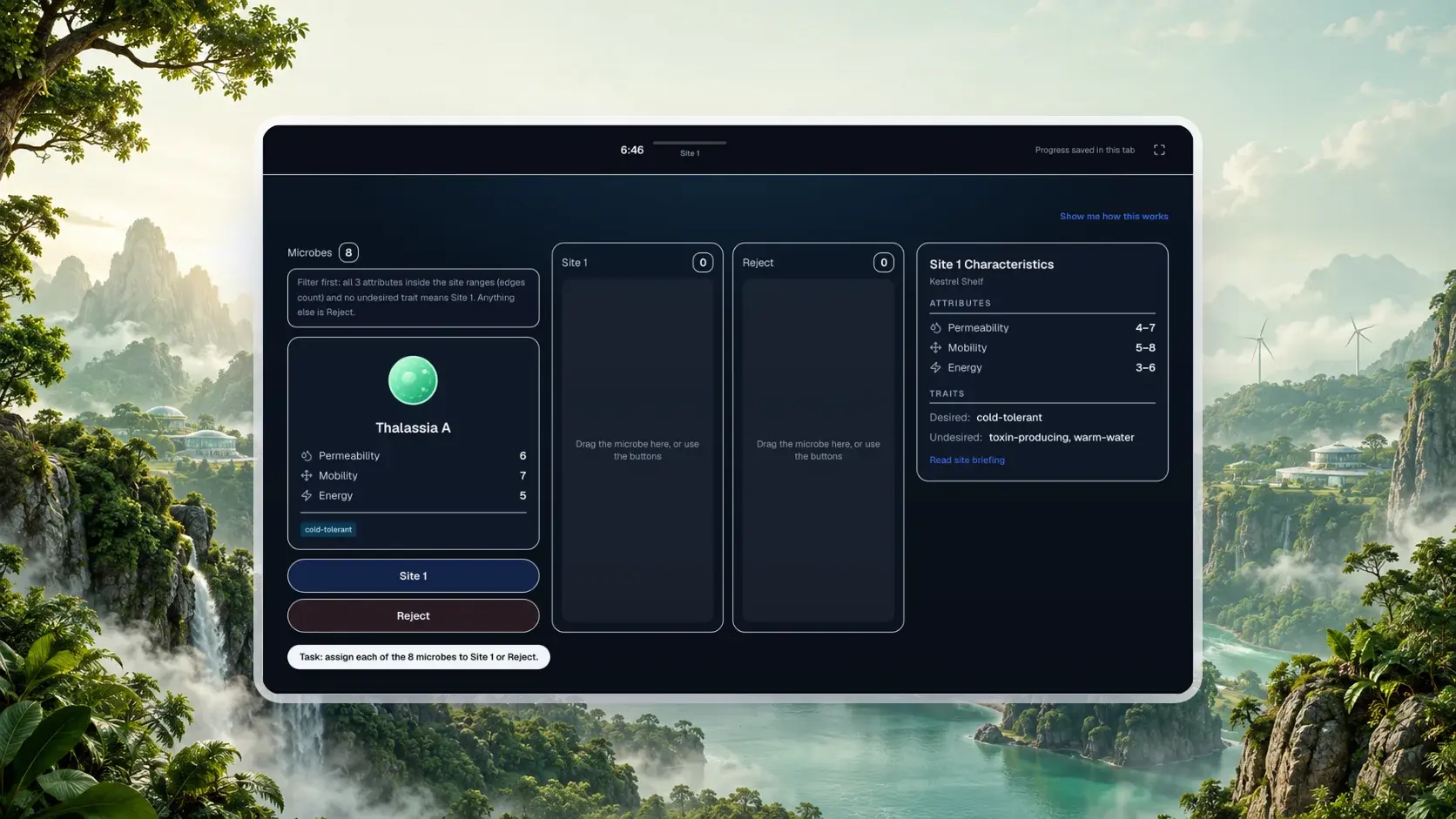
McKinsey officially describes Solve as a game-based step in consultant recruiting. It does not publish a test list by role, so no public guide can tell every applicant which assessment they will receive. Use your invitation as the decision point. Older accounts of specialist or technical assessments are unverified, not a firm-wide policy.
| Question | Short answer | Status |
|---|---|---|
| Consultant recruiting | Solve is a game-based assessment used as one step. | Official, Solve page |
| All roles | No public assessment list by role or guarantee that every applicant takes Solve. | Not published in the McKinsey sources checked |
| Assessment length | The length of your Solve sitting is in your invitation. | Official, Solve FAQ |
| Older multiple-choice test | McKinsey says Solve replaced an earlier multiple-choice test; the PST name is historical. | Official history; PST label is reported |
| Rules across assessments | McKinsey publishes integrity expectations for assessments and interviews. | Official, integrity page |
Which McKinsey online assessment might you get for your role?
McKinsey officially identifies Solve as a consultant recruiting assessment, but it publishes no role-by-role assignment list, so your invitation is the only dependable answer for your application. The map below separates that official description from what applicants report about other tracks and from what is simply not published. A role label can help you decide what to check next; it cannot predict an invitation, and McKinsey does not say that every applicant receives a Solve invitation.
- Official stated by McKinsey
- Reported applicant accounts, unverified
- Retired replaced, according to McKinsey
- Not published absent from the McKinsey sources checked
Consulting generalist
- OfficialSolveThe game-based assessment McKinsey names as one step in consultant recruiting.
- RetiredEarlier multiple-choice testMcKinsey says Solve replaced it. Candidates knew it as the PST.
- Not publishedWho receives SolveNo public rule says which applicants are invited.
Start here. If your email names Solve, begin with the Solve overview.
Specialist or expert
- ReportedRole-specific screening or interview tasksDescribed by applicants, and different from one role to the next.
- Not publishedA standard online test for this familyNone appears in the McKinsey sources checked.
Start here. Prepare the step your invitation names. Ask the recruiter when the label is unclear.
Technical or digital
- ReportedQuantHubOlder accounts mention it for some analytics roles.
- ReportedTechnical evaluationDescribed in some digital hiring processes.
- Not publishedWhether either applies to your roleMcKinsey publishes no role-to-test list.
Start here. Prepare the stated technical step. Use Solve material only if Solve is named.
An evidence map, not an assignment policy. “Retired” means McKinsey says Solve replaced that test; it gives no date for every office. Nothing here predicts what your own invitation will name.
The two lanes on the right are deliberately thin. SHL appears in older, unverified accounts of McKinsey hiring, without a reliable current role assignment, and QuantHub is reported only for some analytics applicants. Neither appears in an official role-to-test list in the sources checked here, and a technical interview or assessment centre is a distinct hiring step, not automatically a timed online test. If you are applying with several years of experience or from a business school, the experienced-hire guide and the MBA candidate guide cover what is reported for those routes.
McKinsey's July 2025 account of its game lab says around 300,000 early-career consultant candidates take Solve each year. That supports its use at scale in consultant recruiting, not a claim that every consultant or specialist candidate takes it. The same account calls Solve an additional data point; McKinsey's FAQ says the recruiter considers it with the rest of the application and other assessments. For what that means in practice, read how the Solve result is used.
Choose independent Solve practice. Road to Offer offers one complete free run of each of four practice formats: Red Rock, Sea Wolf, SFL Classic and SFL Island. Start without an account; create a free account to finish and keep your score and worked debrief, with no payment for the first run or its review.
Does McKinsey still use the Problem Solving Test?
McKinsey officially says its game-based assessment replaced an earlier multiple-choice test, while “Problem Solving Test” or “PST” is the reported name attached to that older format; the public sources checked do not give a current role-specific PST policy. The Problem Solving Test guide covers what the test was and whether PST practice still helps. Do not prepare for a paper-style PST solely because an old article uses that name. Read the assessment named in your own email first.
In its July 2025 game-lab account, McKinsey explains that its earlier test was quantitative and multiple choice. The firm wanted a way to observe how candidates think, rather than only whether they chose the right option. That is the supported historical change. The source does not publish a calendar date on which every office stopped using the old format, and it does not say no candidate can ever see a multiple-choice question in another assessment.
The practical distinction is format. PST preparation materials typically train a written quantitative screen. Solve is McKinsey's current named game-based assessment. If your invitation says Solve, start with how to read the Solve invitation, then use the Solve preparation plan. If the invitation uses an unfamiliar label, ask the recruiter what task and rules it refers to before choosing practice material.
Are PSG, Imbellus and Solve different assessments?
McKinsey officially calls its current game-based assessment Solve and says it acquired Imbellus; candidates have used “Imbellus test” and “Problem Solving Game” (PSG) as older names for that assessment, but those aliases do not guarantee the same games or rules today. A name in an old video identifies an era more reliably than the contents of your current invitation.
- Before the gamesRetiredMultiple-choice test
McKinsey confirms. It previously used a very quantitative multiple-choice test, and Solve replaced it.
Reported. The names Problem Solving Test and PST, and its description as a paper test, come from candidates.
- Older game namesReportedImbellus test and PSG
McKinsey confirms. It was the first client of Imbellus, later acquired the start-up, and has had its game lab since late 2020.
Reported. The labels “Imbellus test” and “Problem Solving Game”, and the game lists in old guides.
- TodayOfficialSolve
McKinsey confirms. Solve is the name on its careers page, and Sea Wolf is a game candidates play.
Not published. The full task mix. Your invitation and the tutorial tell you what your sitting contains.
The track translates labels. It does not promise that today's game mix matches an older recording, and McKinsey publishes no date for each change. For the full history, read PSG, Imbellus and Solve.
“Digital assessment” adds another layer of ambiguity: it can be a generic phrase for an online step, and it appears in the URL of McKinsey's official Solve page. That does not make every digital step for every role Solve. Look for the named assessment, its link, and its stated task instructions. Scenario names drift in the same way: the Ocean Treatment and Ocean Cleanup guide sorts the older labels candidates attach to the microbe task. The cross-firm assessment comparison answers a different question if you have invitations from several consulting firms.
What is actually known about the games inside Solve?
McKinsey officially names Sea Wolf as part of Solve, but it does not publish a current game list, order, per-game times or a universal assessment length; Red Rock and Sustainable Futures Lab are candidate-reported names. That distinction matters when an older guide presents a game list as a permanent specification.
McKinsey's July 2025 game-lab article describes Sea Wolf as selecting and evaluating microbes to clean contaminated sites. Candidates report Red Rock as a data investigation followed by shorter questions and Sustainable Futures Lab in some longer invitations. Those descriptions can orient your practice, but they are not official blueprints. The Red Rock method, Sea Wolf method and Sustainable Futures Lab guide own the detailed formats and original exercises, and what Solve measures in each game covers the skills behind them.
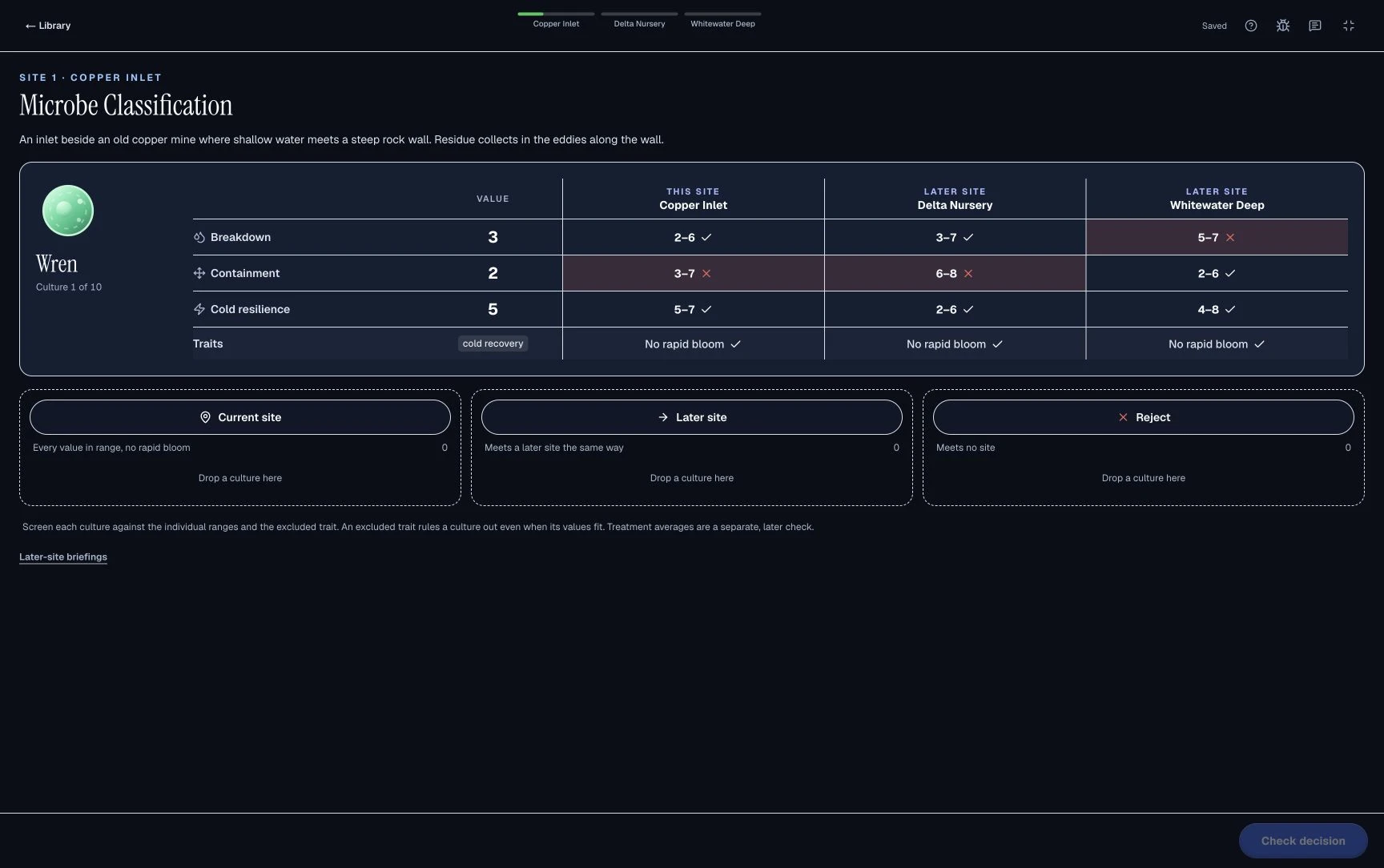 Official nameSea Wolf
McKinsey describes selecting and evaluating microbes to clean up contaminated sites.
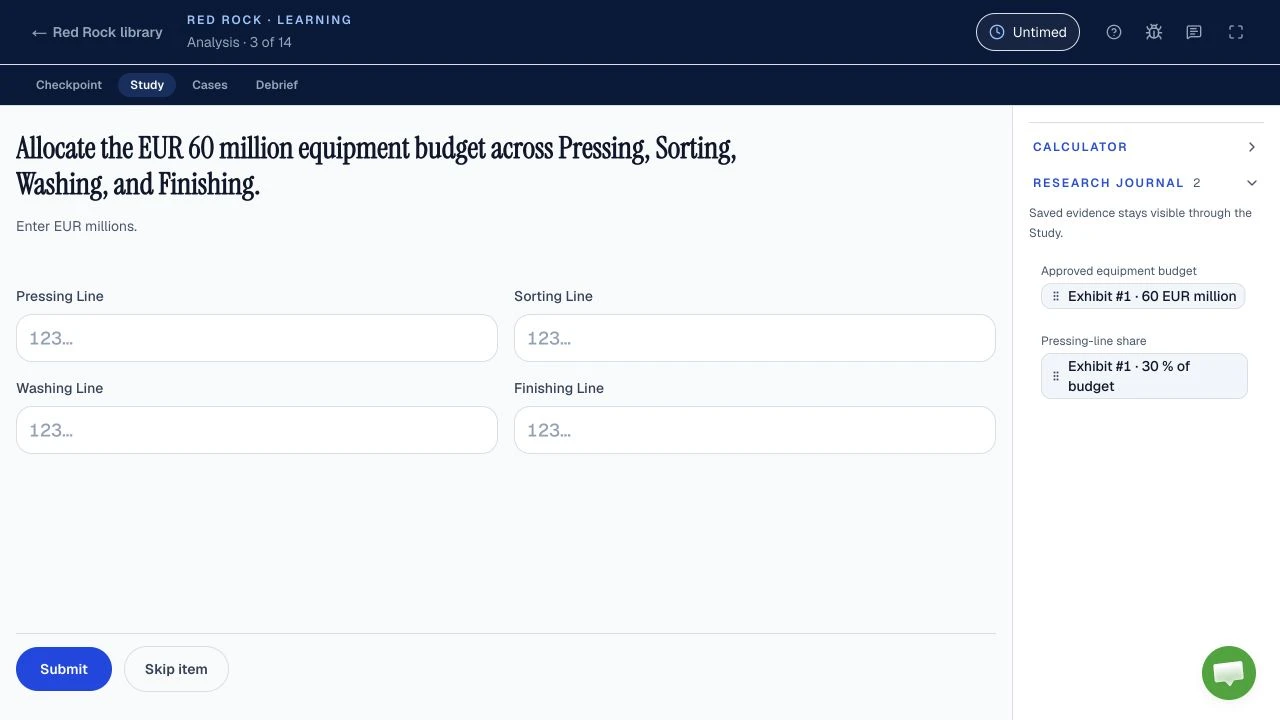 Reported nameRed Rock
Candidates describe a data investigation followed by shorter questions.
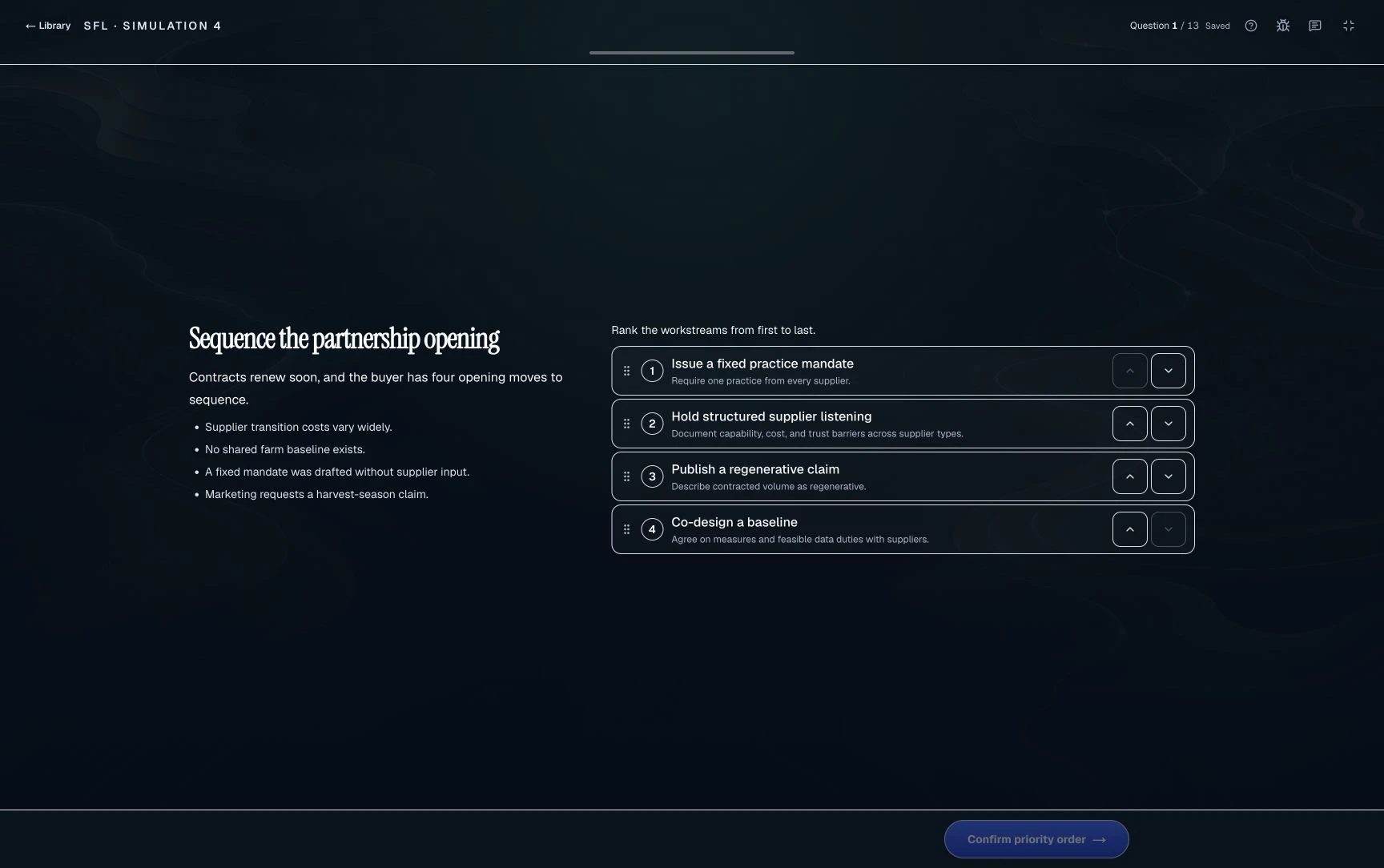 Reported nameSustainable Futures Lab
Candidates report it in some longer invitations.
The screens are independent practice captures from Road to Offer, shown so you can recognise each task type. They are not McKinsey's assessment screens. Ecosystem Building is an older game that candidates no longer report.
McKinsey's FAQ says each task begins with an untimed tutorial that explains its objective and navigation. It also says the assessment length is in your invitation. Candidates report different invitation lengths and game combinations; the invitation-length guide explains those reports without treating them as a McKinsey guarantee, and the 30-minute Sustainable Futures Lab guide covers the newer team-based version reported in 95-minute invitations. For changes in reported game versions, use the dated Solve changes log.
An exception to watch for is an invitation that gives instructions you did not expect. The official tutorial and your own email govern that sitting. Do not force the live task into a remembered game description, and do not assume an older game such as Ecosystem Building appears just because a historical guide covers it. The Ecosystem history is useful for sorting old references, not identifying your current task. If you have time for only one game before your sitting, which game to practise first compares the two most reported ones.
How do you decide what to prepare from your invitation?
Use the exact assessment name, task instructions and stated length in your invitation; McKinsey officially puts Solve's length there, while it publishes no public role-to-test matrix. This gives you a repeatable decision method even when a search result uses an older label.
- Named step Official“Solve” is McKinsey’s game-based assessment. Any other label is its own step.
- Length of the sitting OfficialMcKinsey says your invitation states it. No number of minutes is public.
- Complete by Not publishedMcKinsey publishes no deadline or extension rule. Go by the date in your email.
- Link and support OfficialPC or Mac only, with a tech check after you click the link and support by email or live chat.
The email sketch is a fictional layout drawn for this guide, not McKinsey's wording. Follow your own invitation wherever it is more specific.
Keep the length of the sitting and the completion date apart: one is how long you will be working, the other is when the link stops being useful to you. McKinsey publishes no extension policy, so a clash goes to your recruiter; the deadline and late-start guide covers what to ask. For the device line, the system requirements guide explains the tech check McKinsey runs after you click the link.
Which step does your email name?
- “Solve”The email names the product.Prepare for Solve: its games, the tutorial and the rules.
- Another named stepA technical interview or a role task.Prepare that step. Nothing public says Solve practice matches it.
- A generic “online assessment”No product name anywhere in the email.Ask the recruiter which task and rules apply before choosing material.
A reading method written for this guide, not a McKinsey-published assignment flow. If one email names two steps, treat them as separate requirements with separate dates.
For example, “complete Solve” and “complete an online assessment” are not equally informative. The first names the product; the second needs the rest of the email or recruiter clarification. A consulting applicant whose email is headed “Solve” can prepare for Solve, and a data specialist whose email names a technical interview should prepare for that interview. These are reading examples, not predictions about what McKinsey will send. The Solve timeline and test-day checklist keep those questions apart.
Which rules apply to McKinsey online assessments?
McKinsey officially expects candidates to complete its assessments alone, on one screen and on camera, without outside applications, websites, AI tools, calculators, prepared notes, recording or shared content, subject to approved accommodations; your invitation controls the details of your sitting. These are the firm's general assessment integrity expectations, not evidence that every role takes Solve.
Do
- Work alone, as yourself
- Use one screen, with no overlays
- Stay on camera, without a virtual background or blur
- Keep your upper body and hands in view while you take notes
- Use pen and paper for notes and calculations
- Discard your notes afterwards
Do not
- Use a calculator of your own
- Open applications, websites or generative AI
- Bring prepared notes
- Record or screenshot anything
- Take help from another person
- Share assessment content
Summarised from McKinsey's assessment integrity expectations, checked October 11, 2026. The only exception McKinsey describes is an accommodation approved in writing. McKinsey may ask to see your notes.
The general rules permit pen and paper for notes and calculations and say McKinsey may ask to see the notes; discard them afterwards. They bar an outside calculator. Candidate reports of a calculator built into Red Rock concern a feature inside that task and do not override the outside-tool restriction; the Red Rock calculator and journal guide keeps the two apart. The Solve-specific FAQ separately bars help from others, applications, websites, AI tools, pre-prepared notes, recording and screenshots. It says scenarios vary between candidates, another reason to practise reasoning rather than memorise a supposed answer key.
If you need a disability, health or learning accommodation, McKinsey says to discuss it with your recruiter. Do so before using any aid that would otherwise be restricted; McKinsey describes an exception for accommodations approved in writing. If a technical problem occurs during Solve, use the support email or live chat in the official FAQ at the time of the problem. McKinsey says support may provide extra time or reset the link depending on the issue, and that failing to contact support can rule out a reset exception. The test-day checklist gives the setup sequence.
| Problem | Where it goes | Status |
|---|---|---|
| Technical issue during Solve | [email protected] or the live chat on the assessment link, at the moment it happens. | Official, Solve FAQ |
| Non-technical question | Your recruiter. | Official, Solve FAQ |
| Accommodation | Your recruiter, before the sitting. The exception to the tool rules is an accommodation approved in writing. | Official, Solve FAQ and integrity page |
| Deadline conflict | Your recruiter. No extension or rescheduling policy is public. | Not published |
Where should you prepare once you know the assessment?
If your invitation names Solve, use the independent practice chooser to select the relevant game; if it names another step, McKinsey's public sources do not establish that Solve practice matches it. McKinsey says no business knowledge or gaming experience is needed for Solve and that each task starts with a tutorial, so practice is a way to rehearse reading instructions and making decisions, not a requirement set by McKinsey.
Start with the Solve overview if the game names are unfamiliar. Move to practical Solve habits for pacing and evidence handling, then choose one game in the practice hub. The Solve FAQ with 30 short answers is the quickest place to check a single fact. Road to Offer's runner is independent preparation, not McKinsey's official test or a score that predicts McKinsey's decision. Paid Learning mode adds a step-by-step path with coaching and feedback as you go in all four formats, untimed in the clocked games, with the matching game pack, Solve pack or qualifying Annual access. The Solve plan is free with a free account: invitation length and test date select dated steps for up to 28 days, without using your score. For the broader question of whether a sitting felt difficult, the difficulty guide separates task demands from an unpublished passing threshold.
After an assessment, avoid inferring a result from any practice score or a figure circulating online. McKinsey publishes no Solve pass mark, pass rate, scoring weights or result timing in the sources checked for this guide. Its FAQ says the recruiter considers Solve with the rest of the application and any other assessment results. Read what a Solve result can tell you and why pass-rate claims remain unverified if those are your next questions. McKinsey also publishes no retake or carry-over rule; the retake and reapply guide sets out what is and is not known.
Sources and evidence boundaries
- McKinsey Solve careers page, checked October 11, 2026: official name, consultant recruiting context, preparation statement, integrity and use of the result.
- McKinsey Solve FAQ, August 2025, checked October 11, 2026: invitation length, tutorials, device, accommodations, support, variation, conduct and use of results.
- McKinsey assessment integrity expectations, checked October 11, 2026: general assessment and interview rules, separate from Solve's task description.
- McKinsey's July 2025 game-lab account, checked October 11, 2026: the prior multiple-choice test, Imbellus acquisition, Solve's consultant recruiting scale and Sea Wolf.
- Reported, not official: PST, PSG and Imbellus as candidate labels; current Red Rock and Sustainable Futures Lab formats; older mentions of SHL in hiring and QuantHub for some analytics roles. The accounts are dated and unverified. None is a universal assignment rule.
- Unknown from the McKinsey sources checked: a role-by-role assessment list, who gets which invitation, current game mix for every candidate, pass mark, score scale, and results timetable. Your invitation and recruiter can resolve your individual process.