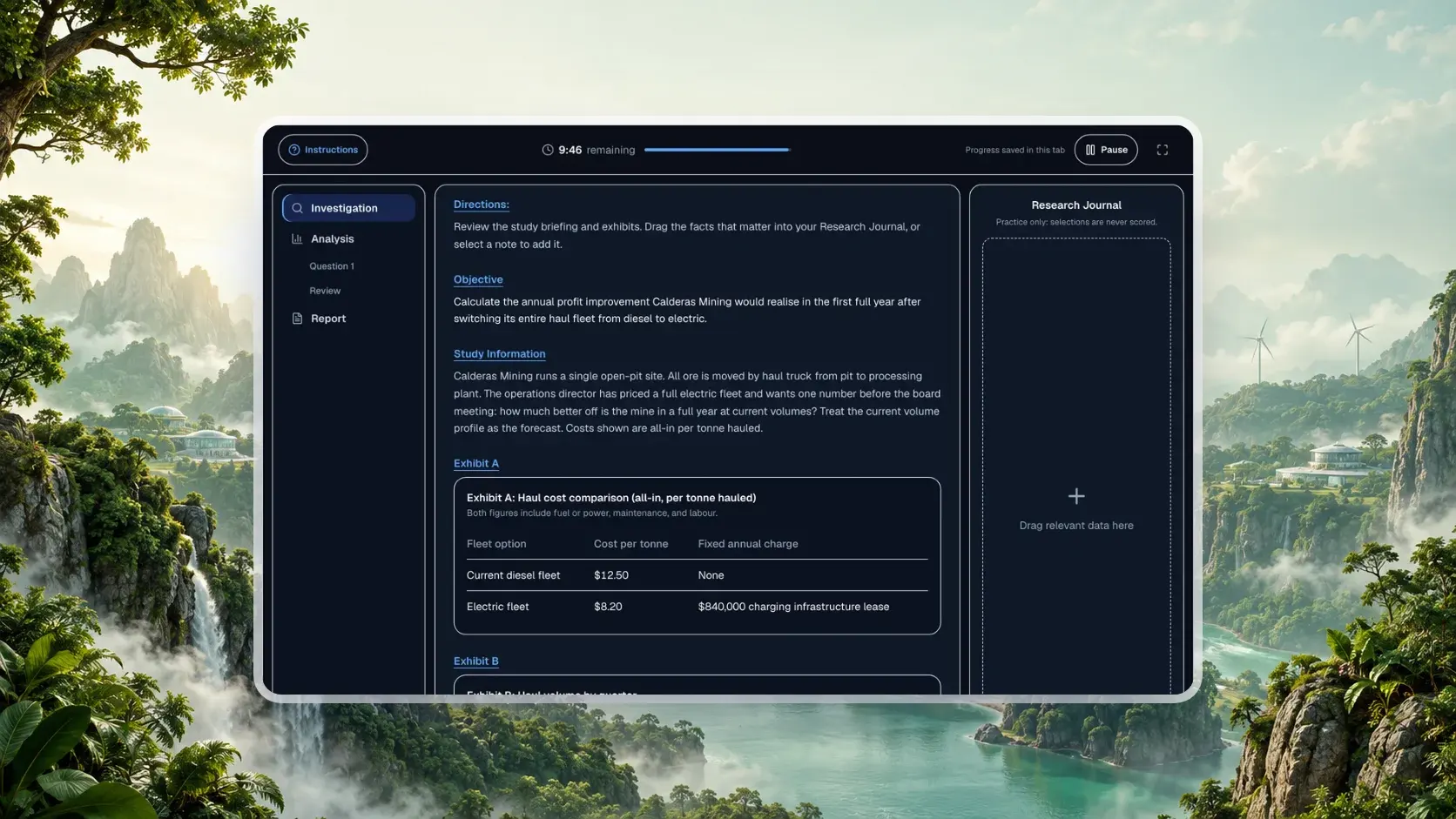
Start with the game that exposes more errors in a short trial. Red Rock tends to expose evidence and arithmetic mistakes; Sea Wolf tends to expose missed constraints. McKinsey does not publish a difficulty ranking or game weights, so there is no universally harder game and no safe game to skip.
| Question | Answer | Status |
|---|---|---|
| Is Sea Wolf a Solve game? | McKinsey names Sea Wolf and says it involves selecting and evaluating microbes to clean contaminated sites. | Official July 2025 McKinsey blog |
| How long is each game? | About 35 minutes for Red Rock and about 30 for Sea Wolf, according to candidates. Your invitation states the total Solve length. | Reported game times; Official invitation rule |
| What does Red Rock contain? | A connected Study and six shorter Cases are commonly described. | Reported |
| What does Sea Wolf contain? | Candidates describe three sites and a three-microbe treatment for each. | Reported |
| Which is harder or worth more? | McKinsey publishes no comparative difficulty data or game weights. | Not published |
Is Red Rock or Sea Wolf harder, and which should you practise first?
Neither Red Rock nor Sea Wolf is demonstrably harder for everyone, because McKinsey publishes no game difficulty data; practise the one where your own errors or slow decisions are more frequent first. A candidate who can calculate quickly but forgets a forbidden trait may need Sea Wolf first. Another who checks every rule calmly but divides growth by the ending value may need Red Rock first. This is a coaching decision about practice, not a claim about how McKinsey ranks candidates.
Do not choose solely from the clock. Candidates report a slightly longer Red Rock block, but the extra reported minutes do not establish that it is harder or contributes more to the result. Nor does feeling uncomfortable prove a low score. Make one short attempt of each, write down what went wrong, then verify the diagnosis with a timed run. The guide to what makes Solve hard explains wider pressure points without claiming a pass threshold, and what each Solve game measures sets out the skills McKinsey names against the ones candidates infer.
If your invitation is imminent, the fastest first correction is often a single repeated error: a missing unit, a wrong denominator, or an ignored trait. The Solve tips guide gives a broader error log, while the test below makes the two-game choice concrete.
How do Red Rock and Sea Wolf differ in task, time and avoidable errors?
Candidates describe Red Rock as an evidence and calculation task lasting about 35 minutes, and Sea Wolf as roughly 30 minutes of microbe constraint checks across three sites; McKinsey publishes no per-game clock or detailed format. Sea Wolf's name and microbe-selection premise are official. Use the comparison as a preparation map and let your tutorial override it.
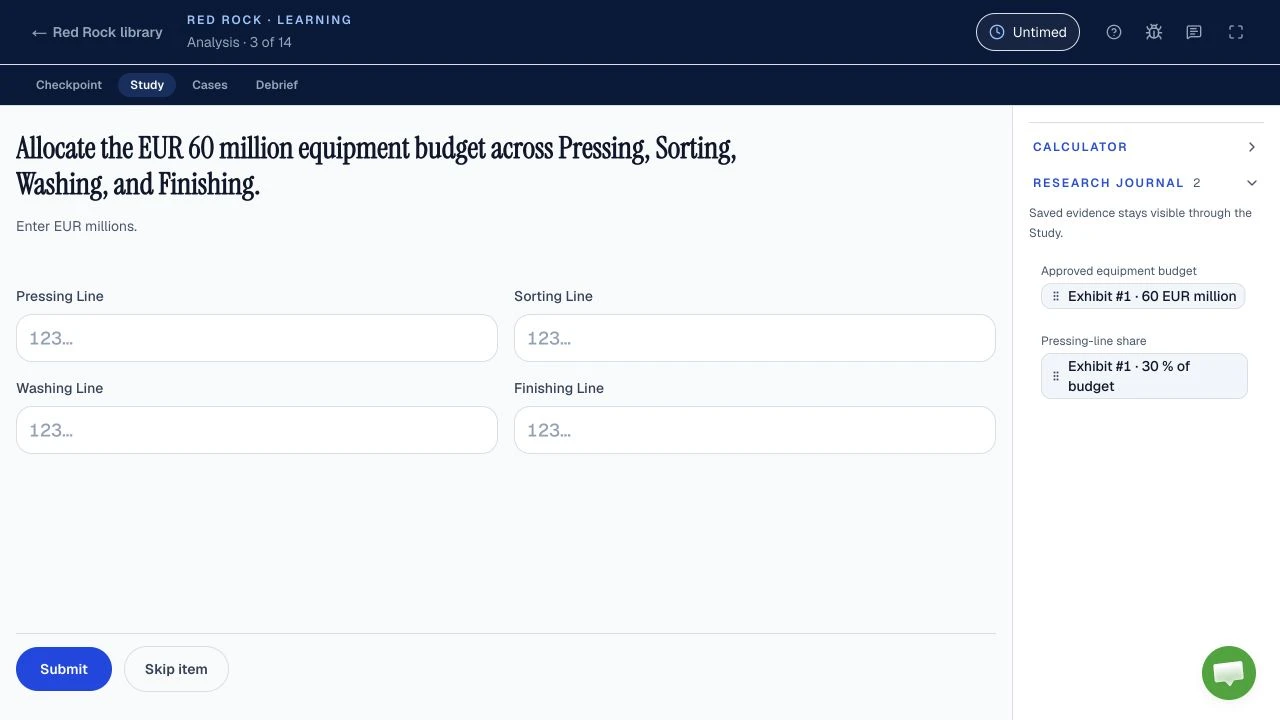
Red Rock Reported: about 35 min
Pick the evidence, calculate, report a finding, then reset for shorter Cases.
- Skill
- Match the question to a quantity, period and denominator.
- Typical slip
- A plausible number from the wrong exhibit, or a division by the ending value.
- First drill
- Write the requested quantity and formula before you calculate.
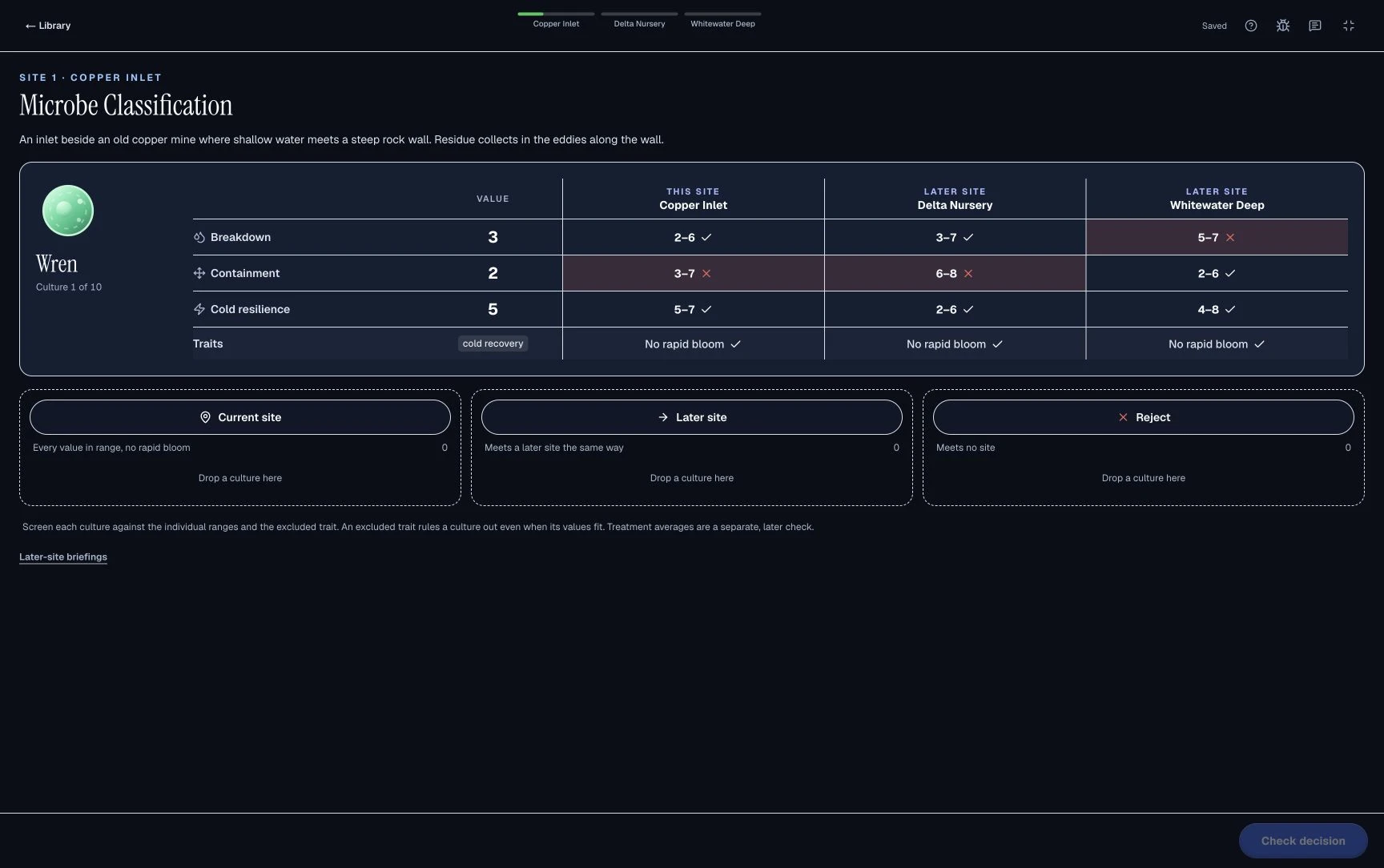
Sea Wolf Reported: about 30 min
Screen microbes, then build a three-microbe treatment for each contaminated site.
- Skill
- Keep the treatment's averages and every trait rule true together.
- Typical slip
- Judging one microbe alone, or missing an excluded trait.
- First drill
- State every site condition, then test one trio against all of them.
Practice screens from Road to Offer, not McKinsey screenshots. Task descriptions and times are candidate reported; the skills, slips and drills are our coaching read, with no claim about scoring.
- Red Rock
- Sea Wolf
Candidate-reported minutes, drawn to scale. McKinsey publishes no per-game clock, and a gap of 5 minutes says nothing about which game is harder or counts for more.
The reported Red Rock Study connects evidence selection, analysis and a report; its later Cases ask you to reset for fresh data. Sea Wolf asks you to keep multiple conditions true at the same time. In either game, an attractive partial answer can be wrong: a correct calculation on irrelevant Red Rock data, or a Sea Wolf trio with acceptable averages but a forbidden trait. For the full phase-by-phase work, use the Red Rock practice method and Sea Wolf practice method. This guide stays with the choice between them.
The two clocks also behave differently. Red Rock's reported minutes are shared between the Study and six Cases, so an overrun early costs you later questions; the 35-minute Red Rock budget shows one way to divide them. Sea Wolf repeats the same loop three times, which is why a compact Sea Wolf cheat sheet of rules for every step helps more there than a time plan.
Can a five-minute self-test show which game needs your first practice block?
This original five-minute self-test can show whether a Red Rock style calculation or a Sea Wolf style constraint check trips you up today; it cannot predict a McKinsey result. Set a five-minute timer before reading the answers. Give each of the four items one point only if your answer and its reason are both right. The data and solutions below are fictional, made for this guide and checked by a local arithmetic test.
- Read the two Red Rock itemsOriginal exercise
Name the denominator before calculating. If you cannot choose one, that uncertainty is the error to log.
- Read the two Sea Wolf itemsOriginal exercise
Test the treatment averages and traits separately. A good average cannot erase a forbidden trait.
- Score by game, then chooseCoaching rule
The lower game score gets your first practice block. A tie means you sample both under a longer clock.
This is a small diagnostic, not a Solve replica. The real assessment uses varied parameters, and McKinsey publishes no way to convert these points into its result.
Red Rock style item A: calculate growth
Fictional marsh restoration records show 75 hectares restored at the start and 90 hectares at the end. What is the percentage increase from the starting area? Write the denominator with your answer. A higher ending number alone is not enough: the question asks for a relative change.
Red Rock style item B: find the share
In a separate fictional survey, 18 of 60 samples met a condition. What percentage of all samples met it? The marsh area is irrelevant to this question. Use the total sample count as the denominator. Both items belong to the eight worked Red Rock calculation types, which is the place to go for more of them.
Sea Wolf style item A: check a complete treatment
In this original microbe puzzle, a site accepts an average resilience from 4 to 6 and average energy from 3 to 5. The trio must include a purifier and exclude any invasive culture. Is the proposed trio valid? Check the average, not whether every single culture falls inside each range.
| Culture | Resilience | Energy | Trait |
|---|---|---|---|
| A | 3 | 6 | Purifier |
| B | 6 | 4 | Neutral |
| C | 6 | 5 | Neutral |
Sea Wolf style item B: choose the final culture
A second fictional site needs average resilience from 4 to 5, average energy from 3 to 5, at least one purifier, and no invasive culture. Cultures D and E are fixed. Which single option, F, G or H, completes a valid trio? Choose only one.
| Role and culture | Resilience | Energy | Trait |
|---|---|---|---|
| Fixed D | 4 | 4 | Purifier |
| Fixed E | 5 | 6 | Neutral |
| Option F | 6 | 2 | Neutral |
| Option G | 9 | 3 | Neutral |
| Option H | 6 | 2 | Invasive |
What are the self-test answers, and what does each mistake mean?
The original self-test answers are 20% growth, 30% of samples, a valid first Sea Wolf trio, and option F; these are computed from fictional data, not official Solve answers. Check the reason for every answer before you count a point. A lucky guess with the wrong denominator or an unchecked trait identifies a practice need.
Red Rock style answers
Item A asks for a relative change, so the increase goes over the area you started from.
Item A: percentage increase
Tempting wrong answer
Divides by the ending area. That answers how much of the final marsh is new, a different question.
Right setup
Divides by the starting area, the base that “increase from” names.
Item B asks for a part of a whole, and the whole is every sample in the survey, not the marsh area from item A.
Item B: share of all samples
- Met the condition18 samples · 30%
- Did not42 samples · 70%
- All samples60 samples · 100%
Fictional survey. The bar is the denominator: every sample, drawn once.
If either item went wrong, practise naming the requested quantity before doing more arithmetic. The seven Red Rock errors and their fixes covers the wrong base alongside the other slips candidates describe, and the guide to when to use the Red Rock calculator and journal explains why a reported in-game calculator does not protect you from a wrong setup.
Sea Wolf style answers
Item A is valid, because the rule applies to the average of the three cultures and both averages land inside the site ranges.
Item A: average resilience
Item A: average energy
Fictional site. Rejecting culture A for its own values is the trap: the site rule in this exercise tests the treatment's average. A purifier is present and no invasive culture appears, so the trait rules hold too.
Item B has one valid answer, option F. With D and E fixed, work the two averages for each candidate third culture, then read its trait.
Item B: resilience with option F
Item B: energy with option F
Item B: resilience with option G
Above the site maximum of 5, so option G is out before you look at energy.
- Option FAverages insideTraits passValid
- Option GResilience outsideTraits passNot valid
- Option HAverages insideInvasive traitNot valid
Fictional site. Options F and H give the same averages (5 resilience, 4 energy), so a number line cannot separate them. Only the trait check does: H carries the forbidden invasive trait.
If you chose G or H, your next drill is a complete condition checklist, not faster arithmetic. The averages themselves get quicker once you compare sums instead of dividing every time: the Sea Wolf sum shortcut and elimination order works that method, and the errors that break a Sea Wolf treatment lists the trait and range slips to log.
How should you turn the four answers into a practice split?
Score the two Red Rock items and two Sea Wolf items separately: our coaching rule gives the lower-scoring game two practice blocks for every one block on the stronger game, while a tie gives one block to each. This ratio is a way to allocate preparation, not a McKinsey score formula. A block can be one focused exercise plus review; use the same length for each block so the ratio means something.
Our coaching rule, computed for all nine score pairs: the lower score gets 2 blocks for every 1 on the other game, and a tie gets 1 each. It is not a McKinsey formula and predicts nothing about a result.
If you scored equally poorly in both, the tie does not mean you are ready. It means this small sample has no basis to rank the games, so spend one block on each and compare the errors in a longer timed run. If you scored equally well, the clock may still reveal a weakness: the test has no research-journal navigation, multi-site search or long sitting. Use the scores and results guide for why an independent practice score is not a hiring prediction.
How should you split Red Rock and Sea Wolf practice when the deadline is close?
When your deadline is close, give the lower-scoring game the first block and repeat the error that caused its loss; our two-to-one block rule applies only after you have sampled both. McKinsey does not prescribe a preparation split, and its FAQ says no preparation is required, so these are optional coaching plans rather than official targets. Reserve room for every game your own invitation names.
Leave time for device setup and rest.
Make one block per game a timed run. Stop adding new techniques on the final evening.
Check whether the repeated error improved before the back-to-back sitting.
Review after each timed run and rebalance if the weaker error disappears.
- Weaker game block
- Stronger game block
- Both games back to back
Our recommendation, not a McKinsey rule or an official target. One square is one practice block of equal length, in the order to run them. The block counts scale the 2:1 rule; choose a block length that fits your days.
If your two scores tied, keep the same number of rounds and give each game one block per round: 1 and 1, then 2 and 2, then 3 and 3, then 4 and 4 across the four windows. Use the timed runs to break the tie, and aim the next block at whichever error repeats.
The number of days changes how much evidence you can gather, not which game McKinsey values. With one day, trying to learn every detail can crowd out setup and sleep. With a week, a weak first score may already be fixed after a few runs, so do not keep following the initial ratio mechanically. For an actual day-by-day calendar, use the Solve prep plan. For reported invitation lengths and whether a third game may be present, use the length and game map; if your invitation is one of the longer ones, the Sustainable Futures Lab guide covers that game separately. The test-day checklist covers setup and official conduct rules.
Can a strong Sea Wolf result compensate for a weak Red Rock result?
McKinsey does not publish whether a strong Sea Wolf result can compensate for a weak Red Rock result, because it gives no game weights or pass mark. The official Solve page says performance is considered together with the rest of your application and other assessments. That establishes a broader hiring review, not a trade-off rate between these two games. The guide to how the Solve result is used goes through what McKinsey says about that review.
For preparation, the practical response is to make both games dependable. If your Sea Wolf test is perfect but Red Rock has a denominator error, work on that error while keeping a short Sea Wolf refresher. Reverse the order if you missed trait rules. Do not assume that a reported efficiency figure or any practice percentage tells you how close you are to an unpublished cutoff. The Solve overview explains the assessment context, and the pass-rate guide separates published facts from unsupported percentages.
What should you do after choosing the first game?
After choosing Red Rock or Sea Wolf, run one independent practice session for that game, record one error type, and repeat the same kind of decision until you can explain it; this is our coaching sequence, not an official McKinsey requirement. Then run the other game once. The short test isolates arithmetic and constraints, but a longer run tests pace, attention and switching between tasks.
If Red Rock came first, continue with the worked Red Rock study and cases. If Sea Wolf came first, use the full Sea Wolf treatment method. The practice chooser offers four independent Road to Offer practice formats, each with one complete free run: Red Rock, Sea Wolf, SFL Classic and SFL Island. Classic includes 13 linked decisions without a countdown, with decision and dependency diagrams in its worked review; Island includes onboarding and all three project days, with evidence chains, placement maps and team feedback. When you take the real assessment, the untimed tutorial governs the task instructions and your invitation states the overall length; outside practice is preparation only and should not be opened during Solve.
Sources and evidence boundaries
- Official, checked October 11, 2026: McKinsey's Solve page describes the assessment and says its result is considered with the wider application. The August 2025 Solve FAQ says the total length is in your invitation, tutorials are untimed, and outside aids are restricted. McKinsey says no preparation is needed.
- Official, checked October 11, 2026: McKinsey's July 2025 game lab article names Sea Wolf and describes microbe selection. Its assessment integrity page gives wider conduct rules; follow your invitation for Solve-specific setup.
- Reported, unverified: Red Rock's Study and Cases, Sea Wolf's three-site treatment flow, individual game times and reported order come from candidate descriptions. McKinsey's public sources do not specify these details. Candidate accounts disagree on some interface steps and clocks, so your live tutorial wins.
- Unknown: McKinsey publishes no comparative difficulty data, per-game weights, pass mark, score scale, or conversion from a practice result to a hiring outcome. The four questions, their data, answer key and block-ratio plan are original coaching material, not assessment content.