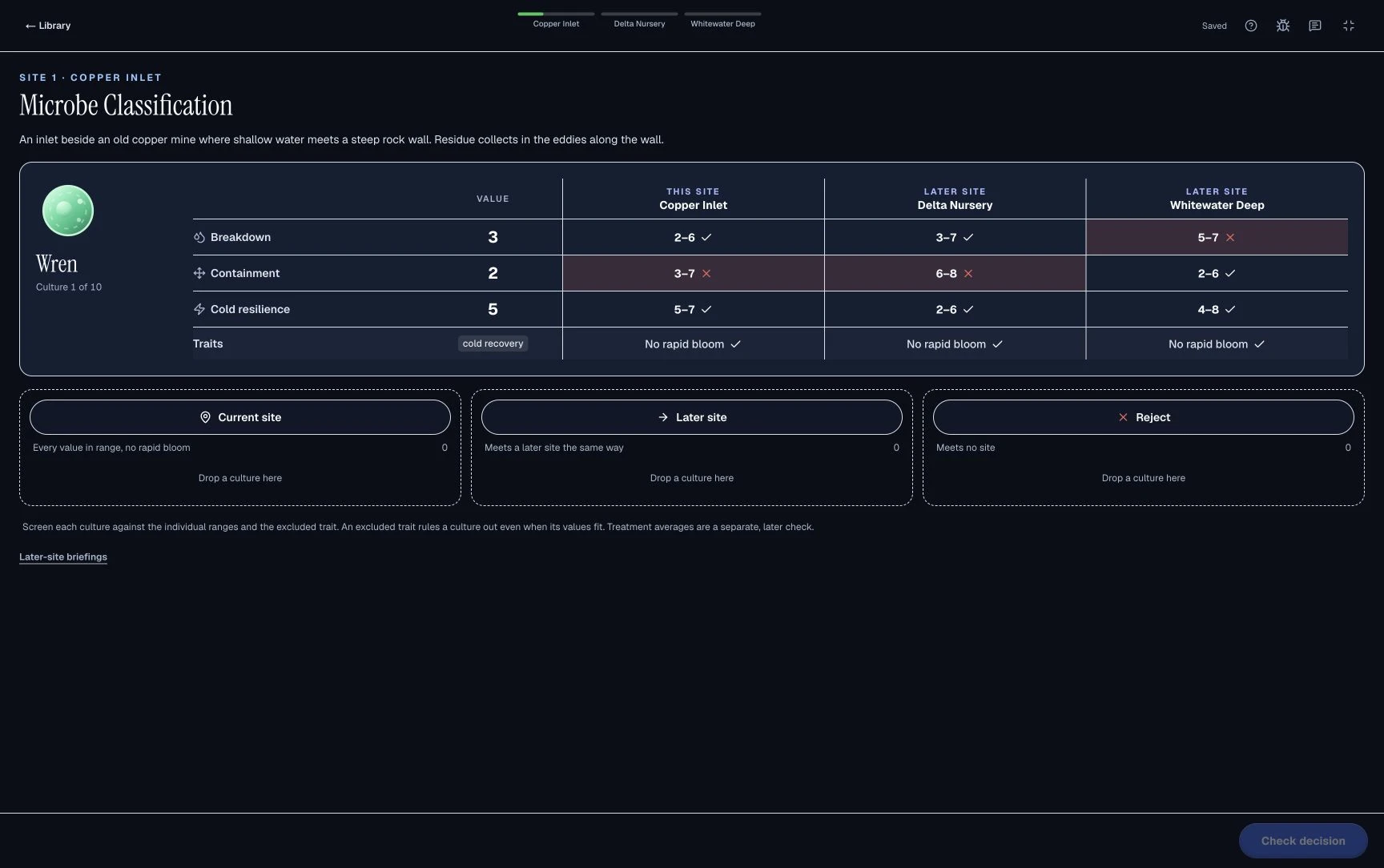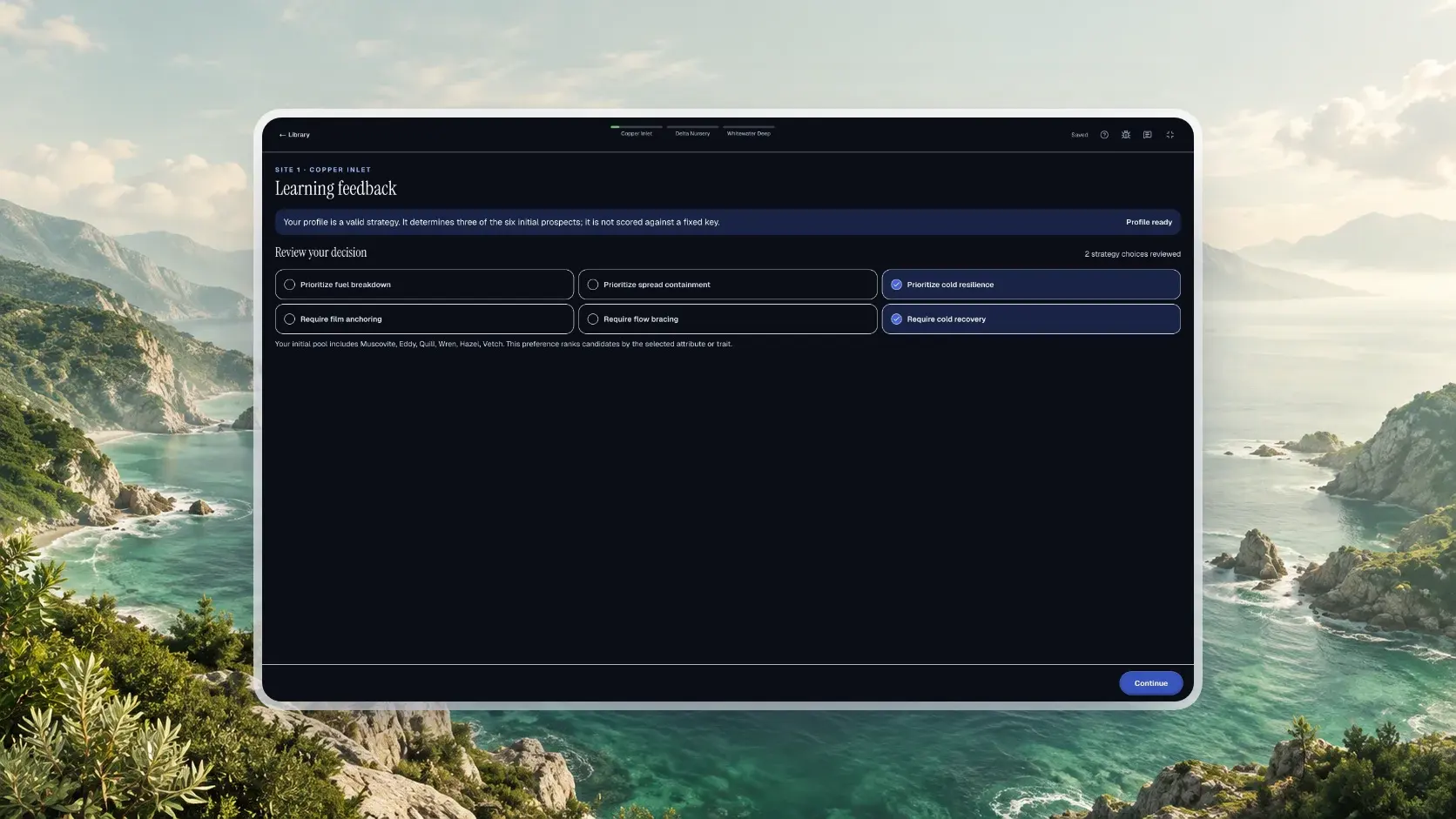
A Sea Wolf treatment can look reasonable and still fail a site rule. Candidates report three-microbe averages, a desired trait and an excluded trait; McKinsey has not published the detailed rules or real scoring. Recheck the current site brief, then test every condition before you submit.
| Question | Answer and limit | Status |
|---|---|---|
| What is Sea Wolf? | McKinsey names a task in which candidates select and evaluate microbes to clean contaminated sites. | Official, McKinsey July 2025 blog |
| How does a treatment work? | Candidates describe selecting three microbes whose attribute averages meet site ranges, with desired and forbidden trait rules. McKinsey has not published these details. | Reported |
| How many sites and minutes? | Candidates describe three sites in about 30 minutes. Your invitation states the assessment length; McKinsey gives no public per-game time. | Reported and official, FAQ |
| Is the tutorial timed? | Each task begins with an untimed tutorial explaining its objective and navigation. | Official, FAQ |
| What does a miss cost? | McKinsey does not publish Sea Wolf penalties, weights, pass marks or a score scale. | Not published |
Original fictional exercise. Iris through Pebble are invented microbes. Their values and the two site briefs below are teaching data, not McKinsey content or a model of its scoring. In this exercise, range endpoints count as inside the range.
Why does a Sea Wolf treatment that looks plausible fail?
A plausible Sea Wolf treatment fails when one reported site condition is overlooked, but McKinsey does not publish the detailed treatment rubric or the cost of a miss. In practice, diagnose the condition before trying another trio: check the current site's attribute averages, the required trait and the forbidden trait separately.
Our fictional first site asks for resilience 4 to 6, energy 3 to 5, and adhesion 5 to 7. It needs at least one Binder and excludes Invasive. The table gives you one small pool to use throughout this guide. Its names, traits and numbers were made for this article, so a result here shows only whether a proposed trio meets this exercise's rules. McKinsey's own name for the task is Sea Wolf; if you have seen it called something else, the guide to Ocean Treatment and Ocean Cleanup versus Sea Wolf sorts out the names.
| Microbe | Resilience | Energy | Adhesion | Trait |
|---|---|---|---|---|
| Iris | 4 | 3 | 5 | Binder |
| Juniper | 5 | 4 | 6 | Neutral |
| Kite | 6 | 5 | 7 | Neutral |
| Lumen | 5 | 9 | 6 | Neutral |
| Moss | 6 | 5 | 7 | Invasive |
| Nacre | 9 | 5 | 7 | Neutral |
| Oar | 5 | 4 | 6 | Shield |
| Pebble | 5 | 4 | 6 | Neutral |
Use Iris + Juniper + Kite as the control. Each check is one average: add the three values in a column and divide by the number of microbes in the treatment.
Average of a trio
Original fictional exercise. Iris supplies Binder and no member carries Invasive, so all 5 checks pass.
That makes this trio valid under the invented first-site brief. If you want the complete reported game flow before diagnosing mistakes, read the Sea Wolf rules, strategy and practice guide; for a one-screen reminder of the reported steps, keep the Sea Wolf cheat sheet open while you prepare. For now, keep this control beside each wrong attempt so you can point to the single changed condition.
Road to Offer's complete free Sea Wolf run covers all three sites, with Profile, Classification, Prospect Pool and Treatment at each site, on a 30-minute Simulation clock. Our practice rubric scores all four stages, not treatment alone. Start without an account; create a free account to finish and keep your score, points breakdown and worked feedback on submitted decisions with constraint and treatment visuals, with no payment for the first run or review. Red Rock, SFL Classic and SFL Island each also have a complete free run. Paid Learning mode adds step-by-step coaching and feedback across all four formats, untimed in the clocked games, with the matching game pack, Solve pack or qualifying Annual access. The separate Solve plan is free with a free account: it asks your invitation length and test date, then gives dated practice steps selected for that invitation for up to 28 days.
How can checking one attribute hide a failed average?
Checking one Sea Wolf attribute can hide a miss on another: candidate reports say every displayed attribute average matters, while McKinsey publishes no official Sea Wolf scoring weight. In our first-site exercise, Iris + Kite + Lumen looks fine if you stop after resilience, but its energy mean crosses the upper limit.
Stops after one column
Resilience is the attribute the swap was meant to protect. It sits inside its range, so the trio gets submitted with energy unchecked.
Sweeps every column
The same trio's energy average is above the ceiling of 5. One failed column fails the treatment in this exercise.
Start with the site brief, not with whichever number catches your eye. Swapping Juniper for Lumen leaves resilience and adhesion where they were and moves only energy:
Energy average after the swap
The site allows 3 to 5.
Original fictional calculation for Iris + Kite + Lumen. The Binder and Invasive checks both pass, so this is an isolated energy error.
Swapping a microbe solely to improve resilience would solve the wrong problem. The corrective drill is a column sweep: mark each range pass or miss without changing the trio, then make one substitution and repeat the whole sweep. A microbe outside a range can still balance with its partners, so do not reject it on its individual value alone. Sea Wolf math turns each average range into a sum target, which makes the sweep three additions instead of three divisions.
Why does a forbidden trait break an otherwise balanced trio?
A forbidden trait breaks an otherwise balanced Sea Wolf trio under the candidate-reported treatment rule, although McKinsey has not published its exact penalty. In the fictional first site, Iris + Juniper + Moss passes all three average windows and includes Binder, yet Moss carries Invasive.
Trusts the averages
Every average is inside its range, so the arithmetic says submit. No average can see a trait.
Scans traits first
Count the Invasive carriers in the trio. The site allows none, so one carrier rejects the treatment before any division.
Original fictional calculation. Moss has the same three values as Kite, so these averages match the control exactly. The only difference is Moss's Invasive trait.
You could spend time recalculating those means and still miss the categorical problem. Mark Invasive beside every candidate before comparing trios, then check the final three again before confirming. Replacing Moss with Kite restores the control trio, which passes every check in our exercise. The trait has no numerical average for another member to cancel.
After the swap
The exception is a different site brief: a trait forbidden at one site might be neutral or desired at another. The current site's words decide the rule, not the microbe's name or your memory from the previous site. For a broader discussion of why those simultaneous constraints feel difficult, see where Solve feels hard, and for the skills behind each task, read what Solve measures in each game. If your practice feedback names a trait failure, drill trait scanning before doing another long arithmetic set.
How can an early pool choice leave a later site without its needed trait?
An early Sea Wolf sorting choice can leave a later site without an obvious trait option in a candidate-reported workflow, but McKinsey has not published how its screens carry microbes between sites. The safe practice habit is to read any later-site clue before rejecting a microbe that has little value for the current site.
In our fictional second site, the numerical windows stay the same, but the desired trait becomes Shield and Binder becomes forbidden. Oar is the only Shield carrier in this exercise's pool of 8.
Sorts for this site only
Iris already supplies site one's Binder, so Oar looks spare and is discarded. Site two then has no Shield carrier to choose.
Reads the next clue first
Oar is kept for the later site. One carrier is enough to meet the Shield rule.
- At least one needed1 to 3
- Oar discarded0Outside
- Oar kept1Inside
Original fictional pool. This is a pool problem, not a final-average problem: no arithmetic on the remaining microbes can create the missing trait.
If Oar remains available, Oar + Juniper + Kite meets the second brief. Its three averages:
With Shield present and Binder absent, that trio is valid for our second site.
- Read the next-site clue.
In this exercise, site two needs Shield and forbids Binder.
- Keep a useful option available.
Oar is the pool's only Shield carrier. Do not discard it for failing site one's Binder test.
- Check the later trio.
Oar + Juniper + Kite passes all 5 fictional checks; Iris + Juniper + Kite does not.
This is an invented sorting scenario, not a claim that a real Sea Wolf microbe is consumed or scored in this way. Follow the actual on-screen choices.
Practise by writing one line for the next site whenever the exercise reveals a clue. Compare each microbe against the current site and that clue before you sort it. The reported phases and their handoffs are covered in the main Sea Wolf guide. If your invitation includes other games, the invitation-length guide explains the reported game mixes without treating them as McKinsey's published schedule, and Red Rock versus Sea Wolf helps you decide which one to practise first.
Why is an average near the range edge easy to misread?
A Sea Wolf average near a range edge is easy to misread because an appealing rounded impression can conceal a value outside the window; the averaging rule is candidate-reported, not a published McKinsey specification. The fictional Iris + Kite + Nacre trio is the check: its resilience sum is 19, so its mean is 6.33, beyond the first site's upper bound of 6.
Rounds by eye
Rounds the mean to the bound and calls it inside. The exact value is 6.33, which is above 6.
Compares exact sums
Skips the division. The highest allowed sum for three microbes is 18, and 19 is above it.
Turn the range into a sum window once per site: multiply each bound by the number of microbes in the treatment.
Resilience sum window
- Allowed sum12 to 18
- Control15Inside
- With Nacre19Outside
Original fictional calculation. Energy and adhesion still pass at 4.33 and 6.33, Iris supplies Binder and no member carries Invasive: resilience is the only failure.
That makes this a useful drill for boundary accuracy. At a true endpoint, this exercise counts the average as valid; that is a rule of our invented example, not a promise about McKinsey's live interface. The live tutorial and site brief decide how its ranges are presented. The full sum method, with an elimination order, is worked in the Sea Wolf sum shortcut guide, and the Solve tips guide covers numerical habits across the other games. Here the drill is narrower: write the bound, write the sum, and make a pass or miss decision without rounding by eye.
When should you stop searching after finding a valid treatment?
Stop searching a Sea Wolf practice pool once you have verified a valid trio and reached your planned checkpoint; this is coaching advice under a candidate-reported clock, not a published McKinsey scoring rule. Our fictional first site has 9 valid trios among the 56 possible ones, including Iris + Juniper + Kite and Iris + Juniper + Pebble, so a second valid trio does not by itself show the first was wrong.
Tests every trio
A pool of 8 holds this many different trios. Checking them all to find a nicer one spends the clock on a site that is already solved.
Verifies one, then moves on
One trio needs 3 average checks and 2 trait checks. When all pass, the site is done in this exercise.
- Pass every check9 · 16.1%
- Fail at least one check47 · 83.9%
- All possible trios56 · 100%
Original fictional pool, counted by the guide's test. Several answers are valid here, and this exercise has no rule that ranks one valid trio above another.
For the alternative, Iris + Juniper + Pebble, the averages are:
- Site range4 to 6
- With Pebble4.67Inside
- Control5Inside
Both sit inside the range, and both contain Binder and exclude Invasive. Sitting nearer the middle earns nothing in this exercise.
You can verify both, then move to the next site instead of testing every remaining combination. If no trio meets the displayed rules, record the precise conditions that remain unmet and choose according to the live instructions; McKinsey has not published a penalty model that would justify an invented tie-breaker here.
Candidates report about 30 minutes across three Sea Wolf sites, but your invitation and tutorial control your sitting. In practice, set a checkpoint before you start, then log how much time you spent after first finding a valid trio. That measures the behaviour you can change. The Solve prep plan helps place timed runs around other games, while the test-day checklist covers the official conduct and setup rules.
What happens when you reuse the previous site's brief?
Reusing a previous Sea Wolf site's brief can make a numerically valid trio fail new trait checks in the candidate-reported format; McKinsey has not published the site-by-site treatment rules. Our fictional Iris + Juniper + Kite still fits all three numerical ranges on site two, but Iris carries the newly forbidden Binder trait and no member supplies the newly desired Shield trait.
Checks the old brief
Site one needed at least one Binder, so one carrier looked like a pass. Site two forbids Binder.
Reads the new brief
Site two needs at least one Shield. The trio has none, and the averages cannot fix that.
- Site one: needs Binder, excludes Invasive
- Iris Binder, neededJuniper NeutralKite Neutral
- Site two: needs Shield, excludes Binder
- Iris Binder, excludedJuniper NeutralKite NeutralNo Shield carrier
Original fictional briefs. The microbes and their numbers did not change between the rows; only the words of the brief did.
The averages are the control's, unchanged, so recalculating only those means would falsely reassure you. Pause at every new site to copy its current desired and forbidden words, then cross out the previous site's words. Run the categorical check before the arithmetic check. In this exercise, swapping Iris for Oar changes the trait verdict and still leaves the numerical checks inside their windows.
- At least one needed1 to 3
- With Iris0Outside
- With Oar1Inside
Original fictional check. The swap also takes the Binder carriers from 1 to 0.
The exception is when the next site genuinely repeats a requirement. You still verify it from the new brief; you do not assume it carries forward. McKinsey confirms each task has an untimed tutorial, but it does not say every site has its own untimed reset. Use only the pause or tutorial the actual interface explicitly gives you. The invitation guide explains which timing facts come from McKinsey and which come from candidate reports.
How do you turn a weak Sea Wolf practice run into one useful drill?
Turn a weak Sea Wolf practice run into one useful drill by naming the first failed condition and replaying that decision with a new fictional pool; this is our review method, not McKinsey guidance or frequency data. A vague note such as “bad at Sea Wolf” cannot tell you whether to practise arithmetic, trait reading, pool decisions or pacing.
- One average outside the window. You checked only the attribute you meant to improve. Make one substitution, then check every column again.
- All averages pass, one excluded trait remains. You calculated before scanning traits. Mark needed and excluded traits first, then calculate.
- A later site lacks its needed trait. You discarded a useful option when sorting earlier. Use the next-site clue before each keep or reject choice.
- A near-boundary answer looked safe. You rounded a mean by eye. Compare the exact sum with both allowed sum bounds.
- A valid early answer took too long. You kept polishing after a complete check. Time yourself from first valid trio to submission and set a stop checkpoint.
- Numbers pass on a new site, traits fail. You read the previous site's brief. Rewrite the new site's trait pair before selecting a trio.
Our review method. The order follows this guide, not a measured frequency: we have no data on which mistake is most common.
First, compare your selected three with the brief that was actually on screen. Second, record the first condition that failed and the step where a better option disappeared. Third, do one short drill on that failure, then run a fresh full practice site. If the practice tool does not show enough detail to isolate a failure, mark the cause unknown rather than inventing one from the final score. The practice page lists the available independent modules, the complete Solve guide puts Sea Wolf beside the other reported games, and seven Red Rock mistakes applies the same diagnosis to the other reported game.
What can a Sea Wolf practice result tell you about the real score?
A Sea Wolf practice result can show which checks you passed in that independent exercise, but McKinsey does not publish a conversion from practice performance to its real Solve result. It has not published a Sea Wolf pass mark, score scale, per-condition penalty or game weight, so a fictional clean trio is evidence of a learned method, not a prediction of admission.
McKinsey's FAQ says Solve is considered alongside the rest of an application and other assessment results; how the Solve result is used goes through what that does and does not establish. It also says scenarios vary between candidates, which is why memorizing Iris + Juniper + Kite cannot prepare you for a different set of parameters. Use fresh practice to test whether you can read the next brief, choose a plausible pool, verify every average and trait, and reach a decision in time. For the broader result question, read what a Solve score can tell you and what is known about pass rates. If a sitting has already gone badly, the retake and reapply guide sets out what is and is not known about trying again.
McKinsey also bars outside applications, websites, AI tools and prepared notes during the live assessment unless it has approved an accommodation in writing. A spreadsheet may help you inspect a fictional training pool after a run, but it is not a live-test aid, and the Sea Wolf solver and Excel guide shows what such a sheet does and the mental method that replaces it. When you practise, close the loop on your own reasoning: name the mistake, show the corrected check, and carry that habit into a new scenario. Short answers to the other common questions are collected in the Solve FAQ.
Sources and evidence boundaries
- Official, checked October 11, 2026: McKinsey's Solve page and August 2025 Solve FAQ establish the assessment's role, untimed task tutorials, invitation-owned length, scenario variation and rules on outside aids. McKinsey's July 2025 game lab article names Sea Wolf and describes selecting and evaluating microbes for contaminated sites.
- Reported, unverified: candidates describe three sites, three-microbe treatments, average-range and trait checks, and about 30 minutes. Your on-screen tutorial takes priority over those reports. We have no measured frequency for any mistake on this page.
- Not published by McKinsey: the detailed Sea Wolf treatment specification, real penalties, game weights, pass mark and score scale. Every microbe, number and result in the worked exercise is original and fictional, and its verdict applies only to the exercise's printed rules.