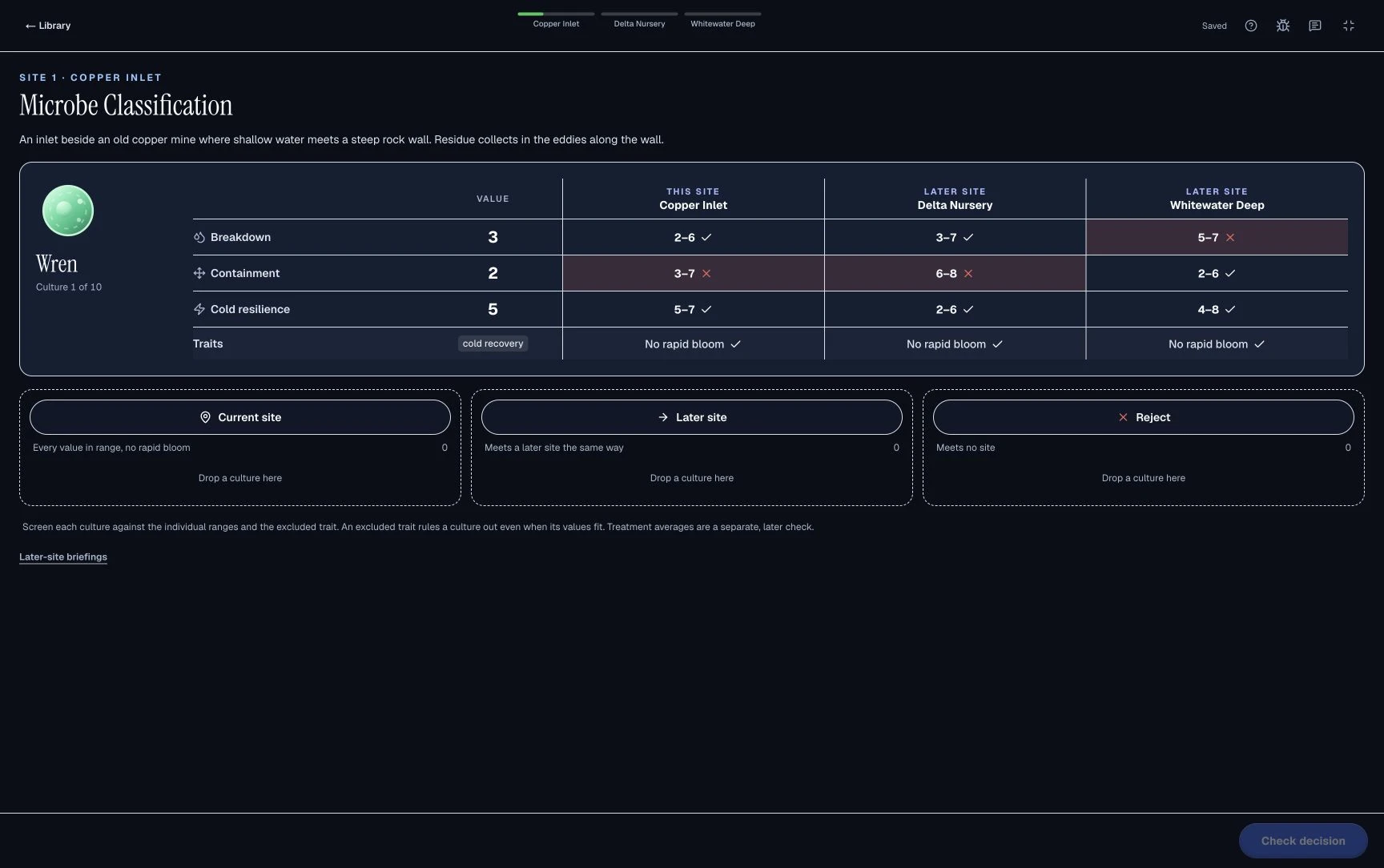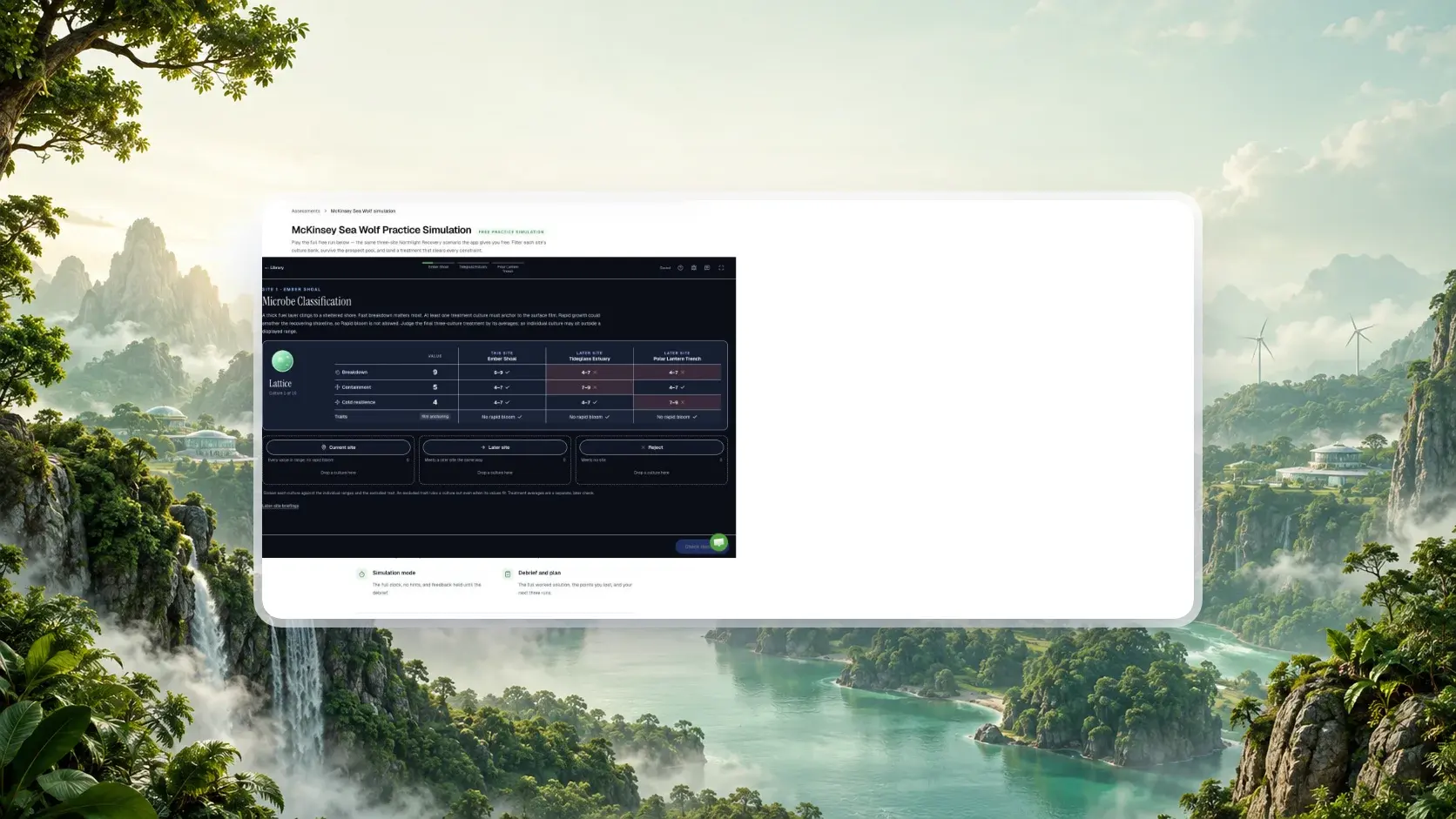
No. McKinsey states that candidates may not use applications, websites, AI tools or pre-prepared notes in Solve, so a Sea Wolf solver or Excel sheet cannot be part of your assessment (official). Afterwards, a solver can check a trio you built by hand, but it cannot supply the skill Sea Wolf is meant to show, and McKinsey publishes neither the real microbe values nor the scoring a solver would have to copy (not published).
| Point | Answer | Status |
|---|---|---|
| Tools during Solve | Apps, websites, AI tools and prepared notes are banned unless an accommodation is approved in writing. | Official |
| Scenarios | Solve uses AI methods, so scenarios vary and candidates do not share the same parameters. | Official |
| Sea Wolf format | Three sites, three microbes per site, about 30 minutes in all. | Reported |
| Approved third-party solver | None. McKinsey does not certify or mention any. | Not published |
| Real attribute values and scoring | Not published, so no tool can be checked against them. | Not published |
Can you use a Sea Wolf solver or Excel sheet during McKinsey Solve?
No: McKinsey's Solve FAQ and Solve page say candidates may not use "applications, websites, AI tools, or pre-prepared notes" during the assessment, so a solver, a spreadsheet or a written cheat list is outside the rules (official). The only exception McKinsey states is an accommodation it has approved in writing. The same sources list the consequences as exclusion from consideration, a rescinded offer, restrictions on future applications or legal action.
Not permitted
- A solver script or app
- An Excel or Sheets file
- Websites and AI tools
- Notes or formulas prepared in advance
- Recording or screenshots of the game
Described as acceptable
- Pen and paper notes and sums made during the sitting
- Your own reasoning from what the screen shows
Left column: the August 2025 Solve FAQ and the Solve page (official). Right column: McKinsey's general assessment integrity page, which covers any assessment or interview and lists pen and paper only for notes and calculations (official, not Solve specific). The invitation you receive governs your own sitting.
The rule reaches further than a downloaded solver. A formula you memorised from a sheet is your own thinking, but a cheat list copied out before the sitting is a prepared note. Use the question "did I make this during the sitting, on paper, from what I could see?" as the test. The proctoring guide covers the camera and single-screen expectations, the test-day checklist covers setup, and the accommodations guide explains the one route McKinsey names for assistance. To see how Solve is described in full, start with the Solve overview.
Original fictional scenario: a candidate hears that a spreadsheet "would be faster" and asks whether it is worth the risk. The faster route they are missing is the paper routine in this guide, which McKinsey's integrity expectations do describe as acceptable. For other rumours of this kind, see the guide to ten Reddit claims checked.
What does a Sea Wolf solver actually compute?
A Sea Wolf solver is a short search program: it lists every group of three microbes in a pool, drops any group that breaks a trait rule, then keeps the groups whose attribute totals fit every site range (our description of the general technique; McKinsey publishes no solver). Nothing in it is hidden or advanced, which is why the same search can be learned on paper. The pool below is original and fictional, with a teaching size of 8 microbes.
| Microbe | Warmth, salt, drift | Trait |
|---|---|---|
| K | 3, 9, 4 | Scrubber |
| L | 7, 4, 2 | Neutral |
| M | 5, 6, 5 | Neutral |
| N | 4, 5, 9 | Neutral |
| P | 8, 7, 3 | Spiller |
| Q | 6, 3, 4 | Scrubber |
| R | 2, 8, 6 | Neutral |
| S | 5, 5, 1 | Neutral |
Start with how many groups exist. Order does not matter, so each trio is counted once.
Number of trios in the pool
Choose 3 of 8: three descending picks, divided by the 6 orderings of the same three microbes.
The program then applies the rules in turn, and each rule removes some trios for good. Here the funnel is 56, then 35, then 25, then 10, then 4, and the warmth totals remove none of the survivors. The result is 4 valid trios.
Original fictional pool. Each bar counts the trios left after that rule and every rule above it.
- Contains the Spiller21 · 37.5%
- No Scrubber in the trio10 · 17.9%
- A total missed its window21 · 37.5%
- Valid trios4 · 7.1%
- All trios56 · 100%
Trios are counted by the first rule that removes them, so the four parts add up to the whole.
The survivors are K + L + Q, K + Q + S, L + Q + R, Q + R + S. One microbe, Q, sits in every one of them. A solver prints that pattern, but you could also see it from the table: only K and Q carry the required trait, and K is therefore a natural place to start a search. Checking one survivor shows what each test does.
Salt total for K + L + Q
Inside the salt window of 15 to 18, so the salt rule passes.
For the wider method behind these totals, the Sea Wolf math guide works a different pool through the same sum shortcut, and the Sea Wolf cheat sheet lists the rules to check at each step.
Why can't you simply test every trio by hand?
Testing every trio by hand does not fit a timed site because the number of trios climbs fast as the pool grows: 8 microbes give 56 trios and 280 separate checks, and candidates report only about 10 minutes per site (reported; McKinsey publishes no per-site time). A computer does this in an instant, which is why a solver looks tempting, but it also shows why nobody should try to out-enumerate it.
Checks if you test every trio
Five checks per trio: three attribute totals, the required trait and the forbidden trait.
Time per trio if you had the whole site budget
The budget is the reported 30 minutes divided across 3 sites. It also has to cover reading the brief and choosing microbes, so the real figure is smaller.
Original arithmetic. From 8 to 12 microbes the trio count rises from 56 to 220. McKinsey does not publish pool sizes; 8 is a teaching size.
So the aim is not to list trios but to rule most of them out before you write any sum. That is the job of the next routine. If you want a fuller view of how the game flows from step to step, the Sea Wolf practice method walks through it, and the guide to Ocean Cleanup and Ocean Treatment names explains why you will see the same task under several labels.
What replaces a solver in your head?
The replacement is a three-move routine you can do on pen and paper: turn each average range into a total, fix a required-trait microbe and one partner, then compute the window the third microbe must land in. On the Harbour pool it reaches valid trios without listing all 56 (our method; the paper part matches the integrity page, the rest is practice advice).
Move 1: turn each range into a total
Because three microbes are averaged, a range on the average is a range on the sum, multiplied by 3. Do it once per attribute and write the three windows where you can see them.
Salt window
Drift window
Warmth window
Move 2: fix the scarce microbe and one partner
Start from the rule that is hardest to satisfy. Here only K and Q carry the Scrubber trait, so every valid trio holds one of them. Take Q with L, add their values, and subtract from each window.
Salt left for the third microbe after Q + L
Drift left for the third microbe after Q + L
Warmth left for the third microbe after Q + L
The lower bound is below zero, so any warmth value passes at the bottom. Only the upper bound matters.
Move 3: test the candidates against the windows
With Q + L fixed, 5 microbes remain once the Spiller is removed. Compare each one's totals with the windows. The salt track and drift track below show four of them.
- Salt window15 to 18
- K16Inside
- R15Inside
- M13Outside
- N12Outside
- Drift window9 to 12
- K10Inside
- R12Inside
- M11Inside
- N15Outside
Only K and R clear both tracks and the wide warmth window, which gives Q + L + K and Q + L + R. M misses on salt, and N misses on both salt and drift, so neither needs a second look. Repeating the routine with a different partner finds the remaining valid trios. It is a handful of subtractions, not 56 trios.
Tempting wrong answer
Compares a total with a range written for averages, so a good trio looks too high.
Right setup
Divides by three and compares with the average range of 4 to 6, or keeps the total with the total window.
The Sea Wolf mistakes guide lists this and other slips, and the guide to what Solve measures covers the skills McKinsey says the games observe. McKinsey's blog describes Solve as a way to measure "how people think, as opposed to what they know".
Where does a solver help, and where does it hurt?
A solver helps in one place, which is checking a trio you built yourself after the practice run is over, and it hurts wherever it replaces your first attempt (our judgement, since McKinsey does not comment on practice tools). The deciding factor is whether you attempt before you look. Compare the common uses on the same two questions.
| Use | Does it build the skill? | Does it risk a bad habit? |
|---|---|---|
| Check a finished trio | Yes, it shows which total missed | Low, if you attempted first |
| Reveal the pattern after a run | Yes, you compare it with your own shortlist | Low |
| Get the answer first | No, you read a result instead of making one | High, you stop looking for windows |
| Rely on it for every site | No, your paper routine goes unpractised | High, nothing carries to a screen without it |
Answer first
Type in the pool, take the trio it returns, and move to the next site.
Reads the solver's trio, copies it, and never learns which window was tight.
Attempt first
Write your trio and its three totals, run the check, then note the first window you missed.
Builds a trio on paper, then compares it and records the total that missed.
Two further limits apply. First, a solver's "best" trio rests on a scoring rule, and McKinsey publishes none for Sea Wolf (not published), so any ranking beyond "valid or not" is invented. Second, McKinsey says Solve scenarios vary by candidate (official), so an answer learned for one pool does not transfer. In the Harbour pool, valid trios all contain Q; a different pool has a different pattern. The scores and results guide and the pass rate guide show how little is published.
How can you use a spreadsheet after practice without leaning on it?
If you like spreadsheets, keep one as a review log that you open only after a timed practice run, never as the first tool you reach for (our advice; it is not a McKinsey requirement and the same file may not be used during Solve). The log earns its place only when it records a mistake you can fix. The loop below is the order that keeps the paper skill in front.
- Attempt on paper, with a clock
Write the three windows, build a trio, and note its totals.
- Commit to a final trio
Write it down before you open any checker.
- Check afterwards
Compare each total with its window and each trait with its rule.
- Log the first miss
Record which test failed, not the whole answer.
- Redo on a fresh pool
The same miss on a new pool means the routine is not yet automatic.
Our suggested practice loop. Nothing in it is a McKinsey instruction.
The Solve tips guide and the prep plan show where a loop like this fits in a week. Red Rock is different: candidates report an in-game calculator there, which is part of that game's screen and not an outside tool, and the Red Rock calculator guide keeps the two ideas apart. Whether Sea Wolf offers any such tool is not published.
Is it safe to buy a Sea Wolf solver from a third party?
McKinsey publishes nothing that approves or certifies any third-party Sea Wolf solver, so a seller's claim that a tool matches the real game cannot be checked against any published rule (official: silent; reported: sellers make such claims, unverified). Treat the claims below as questions to ask before paying, and never as proof.
- "Mirrors the real scoring." McKinsey publishes no Sea Wolf scoring, so there is nothing to mirror.
- "Finds the optimal trio." Optimal against which rule? Valid is checkable, best is not.
- "Works on your real pool." The official FAQ says scenarios vary, so no stored answer fits every candidate.
- "Use it in the test." Applications and prepared notes are not permitted.
The first three rest on what McKinsey does and does not publish (checked October 11, 2026). The fourth contradicts the Solve FAQ.
There is also an ordinary file-safety point that has nothing to do with McKinsey: a spreadsheet with macros from a stranger can run code on your machine, so open files like that only if you trust the source (our general caution). The system requirements guide covers what McKinsey does say about your device, and the Solve FAQ roundup has short answers on neighbouring questions. If your goal is a second attempt after a poor result, see the retake and reapply guide instead of looking for a shortcut.
What should you practise instead of using a solver?
Practise the window routine on fresh pools until each site's check feels routine, and spend your extra time on the rule that fails most often for you, because that is the habit a solver would have hidden (our advice). Start with the guides that match your gap, then run practice sites rather than re-reading.
- Totals feel slow. Rehearse Move 1 until the three windows take seconds to write. The math guide has a longer set.
- Traits keep failing a good trio. Read both trait rules before any sum. The mistakes guide shows the cost of skipping them.
- You are unsure which game to start with. The comparison of Red Rock and Sea Wolf helps you decide.
- You want the timing picture. The 65, 85 or 95 minute guide sets out the reported combinations.
Our suggestions. The invitation you receive, not any guide, states your assessment length.
Road to Offer offers one complete free run of each of four independent practice formats: Red Rock, Sea Wolf, SFL Classic and SFL Island. Start without an account; a free account is needed to finish and keep the score, points breakdown and worked feedback on each submitted decision, with no payment required. Sea Wolf worked feedback includes constraint and treatment visuals. Learning mode in all four formats gives coaching and feedback step by step, untimed in the clocked games, with the matching game pack, Solve pack or qualifying Annual access. The free Solve plan uses your invitation length and test date to give dated practice steps for up to 28 days; create a free account to view and save it. Use this independent practice to test your method, not to predict an official result. Where one pool teaches you the shape of the work, a new pool tests whether the routine still holds.
Sources and evidence boundaries
- Official, checked October 11, 2026: McKinsey's Solve page and the Solve FAQ (PDF, August 2025) for the ban on applications, websites, AI tools and pre-prepared notes, the consequences, and the statement that scenarios vary. The assessment integrity expectations page covers pen and paper, one screen and a camera for assessments and interviews in general.
- Official, checked October 11, 2026: McKinsey's July 2025 game-based innovation lab post, which names Sea Wolf and describes selecting and evaluating microbes.
- Reported: three sites, three microbes per site and about 30 minutes for Sea Wolf. These come from candidate accounts and are not confirmed by McKinsey. Seller claims about solvers circulate on prep sites and are unverified.
- Unknown: real attribute names, ranges and pool sizes, any Sea Wolf scoring rule, any approved third-party tool, and how McKinsey detects rule breaches. Every pool, number and example here is original and fictional.