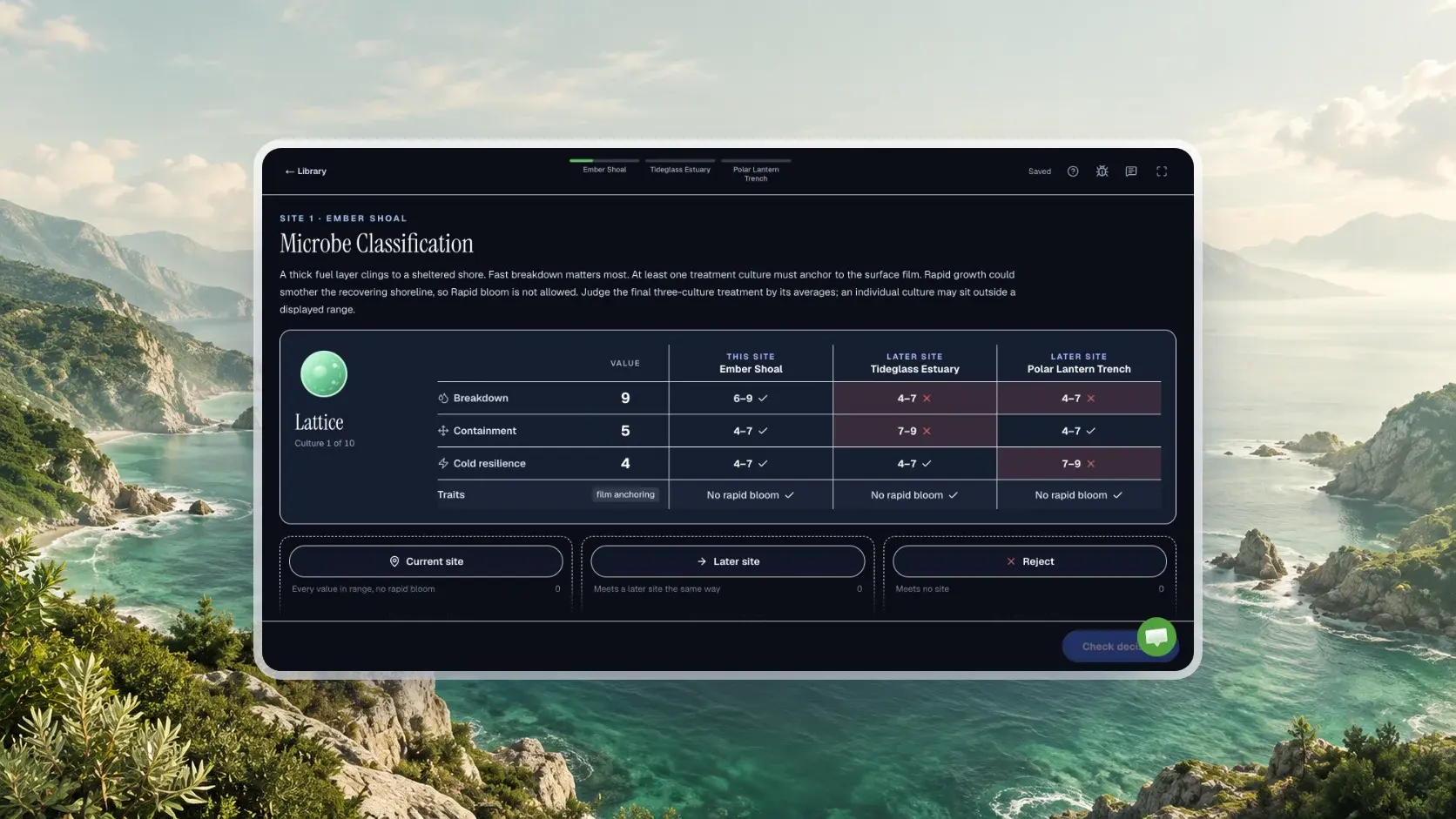
McKinsey officially calls its microbe-selection game Sea Wolf. “Ocean Treatment” and “Ocean Cleanup” are labels used in candidate and preparation material for an ocean or microbe task. The public McKinsey sources we checked do not say whether Ocean Cleanup was once a separate game, so use Sea Wolf for current preparation and your own tutorial for the rules.
| Question | Answer | Status |
|---|---|---|
| Official game name | McKinsey names Sea Wolf and describes selecting and evaluating microbes for contaminated sites. | Official, July 2025 McKinsey blog |
| Ocean Treatment | A descriptive label used around the ocean and microbe task. | Reported, not a name in the checked McKinsey sources |
| Ocean Cleanup | Another label used for that task family; its status as a distinct earlier version is unresolved. | Reported; historical split not published |
| Detailed rules | Sites, microbe counts, averages and traits come from candidate descriptions. | Reported, not a public McKinsey specification |
| Length and scoring | Your invitation states the assessment length; McKinsey publishes no Sea Wolf minutes or pass mark. | Official FAQ for invitation; game figures not published |
What is the McKinsey Ocean Treatment game?
“Ocean Treatment” is a reported label for a McKinsey Solve microbe task, while McKinsey's own July 2025 article names Sea Wolf and says candidates select and evaluate microbes to clean contaminated sites; McKinsey does not use “Ocean Treatment” in the sources checked. If you encountered that phrase in an old guide, translate it into the task description first: microbes are being chosen for a cleanup problem. Then look for the current official name. This avoids preparing for an assumed separate assessment based only on a headline.
- Reported labelOcean TreatmentUsed in candidate and preparation material for the ocean or microbe task.
- Reported labelOcean CleanupUsed for the same task family. Whether it was once a separate game is not published.
Read the arrows as “prepare under this name”, not as a confirmed rename. The Sea Wolf name is supported by McKinsey's July 2025 article; the two labels on the left come from unverified accounts.
McKinsey calls the broader recruiting assessment Solve, a gamified way to showcase problem solving. Sea Wolf is a game within it, not another application stage. The Solve overview explains the wider assessment, and what Solve measures in each game covers the skills behind it. If the old page also says “PSG” or “Imbellus,” use the assessment name history to translate those broader labels separately.
For a candidate with an invitation, the actionable question is which task your tutorial presents. McKinsey's August 2025 FAQ says every task starts with an untimed tutorial that explains its objective and navigation. Read that screen as the instruction for your sitting. A third-party description may teach useful reasoning, but McKinsey has not published a Sea Wolf rulebook that makes any such description universal.
Are Ocean Treatment, Ocean Cleanup and Sea Wolf the same game?
They point readers toward the same reported ocean and microbe task family, but only Sea Wolf is an official McKinsey game name in the sources checked, and McKinsey has not established that the three labels were always interchangeable. Treat the names as a search map, not a confirmed product timeline. The safer translation is “this old page probably concerns the microbe-selection task now publicly called Sea Wolf,” with “probably” doing real work when the page claims an older format.
- Official anchorOfficialSea Wolf
McKinsey names the game and describes the microbe cleanup objective. Start here when identifying the task.
- Descriptive labelsReportedOcean Treatment and Ocean Cleanup
Candidate and preparation material uses these labels. Check the described action rather than assuming a separate current game.
- Unresolved historyNot publishedWas Ocean Cleanup a predecessor?
The stored accounts disagree, and the McKinsey material we hold supplies no rename date or earlier game specification.
The first line is supported by McKinsey's July 2025 blog. The other labels and the proposed split come from unverified accounts, so this is a decision aid rather than a chronology.
If a page describes coral recovery, reef zones, repeated feedback rounds or interactions between corals, do not import those details into your expectation of Sea Wolf. Those specifics appear in one stored account but are absent from McKinsey's description and conflict with other accounts. A description of microbes, target ranges and traits is closer to the more consistent candidate reports, yet even that is reported. The Sea Wolf rules, strategy and practice guide handles the full reported rules and their disagreements.
Was Ocean Cleanup an older game that Sea Wolf replaced?
McKinsey has not published whether “Ocean Cleanup” was a distinct older game, and the descriptions available to us disagree, so there is no verified replacement date. One account calls it an earlier, shorter version with fewer sites and Sea Wolf its successor. Others use Ocean Cleanup, Ocean Treatment and Sea Wolf as names for one game. McKinsey's July 2025 article supports the shared microbe-cleanup subject and the name Sea Wolf at that date; it does not settle whether an older version had a separate identity.
Reported Reading one: a predecessor
- Ocean Cleanupearlier, shorter, fewer sites
- Sea Wolfits successor
Reported Reading two: one game
- Ocean Cleanup
- Ocean Treatment
- Sea Wolf
OfficialMcKinsey's July 2025 article names Sea Wolf and the microbe cleanup task. It gives no rename date and no earlier game specification, so neither reading is confirmed.
That distinction matters when reading a legacy walkthrough. A source that says “two ocean sections” may be describing a different reported version, may be stale, or may be imprecise. You cannot identify which from the name alone. Keep the transferable question, “How do I compare a combination against a target?” and let the tutorial answer how many sites and steps you actually have. For confirmed wider assessment history, see PSG, Imbellus and Solve and the dated Solve update log; for a different older game, see the Ecosystem Building history. None of them establishes an Ocean Cleanup rename.
A claimed launch year, beta status, global rollout date or exact retirement date would make this comparison look tidy, but the official sources in our ledger do not give one for these labels. If you need a current preparation choice, this uncertainty does not force you to wait: Sea Wolf is the official name McKinsey used, and the microbe decision is the relevant skill to rehearse.
How does an old Ocean Cleanup description map to reported Sea Wolf steps?
Old Ocean Cleanup accounts often describe choosing microbes for a cleanup treatment; candidate accounts of Sea Wolf add a site brief, profiling, categorization, prospect selection and a final treatment, but McKinsey has not publicly confirmed those steps. Use the map to recognize the type of decision, then follow the tutorial rather than memorizing a screen count.
- Read the polluted site
- Reported Sea Wolf
- Read each site's target ranges and wanted or excluded traits.
- Practise
- Separate numeric conditions from yes-or-no trait conditions.
- Screen microbes
- Reported Sea Wolf
- Profiling and categorizing ask which microbes fit now, later or neither.
- Practise
- Make each classification against the shown requirements.
- Narrow a larger pool
- Reported Sea Wolf
- Prospect rounds build the options for a later treatment choice.
- Practise
- Preserve complementary values, not only individually attractive ones.
- Choose a treatment
- Reported Sea Wolf
- The final selection checks a small group against ranges and traits.
- Practise
- Check the whole combination before submitting.
Reported A translation of candidate descriptions, not official game rules. Counts and screen order vary between accounts.
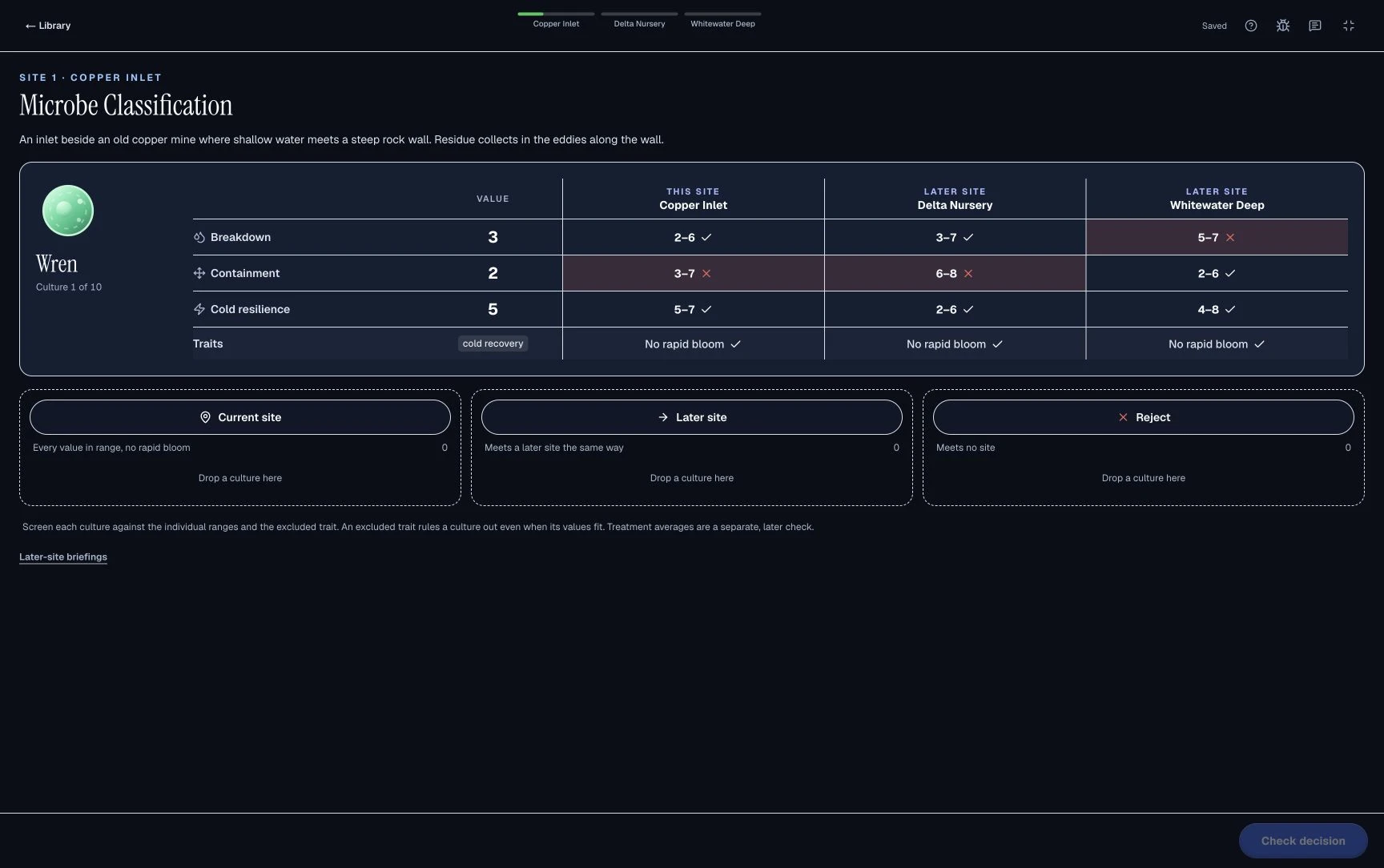
Counts and interface order vary between the stored accounts. That is why this map identifies the decision at each point. If you want a detailed walk through the candidate-reported Sea Wolf sequence, use the Sea Wolf method and puzzles, or keep the Sea Wolf cheat sheet for every step open while you practise. Both explain the reported site loop, including where accounts disagree about carryovers and scoring, without turning those reports into McKinsey rules.
What does a three-microbe Ocean Treatment puzzle teach?
In this original fictional exercise, the useful lesson is that a treatment is judged as a group: A + E + F meets both average ranges and the trait rules, while two nearby trios each fail a different check; these values are practice data, not McKinsey content. The example uses the existing Sea Wolf exercise pool but asks a different decision from the puzzles in that guide.
Suppose your invented site requires average resilience from 4 to 6 and average energy from 3 to 5, inclusive. You must include a purifier and exclude any invasive microbe. Choose which of the three trios below passes all four checks. Nothing in this practice exercise claims to reproduce a McKinsey question or a real scoring formula.
| Microbe | Resilience | Energy | Trait |
|---|---|---|---|
| A | 6 | 2 | Purifier |
| B | 4 | 6 | Neutral |
| D | 8 | 3 | Invasive |
| E | 7 | 5 | Purifier |
| F | 3 | 7 | Neutral |
Try A + E + F, B + E + F, and A + D + F before reading the checks. Each option contains 3 microbes, and each includes at least one purifier. That shared trait is not enough to decide the puzzle.
Check the two averages of A + E + F
Add the three values of one attribute, then divide by the number of microbes in the treatment. Do it once per attribute.
Resilience average, A + E + F
Energy average, A + E + F
Now look at the three energy values on their own. A and F each sit outside the range the average has to meet, yet the trio's average lands inside it.
- Site energy range3 to 5
- A alone2Outside
- E alone5Inside
- F alone7Outside
Original exercise. 2 of the 3 sit outside on their own, yet the average of the group is 4.67, inside the range. The site rule in this puzzle applies to that average.
One microbe at a time
Rejects F because its own energy is above the ceiling of 5, and loses the only valid trio of the three.
The whole trio
Averages the group first. A low A offsets a high F.
Find the numeric check that B + E + F fails
Swap A for B and the resilience average still fits, but the energy total climbs.
Energy average, B + E + F
Above the allowed ceiling of 5.
- Site energy range3 to 5
- A + E + F4.67Inside
- B + E + F6Outside
- A + D + F4Inside
- Site resilience range4 to 6
- A + E + F5.33Inside
- B + E + F4.67Inside
- A + D + F5.67Inside
Original exercise. All three trios pass resilience, so resilience alone cannot separate them.
Find the trait check that A + D + F fails
Both averages of A + D + F fit, so arithmetic alone would accept it.
Resilience average, A + D + F
Energy average, A + D + F
The trait rules are yes-or-no conditions, and no average can repair them. Read the trait of every member.
- A + E + FAPurifierEPurifierFNeutralTraits pass
- B + E + FBNeutralEPurifierFNeutralTraits pass
- A + D + FAPurifierDInvasiveFNeutralExcluded trait
Original exercise Trait names and verdicts come from the connected practice dataset. This shows a checking method, not McKinsey's scoring.
Turn each average range into a sum target
Dividing by 3 every time is slow. Multiply both ends of a range by the treatment size once, then compare plain sums. The Sea Wolf sum shortcut and elimination order builds a full method on this step.
Energy sum target for a treatment of 3
Resilience sum target for a treatment of 3
- Energy sum target9 to 15
- A + E + F14Inside
- B + E + F18Outside
- A + D + F12Inside
Original exercise. The verdicts match the average check above because the sum target is the same rule multiplied through.
| Trio | First failed check | Verdict |
|---|---|---|
| A + E + F | None. Both averages and both trait rules hold. | Valid |
| B + E + F | Energy average 6 is outside 3 to 5. | Invalid |
| A + D + F | D carries the excluded invasive trait. | Invalid |
The surprising comparison is B + E + F: every member is non-invasive, and E is a purifier, yet its energy average fails. A + D + F has acceptable averages, yet the categorical rule rejects D. In a reported Sea Wolf style task, check both kinds of condition; the Sea Wolf errors that break a treatment lists the other slips of this kind. In the real assessment, use the site rule and tutorial you are shown; do not import the invented resilience and energy labels.
How should you prepare if an old guide says Ocean Cleanup?
Prepare for the officially named Sea Wolf microbe task by practising constraint checks, while treating counts, timing and scoring in old Ocean Cleanup guides as unverified; McKinsey says no prior preparation is required. A useful short session is to read one fictional site brief, mark its numeric ranges and trait rules, compare complete groups, then review the first condition you missed. Repeat with fresh values instead of memorizing a trio.
- Read one fictional site brief. Find the objective before any number.
- Mark the rules in two groups. Numeric ranges on one side, yes-or-no trait rules on the other.
- Compare complete groups. Check sums against their targets, then every member's trait.
- Review the first condition you missed. Name it as a range, a trait or a misread brief.
- Repeat with fresh values. A memorized trio does not transfer; the checking order does.
Editorial practice advice. McKinsey says no prior preparation is required and publishes no recommended Sea Wolf routine.
Start with the Sea Wolf guide for the fuller reported flow and original exercises. The practice hub offers one complete free run of each Road to Offer practice format: Red Rock, Sea Wolf, SFL Classic and SFL Island. Start without an account; a free account is needed to finish and keep your score, points breakdown and worked feedback on each submitted decision, with no payment required. Sea Wolf includes constraint and treatment visuals to explain missed ranges or traits. Learning mode across all four formats gives coaching and feedback step by step, untimed in the clocked games, with the matching game pack, Solve pack or qualifying Annual access. The free Solve plan uses your invitation length and test date for dated practice steps up to 28 days; create a free account to view and save it. This is independent practice feedback, not McKinsey feedback or an official score prediction. If you have limited preparation time across multiple games, use the Solve prep plan and Solve tips to allocate practice, and Red Rock vs Sea Wolf to decide which game to practise first. For the data-heavy reported Red Rock task, go to the Red Rock guide instead of treating every Solve game as an ocean puzzle.
Do not infer your exact game mix from an old name. McKinsey's FAQ says the assessment length is in your invitation, while the public sources here do not publish a game list. If your email uses an unfamiliar label, read the invitation guide and check with your recruiter. The invitation length guide maps candidate-reported formats, with that reporting limit stated.
How long is Ocean Treatment, and how is Sea Wolf scored?
McKinsey publishes neither an Ocean Treatment or Sea Wolf game length nor a Sea Wolf scoring formula, so any exact minutes, efficiency deduction, percentile or pass threshold in an old guide is unverified. Its August 2025 FAQ says the total Solve length appears in your invitation and each task begins with an untimed tutorial. The same FAQ says the recruiter considers Solve alongside the rest of the application and any other assessment results.
Official Published in the Solve FAQ
- The total assessment length is stated in your invitation.
- Each task begins with an untimed tutorial.
- The result is considered with the rest of your application.
Not published Found only in outside guides
- Minutes for Sea Wolf, Ocean Treatment or Ocean Cleanup.
- A Sea Wolf scoring formula or efficiency deduction.
- A percentile, cutoff or pass threshold.
Candidate reports commonly describe Sea Wolf as several site decisions on a timed clock, but the stored sources disagree on the numbers and on how an undesired trait affects a treatment. One old Ocean Cleanup account describes fewer sites and a shorter window; another Ocean Treatment account describes a different coral scenario and a longer window. Those contradictions are a reason to use your own invitation and tutorial, not to average the published figures. For the evidence on result interpretation, see Solve scores and results, how the Solve result is used and the pass-rate fact check.
If you see a precise cutoff or a claim that one poor microbe choice automatically rejects you, ask what McKinsey source supports it. None in this ledger does. Your practical control is to read all constraints and submit the best treatment you can under the actual instructions, then let the recruiter communicate the decision.
Can you use an Ocean Cleanup solver during the live assessment?
No: McKinsey's Solve FAQ bars outside applications, websites, AI tools and pre-prepared notes during the assessment, except for an accommodation it has approved in writing. A spreadsheet that searches microbe combinations is an outside application, even if a preparation page recommends it; the Sea Wolf solver and Excel guide explains what such a tool does and the mental method that replaces it. Practice tools belong before the assessment; the test-day rules guide covers the allowed setup and support path.
The FAQ also says no business knowledge or gaming experience is needed and that no two candidates receive the same parameter and data combination. Those two official points favor learning how to read the task over keeping a copied answer key. If a technical problem prevents you from using the official interface, McKinsey directs candidates to its support channel when the issue arises; the system requirements and tech issues guide explains the device rules and that procedure, and the Solve FAQ of short answers covers the other common questions. The practice page's independent simulator is a rehearsal, never the live test.
Sources and evidence boundaries
- Official game name and objective: McKinsey's July 9, 2025 game lab article, checked against the stored source text October 11, 2026. It names Sea Wolf, microbe selection and contaminated sites. It gives no Ocean Cleanup or Ocean Treatment name or rename date.
- Official assessment rules: McKinsey's Solve page and August 2025 Solve FAQ, source texts checked October 11, 2026. They support the tutorial, invitation length, varied data, assessment integrity and role of the result.
- Reported and unresolved: The older names, number of sites, screening and treatment steps, attribute averages, trait rules, per-game timing and efficiency claims come from inconsistent candidate and preparation descriptions. McKinsey does not publish these Sea Wolf details in the sources checked. The separate-predecessor theory remains unresolved.
- Original exercise: The fictional A, B, D, E and F microbe values are our connected practice data. The averages, sum targets and verdicts are computed from that dataset and recomputed by its test; they demonstrate a method only and make no claim about McKinsey's question bank or scoring.