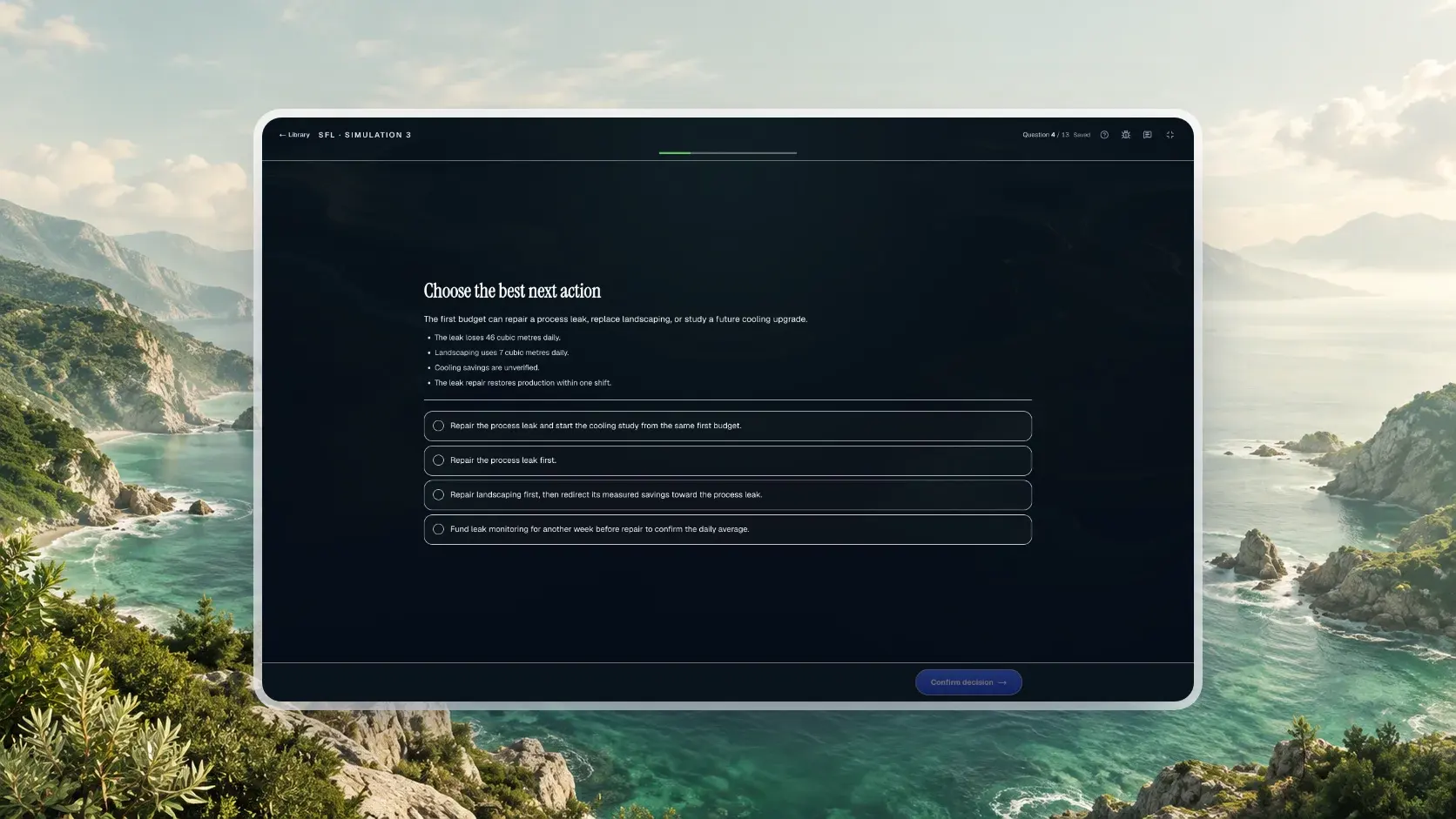
McKinsey does not publish whether every experienced hire must take Solve. Its July 2025 account describes the assessment for early-career consultant candidates, while its current Solve guidance says the result is one part of a recruiting decision. If you receive an invitation, its length and instructions govern your sitting; if your route is unclear, ask your recruiter.
| Question | Answer | Status |
|---|---|---|
| Who receives Solve? | No public rule by role, office or experience level in the McKinsey sources checked. | Not published |
| How does McKinsey describe its audience? | Its July 2025 blog describes around 300,000 early-career consultant candidates a year. | Official |
| What determines your length? | McKinsey says the assessment length is in your invitation email. | Official |
| Are game and minute maps fixed? | Candidates describe several lengths and game combinations; McKinsey does not publish a complete map. | Reported |
| Does Solve decide candidacy alone? | No. McKinsey says the result is considered with the application and other assessments. | Official |
Do experienced hires have to take McKinsey Solve?
McKinsey does not publish a rule requiring every experienced hire to take Solve, or a rule exempting them; its checked public sources leave the answer for your role and office unknown. In a July 2025 account of its game-based innovation lab, McKinsey says Solve is given to around 300,000 early-career consultant candidates a year. That describes a group receiving the assessment. It does not say that an applicant with professional experience will receive it, or that experience creates an exemption.
McKinsey states
- Around 300,000 early-career consultant candidates take Solve each year.
- Solve is a gamified assessment used in consultant recruiting.
- The result is weighed with the rest of your application.
Candidates report
- Applicants on lateral routes describe different experiences from one another.
- Invitations of about 65, 85 and 95 minutes, with different game combinations.
Not published
- An invitation rule by role, office or experience level.
- An exemption for seniority.
- A separate version or cutoff for experienced hires.
Official lines come from McKinsey's Solve page, its August 2025 FAQ and its July 2025 blog. Reported lines are unverified candidate accounts. Nothing in the third column should be filled with a guess.
Candidates asking about lateral routes report different experiences, but an anecdote cannot establish a firm-wide policy. Treat an invitation as a concrete request to sit Solve, not as proof of how every experienced candidate is screened. The wider question of who gets a Solve invitation has the same answer for every applicant group, and the assessments by role guide sets out what is known for non-generalist roles. If you came through a business school route instead, the MBA candidate guide fits your calendar better than this one.
- The invitation is in your inboxFollow the email. Use its stated length and instructions, then reserve one uninterrupted sitting.
- You are applying and the route is unclearAsk the recruiter. One question: does Solve apply to this role and this office?
- You applied and have heard nothingCheck your application channel. Silence is neither a rejection nor an exemption.
McKinsey publishes no universal experienced-hire invitation rule. This is an application decision path, not a prediction of your outcome.
If you already have an invitation, use the invitation guide to separate the deadline, duration and support route. Do not infer from silence that you have been rejected or excused: the timeline guide covers the waiting question.
Is Solve easier, shorter or scored differently for experienced candidates?
McKinsey does not publish a shorter Solve, different scoring curve or separate cutoff for experienced candidates in the sources checked, so parity with campus applicants is unconfirmed rather than guaranteed. Its Solve page describes one gamified assessment in consultant recruiting, and its FAQ gives common instructions on tutorials, devices and integrity. Neither describes a special executive version, nor proves every role gets identical tasks.
Tempting assumption
No checked McKinsey source describes a lighter version, a different curve or a waiver for experience.
Safer reading
The invitation is the only document that describes your sitting, and the tutorial explains each task.
The right-hand reading rests on McKinsey's Solve FAQ: length is stated in the invitation and each task starts with an untimed tutorial.
For example, you may have led complex client projects yet receive an unfamiliar interactive task. The useful transfer is how you define the objective, select evidence and check a decision against its constraints. Your job title does not tell you what is on the screen. McKinsey says its scenarios vary in parameters and data combinations, so practising a remembered answer is less useful than practising a repeatable check. The Solve overview explains the assessment, while the difficulty guide separates format friction from the skills you already use at work.
McKinsey officially says no prior business knowledge or gaming experience is required. It also says Solve performance is considered alongside the rest of your application and any other assessments. That is a reason to prepare the rest of your candidacy, not a promise that a strong resume will cancel a particular Solve result. The guide on how the Solve result is used covers that weighing in full, and the score and results guide handles scoring questions; McKinsey publishes no pass mark, score scale or weighting in the checked sources.
What should an experienced applicant check in the Solve invitation?
McKinsey officially puts your Solve assessment length in your invitation email, but it does not publish a universal game list or deadline window, so record the details in your own message. Check the stated length, any named tasks, the completion deadline and timezone, the assessment link and the support instructions. A duration is time to reserve for the assessment; a deadline is when your opportunity closes. Do not substitute another candidate's invitation for yours.
| Detail | What the checked sources say | Status |
|---|---|---|
| Stated length | McKinsey says the length is in your invitation email and gives no public number of minutes. | Official |
| Named tasks | No game list by role or length is published. Candidates describe several combinations. | Reported |
| Deadline and timezone | No standard window, extension or rescheduling policy is published. Yours is whatever your message says. | Not published |
| Assessment link | The link runs a technical check before the assessment starts. A PC or Mac is required. | Official |
| Support route | Technical faults go to Solve support; other questions and accommodations go to your recruiter. | Official |
Candidates report invitations of about 65, 85 and 95 minutes, with different game combinations, but that map is not a McKinsey specification. The length comparison explains the reports and their limits without making you plan for a game your own invitation does not name. McKinsey's FAQ says each task starts with an untimed tutorial, so reserve time beyond the stated assessment length for the technical check and orientation. Its FAQ does not specify whether that headline length includes every setup step.
- Red Rock
- Sea Wolf
- SFL
- New SFL
Candidate-reported approximate minutes per game, not a McKinsey specification. Untimed tutorials and the technical check sit outside these bars, so block more of your evening than the number in your email.
If you are travelling for work, select a quiet slot when you can finish without interruption, as McKinsey advises. Check the timezone before a trip and use a PC or Mac, not a phone or tablet, because the FAQ restricts the device. Run the link's technical check on the machine you will actually use; the system requirements guide covers work laptops with locked-down software. If the deadline clashes with travel, an accommodation or a work obligation, ask the recruiter about your options before starting. McKinsey does not publish a standard extension or rescheduling policy in the checked Solve sources, and the deadline and extension guide shows how to word that request.
How can you prepare for Solve while working full time?
A five-session, 175-minute evening plan is our original coaching schedule for a working applicant, not a McKinsey requirement or a measured amount needed to pass. McKinsey says preparation is unnecessary and supplies an untimed tutorial for every task; if you remember an older Problem Solving Test from earlier cycles, the Problem Solving Test guide explains what replaced it. Use this optional plan to reduce format surprise: sample a task, practise two different reasoning modes, repeat your weakest one, then protect the final evening for setup and rest. If your invitation is shorter than the plan, compress the practice but keep the device check.
- Find the format
Read your invitation and try the format. Done when: record the stated length, your deadline, and one unfamiliar rule.
- Handle evidence
Work through a data task. Done when: keep each chosen figure with its unit and denominator.
- Handle constraints
Work through a constraint task. Done when: check every range and trait before confirming a choice.
- Repair one mistake
Repeat your weakest task. Done when: write the error, its cause, and the check that would catch it.
- Set up and stop
Review, check your device, and stop. Done when: pass the technical check and leave the final evening clear.
Original coaching sequence, bars drawn to scale against the longest evening. McKinsey does not prescribe preparation time and says each live task has its own untimed tutorial.
Total time across the five evenings
Your own study time, not a game clock and not a McKinsey figure.
This is a worked allocation of your own time, not a claim about game clocks. The first block is deliberately short: open an independent practice task, identify the objective and write down what confused you. In the middle blocks, spend the last part of each session reviewing one concrete error. A useful log entry is “I used the right value but the wrong unit; next time I will write the unit before calculating.” That makes the next run an experiment, not a repeat. If one game is absent from your invitation, use its block for the task you find hardest; the Red Rock versus Sea Wolf comparison helps you pick which to open first.
If you have a longer window, the full prep plan offers longer schedules. This page's five sessions are for someone fitting useful practice around work, not a replacement for the exact plan in your invitation. The practice page lists all four Road to Offer practice formats, each with one complete free run: Red Rock, Sea Wolf, SFL Classic and SFL Island. The Solve plan is also free with a free account: invitation length and test date select dated steps for up to 28 days, without using your score.
What is worth practising when your work experience is already strong?
McKinsey officially describes Solve as assessing analytical thinking and problem solving, while candidates report task formats that reward evidence selection, constraint checks and consistent decisions; McKinsey does not publish a complete current game blueprint. Prepare the decision habits rather than memorising a scenario. Its July 2025 blog names Sea Wolf as a microbe selection task, but Red Rock and Sustainable Futures Lab names and mechanics in this guide are candidate-reported. The guide to what Solve measures maps the skills to each game.
Arithmetic by handA spreadsheet has carried your percentages, ratios and unit conversions for years.
Red RockReported nameWrite the unit and the denominator before you calculate.
Checking every limit yourselfA reviewer or a system usually catches the one requirement a proposal breaks.
Sea WolfNamed by McKinseyList the site rules, reject any option that breaks one, then compare the rest.
Ranking from rules stated oncePriorities at work are settled over several meetings, with time to revisit them.
Sustainable Futures LabReported nameSay the objective and the rule that separates two options before you rank.
Learning a new screen quicklyYou have used the same tools long enough to stop reading instructions.
Every taskOfficial: untimed tutorialUse the whole tutorial before the task starts. McKinsey says it is untimed.
Original coaching map, not a McKinsey skills list. The left column is our judgment about working habits, not survey data. Game mechanics other than the Sea Wolf name are candidate-reported.
Practise selecting evidence, then answering the stated question
In a reported Red Rock style data task, write the requested outcome first. An original fictional example: a project asks whether a service improved after a change. If the exhibit contains activity volume, customer satisfaction and cost, choose the measure that actually defines “improved” in the question, then carry its unit and time period into your answer. Do not assume the most impressive number is relevant. The Red Rock practice method provides detailed worked arithmetic, eight worked calculation types rebuild the percentage and ratio habits, and the calculator and journal guide covers the reported in-game tools. This article uses the example to teach selection, not to reproduce an assessment question.
Practise checking every constraint before selecting
McKinsey's blog officially describes Sea Wolf as selecting and evaluating microbes to clean contaminated sites. Candidate accounts add range and trait rules, but McKinsey has not published those mechanics as a specification. In a fictional practice decision, a treatment can look strong on one attribute and still fail a required trait. Write the site rules as a checklist, reject any option that breaks one, and only then compare the survivors. The Sea Wolf guide contains a full original exercise, and the Sea Wolf math guide shows the averaging step by hand. This method also works in ordinary project decisions where one attractive proposal violates a hard requirement.
Practise keeping a decision consistent when priorities change
Candidates report a Sustainable Futures Lab task involving trade-offs, with more than one reported version. McKinsey has not published its rules, so do not spend your limited evenings memorising a fixed question order. In a fictional team decision, state the objective and the constraint that ranks two options. If new evidence changes a constraint, explain the change before switching priorities. The Sustainable Futures Lab guide covers both reported versions, and the ranking task worked example walks through one original ranking; the independent standard practice does not promise a rehearsal of the newer reported version.
What rules still apply if you are a senior applicant?
McKinsey's official Solve rules apply to anyone taking the assessment: work alone, use no outside applications, websites, AI tools or prepared notes, and do not record or screenshot it, except for an accommodation approved in writing. Your seniority does not create a stated exception. The separate assessment integrity guidance gives wider rules for assessments and interviews; follow the instructions for your own sitting if they add details.
Work habit to drop
Outside applications, prepared notes and help from others are all banned by McKinsey's Solve FAQ.
Test-day habit
The untimed tutorial is official, and it is the only briefing you are meant to use.
The restriction and untimed tutorials come from McKinsey's Solve FAQ. A calculator inside Red Rock is candidate-reported and is not permission to use an outside tool.
McKinsey's FAQ says a PC or Mac is required, sound is unnecessary and a mouse is optional. The link runs a technical check before the assessment; McKinsey does not publish the minimum specification list. If the check fails or graphics break, contact Solve technical support at [email protected] or use the live chat at the time of the fault. The FAQ says support can run diagnostics and may offer extra time or a reset depending on the issue; without contacting support, it says no reset exception can be made. Contact the recruiter for nontechnical questions or accommodations. The test-day checklist collects the setup steps.
- The technical check fails or the graphics breakSolve technical support, at the time of the fault. Email [email protected] or use the live chat.
- You need an accommodationYour recruiter, before you start. McKinsey lists disability, health condition and specific learning difficulty.
- The deadline clashes with travel or workYour recruiter. No standard extension policy is published, so ask early.
Contact routes are from McKinsey's Solve FAQ. It says that without contacting support, no exception for a reset is made.
What happens after an experienced hire completes Solve?
McKinsey officially considers your Solve result together with the rest of your application and any other assessments; it does not publish a distinct experienced-hire result timetable or a public pass cutoff. Its FAQ says the recruiter makes a decision based on multiple factors. That does not make Solve irrelevant, and it does not establish a simple pass or fail gate that overrides everything else.
After you submit, record the submission confirmation and any technical support case, then return to the parts of the application you can still influence. Do not try to infer a score from how the game felt: McKinsey does not publish a score scale, percentile or scoring weights in the checked sources. Nor does it say when an applicant will receive a result or whether an old result carries into another application; the retake and reapply guide sets out what is and is not known there. If a recruiter gave you a response window and it passes, ask that recruiter for an update. The timeline guide owns reported waits and follow-up decisions; the pass-rate guide explains why circulating percentages cannot answer your individual odds.
The practical finish line for this guide is modest: know whether your route includes Solve, practise a small set of transferable decisions if you want to, and follow the exact invitation and integrity rules when you sit it. Independent Road to Offer practice is a way to see a format and review your reasoning. It is not the official assessment and its result cannot predict McKinsey's decision. For anything this page did not reach, the Solve FAQ with 30 short answers is the fastest lookup.
Sources and evidence boundaries
- Official, checked October 11, 2026: McKinsey's Solve page, the Solve FAQ (August 2025 PDF), the July 2025 game lab article and assessment integrity expectations. The blog's early-career figure describes that audience, not the full invitation policy. The integrity page covers assessments and interviews generally.
- Candidate-reported, unverified: experienced-applicant invitation experiences; Red Rock and Sustainable Futures Lab names and mechanics; invitation lengths of about 65, 85 and 95 minutes and the game combinations and minutes per game behind them; the presence of an in-game calculator. These can vary, and the live tutorial and your own invitation take precedence.
- Not published in the checked McKinsey sources: an experienced-hire invitation or exemption rule, a game list by role or length, separate scoring by seniority, a pass mark or pass rate, results timing, retake policy and old-result carryover. The five-session schedule, the map of rusty skills and the fictional practice scenarios are original coaching examples, not observed candidate outcomes or McKinsey guidance.